Advertisements
Advertisements
प्रश्न
The energy of a photon is 2 eV. Find its frequency and wavelength.
Advertisements
उत्तर
Given:
E = 2 eV = 2 × 1.6 × 10−19 = 3.2 × 10⁻¹⁹ J
To find:
- Frequency (ν)
- Wavelength (λ)
Formulae:
- E = hν
- λ = `c/ν`
Calculation:
i. Using formula (i),
v = `(3.2 xx 10^-19)/(6.63 xx 10^-34)`
= `(3.2 xx 10^15)/6.63`
= antilog {log (3.2) + log(1015) − log(6.63)}
= antilog {0.5051 + 15 − 0.8215}
= antilog {14.6836}
= 4.826 × 10¹⁴ Hz
The frequency of photons is 4.826 × 10¹⁴ Hz.
ii. Using formula (ii),
`λ = c/ν = (3 xx 10^8)/(4.826 xx 10^14)`
= antilog {log 3 − log 4.826} × 10−6
= antilog {0.4771 − 0.6836} × 10−6
= antilog {`overline1`.7935} × 10−6
= 0.6216 × 10⁻⁶m
= 6216 × 10−5 m
= 6216 Å
The wavelength of the photon is 6216 Å.
APPEARS IN
संबंधित प्रश्न
Can microwaves be used in the experiment on photoelectric effect?
Explain the inverse linear dependence of stopping potential on the incident wavelength in a photoelectric effect experiment.
Given the following data for incident wavelength and the stopping potential obtained from an experiment on the photoelectric effect, estimate the value of Planck's constant and the work function of the cathode material. What is the threshold frequency and corresponding wavelength? What is the most likely metal used for emitter?
| Incident wavelength (in Å) | 2536 | 3650 |
| Stopping potential (in V) |
1.95 | 0.5 |
Planck's constant is 6.6 × 10⁻³⁴ Js. The momentum of each photon is given radiation Is 3.3 × 10⁻²⁹ kg/s. The λ of radiation is ______.
The minimum frequency for photoelectric effect on metal is 7 × 10¹⁴ Hz, Find the work function of the metal.
Find the energy of photon which have momentum 2 × 10-16 gm-cm/sec.
The maximum velocity of the photoelectron emitted by the metal surface is v. Charge and the mass of the photoelectron is denoted by e and m, respectively. The stopping potential in volt is ______.
The ratio of energies of photons produced due to transition of electron of hydrogen atom from its (i) second to first energy level and (ii) highest energy level to second level is respectively.
Which one of the following is TRUE in photoelectric emission?
The maximum velocity of the photoelectron emitted by the metal surface is 'v '. Charge and mass of the photoelectron is denoted by 'e' and 'm' respectively. The stopping potential in volt is ______.
When a light of wavelength 4000 Å falls on a photoelectric emitter, photoelectrons are liberated. For another emitter, light of wavelength 6000 Å is sufficient for photo emission. The work functions of the two emitters are in the ratio of ____________.
Threshold frequency for a metal is 1015 Hz. Light of `lambda` = 4000 Å falls on its surface. Which of the following statements is correct?
When certain metal surface is illuminated with a light of wavelength A., the stopping potential is V, When the same surface is illuminated by light of wavelength 2λ, the stopping potential is `("V"/3)`. The threshold wavelength for the surface is ______.
Light of frequency 2 times the threshold frequency is incident on a photo sensitive material. If the frequency is made `1/3`rd and intensity is doubled then the photocurrent will ______.
The photo electric effect to take place for a metal, the minimum frequency required is 5.792 × 10¹⁴ Hz. A light of wavelength 6000 Å is incident on that metal surface. What is the corresponding frequency of light and will there be photoelectric emissions? [velocity of light = 3 × 10⁸ m/s]
The photon of frequency vis incident on a metal surface whose threshold frequency is v0. The kinetic energy of the emitted photoelectrons will be ____________.
The lowest frequency of light that will cause the emission of photoelectrons from the surface of a metal (for which work function is 1.65 eV) will be ____________.
The radiations of energies 1 eV and 2.5 eV are incident on a metal surface having work function 0.5 eV. The ratio of the maximum velocities of the emitted photo-electrons is ____________.
An electromagnetic wave of wavelength '`lambda`' is incident on a photosensitive surface of negligible work function. If the photoelectrons emitted from this surface have the de-Broglie wavelength '`lambda_1`' then ____________.
The ratio of slopes m1: ro2 of the lines given in the following graphs is, ______.
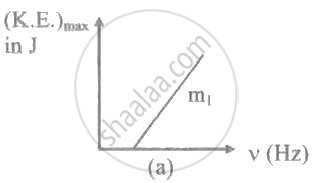
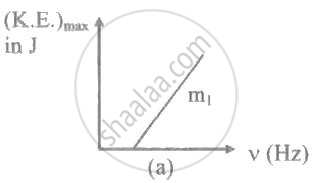
A light of frequency 'v' is incident on the metal surface whose threshold frequency is 'v0'. If v = v0, then [c = speed of light in medium] ____________.
When the work function of a metal increases, maximum kinetic energy of emitted photoelectrons ____________.
Which one of the following graphs represents the variation of photoelectric current (i) with intensity (I) of the incident light?
Is it always necessary to use red light to get a photoelectric effect?
The following graphs show the variation of stopping potential corresponding to the frequency of incident radiation (ν) for a given metal. The correct variation is shown in graph [ν0 = threshold frequency].
|
(A) |
(B) |
|
(C) |
(D) |


Light of two different frequencies whose photons have energies 1.3 eV and 2.8 eV respectively, successfully illuminate a metallic surface whose work function is 0.8 eV. The ratio of maximum speeds of emitted electrons will be ______.
The photoelectric threshold for a certain metal surface is 3600 Å. If the metal surface is irradiated by a wavelength of 1100 Å, then kinetic energy of the emitted photoelectrons is ______.
Draw a neat labelled diagram of photo-current as a function of accelerating potential for fixed incident intensity but different incident frequencies for the same emitter material.
The threshold frequency for a certain metal for photoelectric effect is 1.7 x 10¹⁵ Hz. When a light of frequency 2.2 x 10¹⁵ Hz is incident on the metal surface, the kinetic energy of the emitted photoelectrons is 3.3 x.10-19 J. Calculate Planck's constant.
