Advertisements
Advertisements
प्रश्न
The energy of a photon is 2 eV. Find its frequency and wavelength.
Advertisements
उत्तर
Given:
E = 2 eV = 2 × 1.6 × 10−19 = 3.2 × 10⁻¹⁹ J
To find:
- Frequency (ν)
- Wavelength (λ)
Formulae:
- E = hν
- λ = `c/ν`
Calculation:
i. Using formula (i),
v = `(3.2 xx 10^-19)/(6.63 xx 10^-34)`
= `(3.2 xx 10^15)/6.63`
= antilog {log (3.2) + log(1015) − log(6.63)}
= antilog {0.5051 + 15 − 0.8215}
= antilog {14.6836}
= 4.826 × 10¹⁴ Hz
The frequency of photons is 4.826 × 10¹⁴ Hz.
ii. Using formula (ii),
`λ = c/ν = (3 xx 10^8)/(4.826 xx 10^14)`
= antilog {log 3 − log 4.826} × 10−6
= antilog {0.4771 − 0.6836} × 10−6
= antilog {`overline1`.7935} × 10−6
= 0.6216 × 10⁻⁶m
= 6216 × 10−5 m
= 6216 Å
The wavelength of the photon is 6216 Å.
APPEARS IN
संबंधित प्रश्न
Using the values of work function given in the following table, tell which metal will require the highest frequency of incident radiation to generate photocurrent.
Typical values of work function for some common metals
| Metal | Work function (in eV) |
| Potassium | 2.3 |
| Sodium | 2.4 |
| Calcium | 2.9 |
| Zinc | 3.6 |
| Silver | 4.3 |
| Aluminium | 4.3 |
| Tungsten | 4.5 |
| Copper | 4.7 |
| Nickel | 5.0 |
| Gold | 5.1 |
As the intensity of incident light increases ______
Find the energy of photon which have momentum 2 × 10-16 gm-cm/sec.
State Einstein photoelectric equation.
What is the photoelectric effect? Define stopping potential and photoelectric work function.
The work function of a surface is 3.1 eV. A photon of frequency 1 × 10¹⁵ Hz. Is an incident on it. Calculate the incident wavelength is photoelectric emission occurs or not.
The maximum velocity of the photoelectron emitted by the metal surface is v. Charge and the mass of the photoelectron is denoted by e and m, respectively. The stopping potential in volt is ______.
The kinetic energy of the most energetic photoelectron emitted from a metal surface is doubled when the wavelength of the incident radiation is reduced from λ1 to λ2. The work function of the metal is ______
The maximum velocity of the photoelectron emitted by the metal surface is 'v '. Charge and mass of the photoelectron is denoted by 'e' and 'm' respectively. The stopping potential in volt is ______.
For photoelectric emission from certain metal, the cut-off frequency is v. If radiation of frequency 2v impinges on the metal plate, the maximum possible velocity of the emitted electron will be (m is the electron mass) ____________.
Threshold frequency for a metal is 1015 Hz. Light of `lambda` = 4000 Å falls on its surface. Which of the following statements is correct?
The work function of a metallic surface is 5.01 eV. The photoelectrons are emitted when light of wavelength 2000 Å falls on it. The potential difference applied to stop the fastest photoelectrons is [h = 4.14 x 10⁻¹⁵ eV sec] ____________.
Threshold wavelength for lithium metal is 6250 Å. For photoemission, the wavelength of the incident light must be ______.
When certain metal surface is illuminated with a light of wavelength A., the stopping potential is V, When the same surface is illuminated by light of wavelength 2λ, the stopping potential is `("V"/3)`. The threshold wavelength for the surface is ______.
The work function of a substance is 4.0 eV. The longest wavelength of light that can cause photo-emission from this substance is approximately (h = 6.63 × 10⁻³⁴ Js)[1eV = 1.6 × 10⁻¹⁹ J]
Following graphs show the variation of stopping potential corresponding to the frequency of incident radiation (F) for a given metal. The correct variation is shown in graph (v0 = Threshold frequency).
The lowest frequency of light that will cause the emission of photoelectrons from the surface of a metal (for which work function is 1.65 eV) will be ____________.
A light of wavelength '`lambda`' and intensity 'I' falls on photosensitive material. If 'N' photoelectrons are emitted, each with kinetic energy E, then ____________.
When a certain metallic surface is illuminated with monochromatic light of wavelength '`lambda`', the stopping potential for photoelectric effect is '3V0'. If the same surface is illuminated with a light of wavelength '`2 lambda`', the stopping potential is found as 'V0'. The threshold wavelength for this surface is ____________.
An electromagnetic wave of wavelength '`lambda`' is incident on a photosensitive surface of negligible work function. If the photoelectrons emitted from this surface have the de-Broglie wavelength '`lambda_1`' then ____________.
The ratio of slopes m1: ro2 of the lines given in the following graphs is, ______.
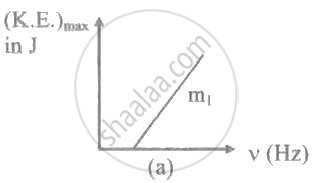
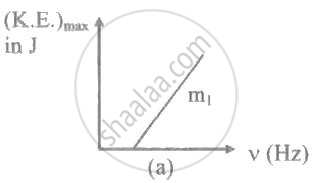
When the work function of a metal increases, maximum kinetic energy of emitted photoelectrons ____________.
In a photoelectric experiment, ultraviolet light of wavelength 280 nm is used with a lithium cathode having work function Φ = 2.5 eV. If the wavelength of incident light is switched to 400 nm, find out the change in the stopping potential.
(h = 6.63 × 10⁻³⁴ Js, c = 3 × 10⁸ ms-1)
When radiation of wavelength λ is used to illuminate a metallic surface, the stopping potential is V. When the same surface is illuminated with radiation of wavelength 3λ, the stopping potential is `"V"/4`. If the threshold wavelength for the metallic surface is nλ. then value of n will be ______.
Photoelectrons are observed to just emit out of a material surface when the light of 620 nm falls on it with the intensity of 100 W m-2. If the light of wavelength 400 nm is incident on the same material with an intensity of 1 W m-2, what would be the minimum reverse potential needed to stop the outflow of the electrons?
If the electron in hydrogen atom jumps from second Bohr orbit to ground state and difference between energies of the two states is radiated in the form of photons. If the work function of the material is 4.2 eV, then stopping potential is ______.
[Energy of electron in nth orbit = `-13.6/"n"^2` eV ]
Give Einstein's explanation of the photoelectric effect.
The threshold frequency for a certain metal for photoelectric effect is 1.7 x 10¹⁵ Hz. When a light of frequency 2.2 x 10¹⁵ Hz is incident on the metal surface, the kinetic energy of the emitted photoelectrons is 3.3 x.10-19 J. Calculate Planck's constant.
