Advertisements
Advertisements
प्रश्न
State Einstein’s photoelectric equation. Explain all characteristics of the photoelectric effect, on the basis of Einstein’s photoelectric equation.
Advertisements
उत्तर
Einstein’s photoelectric equation: K.E.max = (hν – `phi_0`)
Characteristics of photoelectric effect:
- The photoelectric work function `phi_0` is constant for a given emitter. Hence if the frequency ‘ν’ of the incident radiation is decreased, the maximum kinetic energy of the emitted photoelectrons decreases, till it becomes zero for a certain frequency ν0. Therefore, from Einstein’s equation,
0 = hv0 - `phi_0`
∴ `phi_0` = hv0 .......….(1)
This shows that the threshold frequency is related to the work function of the metal and hence it has different values for different metals. - Using equation (1), Einstein’s equation can be written as
`1/2"mv"_"max"^2 = "hv" - "hv"_0`
∴ `1/2"mv"_"max"^2 = "h"("v" - "v"_0)`
This equation shows that:
a. If ν < ν0, then K.E is negative, which is not possible. In this case, photoelectric emission is not possible.
b. If ν > ν0, then photoelectrons move with some velocity.
∴ K.E > 0, which is possible. Hence, photoelectrons are emitted.
c. If ν = ν0, the photoelectrons are just emitted. In this case, K.E = 0. - The photoelectric equation is,
`1/2"mv"_"max"^2 = "hv" - phi_0` .....….(2)
where, hν = energy of the photon of incident radiation.
`phi_0 = "hv"_0` = photoelectric work function of the metal.
Thus, both the terms on the R.H.S of equation (2) depends on the frequency and not on the intensity of radiation. Hence the maximum kinetic energy with which photoelectrons are emitted is independent of the intensity of radiation. However, since `phi_0` and h are constants, the maximum kinetic energy of the photoelectrons is directly proportional to the frequency. - According to the quantum theory, when the intensity of the radiation increases, there is a proportional increase in the number of photons incident per second on the surface. One photon can cause the emission of one photoelectron. Therefore, with the increase in the intensity of radiation, there will be an increase in the photoelectron interactions and the rate of emission of electrons.
- The emission of a photoelectron is the result of a collision between a photon and an electron. As soon as the radiation is incident on the photosensitive surface, the entire energy of the photon is absorbed by the electron at once. Therefore, the electrons are emitted at a moment when light is incident on the metal surface. This explains why photoelectric emission is instantaneous.
- If the electron, with which the incident photon collides, is situated on the emitting surface, the electron will be ejected with maximum K.E as given by Einstein’s equation.
- If, however, the electron is situated in the interior of the emitting material, it will lose some energy in coming to the surface. This explains why the photoelectrons are emitted with different kinetic energies.
Thus, all the features of the photoelectric effect are explained.
APPEARS IN
संबंधित प्रश्न
What is the photoelectric effect?
Radiation of wavelength 4500 Å is incident on a metal having work function 2.0 eV. Due to the presence of a magnetic field B, the most energetic photoelectrons emitted in a direction perpendicular to the field move along a circular path of radius 20 cm. What is the value of the magnetic field B?
Given the following data for incident wavelength and the stopping potential obtained from an experiment on the photoelectric effect, estimate the value of Planck's constant and the work function of the cathode material. What is the threshold frequency and corresponding wavelength? What is the most likely metal used for emitter?
| Incident wavelength (in Å) | 2536 | 3650 |
| Stopping potential (in V) |
1.95 | 0.5 |
As the intensity of incident light increases ______
The energy of a photon is 2 eV. Find its frequency and wavelength.
With the help of a circuit diagram describe the experiment to study the characteristics of the photoelectric effect. Hence discuss any 2 characteristics of the photoelectric effect.
The maximum velocity of the photoelectron emitted by the metal surface is 'v '. Charge and mass of the photoelectron is denoted by 'e' and 'm' respectively. The stopping potential in volt is ______.
When a light of wavelength 4000 Å falls on a photoelectric emitter, photoelectrons are liberated. For another emitter, light of wavelength 6000 Å is sufficient for photo emission. The work functions of the two emitters are in the ratio of ____________.
A metal surface is illuminated by light of given intensity and frequency to cause photoemission. If the intensity of illumination is reduced to one-fourth of its original value then the maximum KE of the emitted photoelectrons would be ______.
In photoelectric experiment, if both the intensity and frequency of the incident light are doubled, then the saturation of photoelectric current ______.
An important spectral emission line has a wavelength of 21 cm. The corresponding photon energy is (h = 6.62 x 10⁻³⁴ Js, c = 3 x 10⁸ m/s) ____________.
Threshold wavelength for lithium metal is 6250 Å. For photoemission, the wavelength of the incident light must be ______.
The threshold frequency for a certain photosensitive metal is v0. When it is illuminated by light of frequency v = 2v0, the maximum velocity of photoelectrons is v0. What will be the maximum velocity of the photoelectrons when the same metal is illuminated by light of frequency
v = 5v0?
When light of wavelength 'λ' is incident on a photosensitive surface, the stopping potential is 'V'. When light of wavelength '3λ' is incident on the same surface, the stopping potential is `"V"/6`. Threshold wavelength for the surface is _______.
When a surface 1 cm thick is illuminated by light of wavelength 'λ', the stopping potential is 'V0'. When the same surface is illuminated by light of wavelength '3λ', the stopping potential is `"V"_0/6`. The threshold wavelength for the metallic surface is ______.
Light of different frequencies, whose photons have energies 3 eV and 18 eV respectively, successively illuminate a metal of work function 2 eV. The ratio of the maximum speeds of the emitted electrons will be ______.
The lowest frequency of light that will cause the emission of photoelectrons from the surface of a metal (for which work function is 1.65 eV) will be ____________.
The work function of a photosensitive material is 4.0 eV. The longest wavelength of light that can cause photon emission from the substance is (approximately) ____________.
When a certain metallic surface is illuminated with monochromatic light of wavelength '`lambda`', the stopping potential for photoelectric effect is '3V0'. If the same surface is illuminated with a light of wavelength '`2 lambda`', the stopping potential is found as 'V0'. The threshold wavelength for this surface is ____________.
When a metal with work function 0.6 eV is illuminated with light of energy 2 eV, the stopping potential will be ____________.
The ratio of slopes m1: ro2 of the lines given in the following graphs is, ______.
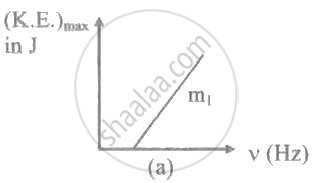
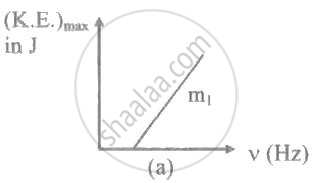
A light of frequency 'v' is incident on the metal surface whose threshold frequency is 'v0'. If v = v0, then [c = speed of light in medium] ____________.
When the work function of a metal increases, maximum kinetic energy of emitted photoelectrons ____________.
Is it always necessary to use red light to get a photoelectric effect?
In a photoelectric experiment, ultraviolet light of wavelength 280 nm is used with a lithium cathode having work function Φ = 2.5 eV. If the wavelength of incident light is switched to 400 nm, find out the change in the stopping potential.
(h = 6.63 × 10⁻³⁴ Js, c = 3 × 10⁸ ms-1)
Two radiations of photons energies 1 eV and 2.5 eV, successively illuminate a photosensitive metallic surface of work function 0.5 eV. The ratio of the maximum speeds of the emitted electrons is ______.
Light of two different frequencies whose photons have energies 1.3 eV and 2.8 eV respectively, successfully illuminate a metallic surface whose work function is 0.8 eV. The ratio of maximum speeds of emitted electrons will be ______.
If the maximum kinetic energy of emitted electrons in the photoelectric effect is 2eV, the stopping potential will be ______.
