Advertisements
Advertisements
प्रश्न
With the help of a circuit diagram describing an experiment to study the photoelectric effect.
Explain the experimental set-up of the photoelectric effect.
Advertisements
उत्तर

Schematic of experimental set-up for the photoelectric effect
- A laboratory experimental set-up for the photoelectric effect consists of an evacuated glass tube with a quartz window.
- The glass tube contains photosensitive metal plates. One is the emitter E and another plate is the collector C.
- The emitter and collector are connected to a voltage source whose voltage can be changed and to an ammeter to measure the current in the circuit.
- A potential difference of V, as measured by the voltmeter, is maintained between the emitter E and collector C. Generally, C (the anode) is at a positive potential with respect to the emitter E (the cathode). This potential difference can be varied, and C can even be at a negative potential with respect to E.
- When the anode potential (V) is positive, it accelerates the electrons. This potential is called accelerating potential. When the anode potential (V) is negative, it retards the flow of electrons. This potential is known as retarding potential.
- A source S of monochromatic light of sufficiently high frequency (short wavelength ≤ 10–7 m) is used.
संबंधित प्रश्न
What is the photoelectric effect?
It is observed in an experiment on the photoelectric effect that an increase in the intensity of the incident radiation does not change the maximum kinetic energy of the electrons. Where does the extra energy of the incident radiation go? Is it lost? State your answer with explanatory reasoning.
The threshold wavelength of tungsten is 2.76 x 10⁻⁵ cm.
(a) Explain why no photoelectrons are emitted when the wavelength is more than 2.76 x 10⁻⁵ cm.
(b) What will be the maximum kinetic energy of electrons ejected in each of the following cases
(i) if ultraviolet radiation of wavelength λ = 1.80 × 10⁻⁵ cm and
(ii) radiation of frequency 4 x 10¹⁵ Hz is made incident on the tungsten surface?
Find the energy of photon which have momentum 2 × 10-16 gm-cm/sec.
Draw a neat labelled diagram of a schematic of the experimental setup for the photoelectric effect.
With the help of a circuit diagram describe the experiment to study the characteristics of the photoelectric effect. Hence discuss any 2 characteristics of the photoelectric effect.
The energy of the incident photon on the metal surface is 3 W and then 5 W, where W is the work function for that metal. The ratio of velocities of emitted photoelectrons is ______.
The ratio of energies of photons produced due to transition of electron of hydrogen atom from its (i) second to first energy level and (ii) highest energy level to second level is respectively.
The kinetic energy of the most energetic photoelectron emitted from a metal surface is doubled when the wavelength of the incident radiation is reduced from λ1 to λ2. The work function of the metal is ______
When a photon enters glass from air, which one of the following quantity does not change?
When light falls on a metal surface, the maximum kinetic energy of the emitted photoelectrons depends upon ______
If the maximum kinetic energy of emitted electrons in photoelectric effect is 3.2 × 10⁻¹⁹ J and the work-function for metal is 6.63 × 10⁻¹⁹ J, then stopping potential and threshold wavelength respectively are
[Planck's constant, h = 6.63 × 1034 J-s]
[Velocity of light, c = 3 × 10⁸ `"m"/"s"`]
[Charge on electron= 1.6 × 10⁻¹⁹ C]
The maximum velocity of the photoelectron emitted by the metal surface is 'v '. Charge and mass of the photoelectron is denoted by 'e' and 'm' respectively. The stopping potential in volt is ______.
An important spectral emission line has a wavelength of 21 cm. The corresponding photon energy is (h = 6.62 x 10⁻³⁴ Js, c = 3 x 10⁸ m/s) ____________.
Threshold wavelength for lithium metal is 6250 Å. For photoemission, the wavelength of the incident light must be ______.
In photoelectric effect, for a light of different intensities but of same frequency, the stopping potential for a given metal is ____________.
Light of different frequencies, whose photons have energies 3 eV and 18 eV respectively, successively illuminate a metal of work function 2 eV. The ratio of the maximum speeds of the emitted electrons will be ______.
The lowest frequency of light that will cause the emission of photoelectrons from the surface of a metal (for which work function is 1.65 eV) will be ____________.
The work function of a photosensitive material is 4.0 eV. The longest wavelength of light that can cause photon emission from the substance is (approximately) ____________.
The ratio of slopes m1: ro2 of the lines given in the following graphs is, ______.
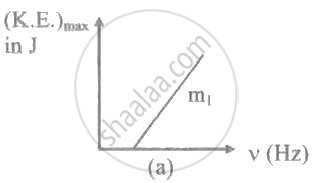
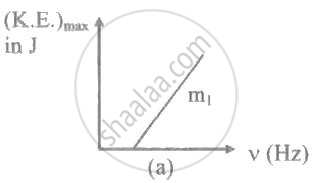
The stopping potential in the context of photoelectric effect depends on the following property of incident electromagnetic radiation ______.
The maximum kinetic energy of the photoelectrons ejected will be ______ eV when the light of wavelength 350 nm is incident on a cesium surface. The work function of cesium = 1.9 eV.
For a given photosensitive material and frequency (> threshold frequency) of incident radiation, the photoelectric current varies with the intensity of incident light as:
Light of wavelength λ, which is less than threshold wavelength is incident on a photosensitive material. If incident wavelength is decreased so that emitted photoelectrons are moving with same velocity, then stopping potential will ______.
The photoelectric threshold for a certain metal surface is 3600 Å. If the metal surface is irradiated by a wavelength of 1100 Å, then kinetic energy of the emitted photoelectrons is ______.
Explain the failure of wave theory of light to account for the observations from experiments on photoelectric effect.
Give Einstein's explanation of the photoelectric effect.
Explain the formation of clouds at high altitude.
A parallel plate capacitor with air between the plates has capacitance 9 pF. The separation between the plates becomes thrice and the space between them is filled with a medium of dielectric constant 6. The capacitance becomes 'x' pF. The value of 'x' is ______.
