Advertisements
Advertisements
प्रश्न
Photocurrent recorded in the microammeter in an experimental setup of the photoelectric effect vanishes when the retarding potential is more than 0.8 V if the wavelength of incident radiation is 4950 Å. If the source of incident radiation is changed, the stopping potential turns out to be 1.2 V. Find the work function of the cathode material and the wavelength of the second source.
Advertisements
उत्तर
Data: VO = 0.8 V, λ = 4950 Å = 4.950 x 10⁻⁷ m, `"V"_"O"'` = 1.2 V, h = 6.63 × 10⁻³⁴ J.s, c = 3 × 10⁸ m/s
1. `"V"_"O""e" = "hv" - phi = "hc"/lambda - phi`
∴ The work function of the cathode material,
`phi = "hc"/lambda - "V"_"O""e"`
`= ((6.63 xx 10^-34)(3 xx 10^8))/(4.950 xx 10^-7) - (0.8)(1.6 xx 10^-19)`
= 4.018 × 10⁻¹⁹ - 1.28 × 10-19
= 2.738 × 10⁻¹⁹ J
`= (2.738 xx 10^-19 "J")/(1.6 xx 10^-19 "J"//"eV")`
= 1.711 eV
2. `"V"_"O"'"e" = "hc"/(lambda') - phi`
∴ `"hc"/(lambda') = "V"_"O"'"e" + phi`
∴ The wavelength of the second source,
`lambda' = "hc"/("V"_"O"'"e" + phi)`
`= ((6.63 xx 10^-34)(3 xx 10^8))/((1.2)(1.6 xx 10^-19) + 2.738 xx 10^-19)`
`= (19.89 xx 10^-26)/(4.658 xx 10^-19)`
= 4.270 × 10⁻⁷ m
= 4270 Å
APPEARS IN
संबंधित प्रश्न
Can microwaves be used in the experiment on photoelectric effect?
Is it always possible to see the photoelectric effect with a red light?
The threshold wavelength of tungsten is 2.76 x 10⁻⁵ cm.
(a) Explain why no photoelectrons are emitted when the wavelength is more than 2.76 x 10⁻⁵ cm.
(b) What will be the maximum kinetic energy of electrons ejected in each of the following cases
(i) if ultraviolet radiation of wavelength λ = 1.80 × 10⁻⁵ cm and
(ii) radiation of frequency 4 x 10¹⁵ Hz is made incident on the tungsten surface?
Radiation of wavelength 4500 Å is incident on a metal having work function 2.0 eV. Due to the presence of a magnetic field B, the most energetic photoelectrons emitted in a direction perpendicular to the field move along a circular path of radius 20 cm. What is the value of the magnetic field B?
Define photoelectric effect.
Find the kinetic energy of the emitted electron, if in photoelectric effect energy of incident Photon is 4 eV and work function is 2.4 eV.
Find the energy of photon which have momentum 2 × 10-16 gm-cm/sec.
Explain the concept of the photoelectric effect.
The ratio of energies of photons produced due to transition of electron of hydrogen atom from its (i) second to first energy level and (ii) highest energy level to second level is respectively.
The following graph shows the stopping potential V0 versus frequency v for photoelectric emission from two metals A and B. The slope of each of the lines gives ______

In photoelectric effect, for a light of different intensities but of same frequency, the stopping potential for a given metal is ____________.
Light of different frequencies, whose photons have energies 3 eV and 18 eV respectively, successively illuminate a metal of work function 2 eV. The ratio of the maximum speeds of the emitted electrons will be ______.
The work function of a substance is 4.0 eV. The longest wavelength of light that can cause photo-emission from this substance is approximately (h = 6.63 × 10⁻³⁴ Js)[1eV = 1.6 × 10⁻¹⁹ J]
The lowest frequency of light that will cause the emission of photoelectrons from the surface of a metal (for which work function is 1.65 eV) will be ____________.
Which one of the following statements ts INCORRECT for stopping potential in photoelectric emission?
Two incident radiations having energies two times and ten times of the work function of a metal surface, produce photoelectric effect. The ratio of maximum velocities of emitted photo electrons respectively is ____________.
A metal surface having work function 'w0' emits photoelectrons when photons of energy 'E' are incident on it. The electron enters the uniform magnetic field (B) in perpendicular direction and moves in circular path of radius 'r'. Then 'r' is equal to (m and e be the mass and charge of electron respectively) ____________.
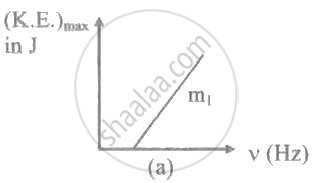
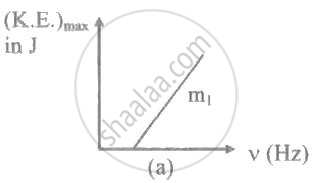
The ratio of slopes m1: ro2 of the lines given in the following graphs is, ______.
A light of frequency 'v' is incident on the metal surface whose threshold frequency is 'v0'. If v = v0, then [c = speed of light in medium] ____________.
The stopping potential in the context of photoelectric effect depends on the following property of incident electromagnetic radiation ______.
In a photoelectric experiment, ultraviolet light of wavelength 280 nm is used with a lithium cathode having work function Φ = 2.5 eV. If the wavelength of incident light is switched to 400 nm, find out the change in the stopping potential.
(h = 6.63 × 10⁻³⁴ Js, c = 3 × 10⁸ ms-1)
When radiation of wavelength λ is used to illuminate a metallic surface, the stopping potential is V. When the same surface is illuminated with radiation of wavelength 3λ, the stopping potential is `"V"/4`. If the threshold wavelength for the metallic surface is nλ. then value of n will be ______.
Photoelectrons are observed to just emit out of a material surface when the light of 620 nm falls on it with the intensity of 100 W m-2. If the light of wavelength 400 nm is incident on the same material with an intensity of 1 W m-2, what would be the minimum reverse potential needed to stop the outflow of the electrons?
The radiation emitted, when an electron jumps from n = 3 to n = 2 orbit is a hydrogen atom, falls on a metal to produce photoelectron. The electrons from the metal surface with maximum kinetic energy are made to move perpendicular to a magnetic field of `1/320`T in a radius of 10-3m. Find the 320 work function of metal:
When ultraviolet light of wavelength 100 nm is incident upon a sample of silver metal, a potential difference of 7.7 volt is required to stop the photoelectrons from reaching the collector plate. The potential required to stop photo electrons when light of wavelength 200 nm is incident upon silver is ______.
In a photocell, frequency of incident radiation is increased by keeping other factors constant (v > v0), the stopping potential ______.
Light of wavelength λ, which is less than threshold wavelength is incident on a photosensitive material. If incident wavelength is decreased so that emitted photoelectrons are moving with same velocity, then stopping potential will ______.
The photoelectric threshold for a certain metal surface is 3600 Å. If the metal surface is irradiated by a wavelength of 1100 Å, then kinetic energy of the emitted photoelectrons is ______.
