Advertisements
Advertisements
प्रश्न
The threshold wavelength of tungsten is 2.76 x 10⁻⁵ cm.
(a) Explain why no photoelectrons are emitted when the wavelength is more than 2.76 x 10⁻⁵ cm.
(b) What will be the maximum kinetic energy of electrons ejected in each of the following cases
(i) if ultraviolet radiation of wavelength λ = 1.80 × 10⁻⁵ cm and
(ii) radiation of frequency 4 x 10¹⁵ Hz is made incident on the tungsten surface?
Advertisements
उत्तर
Data: λ0 = 2.76 x 10⁻⁵ cm = 2.76 x 10⁻⁷ m,
λ = 1.80 × 10⁻⁵ cm = 1.80 × 10⁻⁷ m,
v = 4 × 10¹⁵ Hz,
h = 6.63 × 10⁻³⁴ J.s,
c = 3 × 10⁸ m/s
(a) For λ > λ0,v < v0 (threshold frequency).
∴ hv < hv0. Hence, no photoelectrons are emitted.
(b) Maximum kinetic energy of electrons ejected
`= "hc" (1/lambda - 1/lambda_0)`
`= (6.63 xx 10^-34)(3 xx 10^8)(10^7/1.8 - 10^7/2.76)`J
= (6.63 × 10⁻¹⁹)(3)(0.5555 - 0.3623)
= (6.63)(3)(0.1932 × 10⁻¹⁹)J
= 3.842 × 10⁻¹⁹J
`= (3.842 xx 10^-19 "J")/(1.6 xx 10^-19 "J"//"eV")`
= 2.40 eV
(c) Maximum kinetic energy of electrons ejected
= hv - `"hc"/lambda_0`
`= (6.63 xx 10^-34)(4 xx 10^15) - ((6.63 xx 10^-34)(3 xx 10^8))/(2.76 xx 10^-7)`
= 26.52 × 10⁻¹⁹ - 7.207 × 10-19
= 19.313 × 10⁻¹⁹ J
= `(19.313 xx 10^19 "J")/(1.6 xx 10^-19 "J"//"eV")`
= 12.07 eV
संबंधित प्रश्न
Explain the inverse linear dependence of stopping potential on the incident wavelength in a photoelectric effect experiment.
Given the following data for incident wavelength and the stopping potential obtained from an experiment on the photoelectric effect, estimate the value of Planck's constant and the work function of the cathode material. What is the threshold frequency and corresponding wavelength? What is the most likely metal used for emitter?
| Incident wavelength (in Å) | 2536 | 3650 |
| Stopping potential (in V) |
1.95 | 0.5 |
Find the kinetic energy of the emitted electron, if in photoelectric effect energy of incident Photon is 4 eV and work function is 2.4 eV.
Draw a neat labelled diagram of a schematic of the experimental setup for the photoelectric effect.
If the total energy of radiation of frequency 1014 Hz is 6.63 J, Calculate the number of photons in the radiation.
State Einstein photoelectric equation.
The work function of a surface is 3.1 eV. A photon of frequency 1 × 10¹⁵ Hz. Is an incident on it. Calculate the incident wavelength is photoelectric emission occurs or not.
With the help of a circuit diagram describe the experiment to study the characteristics of the photoelectric effect. Hence discuss any 2 characteristics of the photoelectric effect.
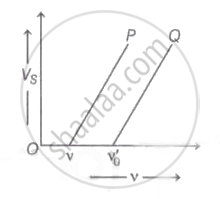
The graph of stopping potential `"V"_"s"` against frequency v of incident radiation is plotted for two different metals P and Q as shown in the graph. ΦP and ΦQ are work-functions of P and Q respectively, then
When a light of wavelength 4000 Å falls on a photoelectric emitter, photoelectrons are liberated. For another emitter, light of wavelength 6000 Å is sufficient for photo emission. The work functions of the two emitters are in the ratio of ____________.
A metal surface is illuminated by light of given intensity and frequency to cause photoemission. If the intensity of illumination is reduced to one-fourth of its original value then the maximum KE of the emitted photoelectrons would be ______.
The work function of a metallic surface is 5.01 eV. The photoelectrons are emitted when light of wavelength 2000 Å falls on it. The potential difference applied to stop the fastest photoelectrons is [h = 4.14 x 10⁻¹⁵ eV sec] ____________.
The photo electric effect to take place for a metal, the minimum frequency required is 5.792 × 10¹⁴ Hz. A light of wavelength 6000 Å is incident on that metal surface. What is the corresponding frequency of light and will there be photoelectric emissions? [velocity of light = 3 × 10⁸ m/s]
When a surface 1 cm thick is illuminated by light of wavelength 'λ', the stopping potential is 'V0'. When the same surface is illuminated by light of wavelength '3λ', the stopping potential is `"V"_0/6`. The threshold wavelength for the metallic surface is ______.
The lowest frequency of light that will cause the emission of photoelectrons from the surface of a metal (for which work function is 1.65 eV) will be ____________.
The photon of frequency vis incident on a metal surface whose threshold frequency is v0. The kinetic energy of the emitted photoelectrons will be ______.
Which one of the following statements ts INCORRECT for stopping potential in photoelectric emission?
The radiations of energies 1 eV and 2.5 eV are incident on a metal surface having work function 0.5 eV. The ratio of the maximum velocities of the emitted photo-electrons is ____________.
When a metal with work function 0.6 eV is illuminated with light of energy 2 eV, the stopping potential will be ____________.
When light of wavelength '`lambda`' is incident on photosensitive surface, photons of power 'P' are emitted. The number of photons (n) emitted in 't' second is (h = Planck's constant, c = velocity of light in vacuum) ____________.
A metal surface having work function 'w0' emits photoelectrons when photons of energy 'E' are incident on it. The electron enters the uniform magnetic field (B) in perpendicular direction and moves in circular path of radius 'r'. Then 'r' is equal to (m and e be the mass and charge of electron respectively) ____________.
In a photoelectric experiment, ultraviolet light of wavelength 280 nm is used with a lithium cathode having work function Φ = 2.5 eV. If the wavelength of incident light is switched to 400 nm, find out the change in the stopping potential.
(h = 6.63 × 10⁻³⁴ Js, c = 3 × 10⁸ ms-1)
A point isotropic light source of power P = 12 watts is located on the axis of a circular mirror of radius R = 3 cm. If the distance of the source from the centre of the mirror is a = 39 cm and the reflection coefficient of the mirror is α = 0.70 then the force exerted by the light ray on the mirror is ______ × 10-10 N.
In a photocell, frequency of incident radiation is increased by keeping other factors constant (v > v0), the stopping potential ______.
Light of two different frequencies whose photons have energies 1.3 eV and 2.8 eV respectively, successfully illuminate a metallic surface whose work function is 0.8 eV. The ratio of maximum speeds of emitted electrons will be ______.
Photoelectric emission is observed from a metallic surface for frequencies ν1 and ν2 of the incident light rays (ν1 > ν2). If the ratio of the maximum value of the kinetic energy of the photoelectrons emitted in the first case to that in the second case is 2 : K, then the threshold frequency of the metallic surface is ______.
Give Einstein's explanation of the photoelectric effect.
Light of wavelength 'λ' falls on a metal having work function \[\frac {hc}{λ_0}\]. Photoelectric effect will take place only if (λ0 is the threshold wavelength) ______.
According to Einstein's photoelectric equation, the graph of kinetic energy of the photoelectron emitted from the metal versus the frequency of incident radiation gives a straight line graph whose slopе ______.
