Advertisements
Advertisements
प्रश्न
Photocurrent recorded in the microammeter in an experimental setup of the photoelectric effect vanishes when the retarding potential is more than 0.8 V if the wavelength of incident radiation is 4950 Å. If the source of incident radiation is changed, the stopping potential turns out to be 1.2 V. Find the work function of the cathode material and the wavelength of the second source.
Advertisements
उत्तर
Data: VO = 0.8 V, λ = 4950 Å = 4.950 x 10⁻⁷ m, `"V"_"O"'` = 1.2 V, h = 6.63 × 10⁻³⁴ J.s, c = 3 × 10⁸ m/s
1. `"V"_"O""e" = "hv" - phi = "hc"/lambda - phi`
∴ The work function of the cathode material,
`phi = "hc"/lambda - "V"_"O""e"`
`= ((6.63 xx 10^-34)(3 xx 10^8))/(4.950 xx 10^-7) - (0.8)(1.6 xx 10^-19)`
= 4.018 × 10⁻¹⁹ - 1.28 × 10-19
= 2.738 × 10⁻¹⁹ J
`= (2.738 xx 10^-19 "J")/(1.6 xx 10^-19 "J"//"eV")`
= 1.711 eV
2. `"V"_"O"'"e" = "hc"/(lambda') - phi`
∴ `"hc"/(lambda') = "V"_"O"'"e" + phi`
∴ The wavelength of the second source,
`lambda' = "hc"/("V"_"O"'"e" + phi)`
`= ((6.63 xx 10^-34)(3 xx 10^8))/((1.2)(1.6 xx 10^-19) + 2.738 xx 10^-19)`
`= (19.89 xx 10^-26)/(4.658 xx 10^-19)`
= 4.270 × 10⁻⁷ m
= 4270 Å
APPEARS IN
संबंधित प्रश्न
What is the photoelectric effect?
The minimum frequency for photoelectric effect on metal is 7 × 10¹⁴ Hz, Find the work function of the metal.
Find the energy of photon which have momentum 2 × 10-16 gm-cm/sec.
What is the photoelectric effect? Define stopping potential and photoelectric work function.
State Einstein’s photoelectric equation. Explain all characteristics of the photoelectric effect, on the basis of Einstein’s photoelectric equation.
The kinetic energy of the most energetic photoelectron emitted from a metal surface is doubled when the wavelength of the incident radiation is reduced from λ1 to λ2. The work function of the metal is ______
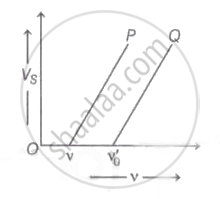
The graph of stopping potential `"V"_"s"` against frequency v of incident radiation is plotted for two different metals P and Q as shown in the graph. ΦP and ΦQ are work-functions of P and Q respectively, then
Threshold frequency for a metal is 1015 Hz. Light of `lambda` = 4000 Å falls on its surface. Which of the following statements is correct?
The work function of a metallic surface is 5.01 eV. The photoelectrons are emitted when light of wavelength 2000 Å falls on it. The potential difference applied to stop the fastest photoelectrons is [h = 4.14 x 10⁻¹⁵ eV sec] ____________.
Photoelectrons emitted from a metallic surface are initially ____________.
In photoelectric experiment, if both the intensity and frequency of the incident light are doubled, then the saturation of photoelectric current ______.
An important spectral emission line has a wavelength of 21 cm. The corresponding photon energy is (h = 6.62 x 10⁻³⁴ Js, c = 3 x 10⁸ m/s) ____________.
Light of wavelength `lambda` strikes a photo-sensitive surface and electrons are ejected with kinetic energy E. If the kinetic energy is to be increased to 2E, the wavelength must be changed to `lambda'` where ____________.
In photoelectric effect, for a light of different intensities but of same frequency, the stopping potential for a given metal is ____________.
In photoelectric effect, graph of saturation current versus frequency of light is plotted. The nature of the graph will be ____________.
The work function of a substance is 4.0 eV. The longest wavelength of light that can cause photo-emission from this substance is approximately (h = 6.63 × 10⁻³⁴ Js)[1eV = 1.6 × 10⁻¹⁹ J]
Following graphs show the variation of stopping potential corresponding to the frequency of incident radiation (F) for a given metal. The correct variation is shown in graph (v0 = Threshold frequency).
When a certain metallic surface is illuminated with monochromatic light of wavelength '`lambda`', the stopping potential for photoelectric effect is '3V0'. If the same surface is illuminated with a light of wavelength '`2 lambda`', the stopping potential is found as 'V0'. The threshold wavelength for this surface is ____________.
Two incident radiations having energies two times and ten times of the work function of a metal surface, produce photoelectric effect. The ratio of maximum velocities of emitted photo electrons respectively is ____________.
A light of frequency 'v' is incident on the metal surface whose threshold frequency is 'v0'. If v = v0, then [c = speed of light in medium] ____________.
When ultraviolet light of wavelength 100 nm is incident upon a sample of silver metal, a potential difference of 7.7 volt is required to stop the photoelectrons from reaching the collector plate. The potential required to stop photo electrons when light of wavelength 200 nm is incident upon silver is ______.
The following graphs show the variation of stopping potential corresponding to the frequency of incident radiation (ν) for a given metal. The correct variation is shown in graph [ν0 = threshold frequency].
|
(A) |
(B) |
|
(C) |
(D) |


Explain the failure of wave theory of light to account for the observations from experiments on photoelectric effect.
The threshold frequency for a certain metal for photoelectric effect is 1.7 x 10¹⁵ Hz. When a light of frequency 2.2 x 10¹⁵ Hz is incident on the metal surface, the kinetic energy of the emitted photoelectrons is 3.3 x.10-19 J. Calculate Planck's constant.
Explain the formation of clouds at high altitude.
In a photoelectric experiment, the stopping potential is 1.5V. What is the maximum kinetic energy of a photoelectron?
