Advertisements
Advertisements
प्रश्न
Radiation of wavelength 4500 Å is incident on a metal having work function 2.0 eV. Due to the presence of a magnetic field B, the most energetic photoelectrons emitted in a direction perpendicular to the field move along a circular path of radius 20 cm. What is the value of the magnetic field B?
Advertisements
उत्तर
Data: λ = 4500 Å = 4.5 × 10⁻⁷ m,
Φ = 2.0 eV = 2 × 1.6 × 10-19 J = 3.2 × 10⁻¹⁹ J
h = 6.63 × 10⁻³⁴ J.s, c = 3 × 10⁸ m/s,
r = 20 cm = 0.2 m, e = 1.6 × 10⁻¹⁹ C, m = 9.1 × 10⁻³¹ kg
`1/2 "mv"_"max"^2 ("KE"_"max") = "hc"/lambda -* phi`
`= ((6.63 xx 10^-34)(3 xx 10^8))/(4.5 xx 10^-7) - 3.2 xx 10^-19`
= 4.42 × 10⁻¹⁹ - 3.2 × 10-19
= 1.22 × 10⁻¹⁹ J
∴ `"v"_"max" = sqrt(2/"m" "KE"_"max") = sqrt((2 xx 1.22 xx 10^-19)/(9.1 xx 10^-31))`
`= sqrt(0.2681 xx 10^12) = 5.178 xx 10^5` m/s
Now, centripetal force, `("mv"_"max"^2)/"r"` = magnetic force, Bevmax
∴ B = `("mv"_"max")/"re" = ((9.1 xx 10^-31)(5.178 xx 10^5))/((0.2)(1.6 xx 10^-19))`
= 1.472 × 10⁻⁵ T
APPEARS IN
संबंधित प्रश्न
Explain the inverse linear dependence of stopping potential on the incident wavelength in a photoelectric effect experiment.
Photocurrent recorded in the microammeter in an experimental setup of the photoelectric effect vanishes when the retarding potential is more than 0.8 V if the wavelength of incident radiation is 4950 Å. If the source of incident radiation is changed, the stopping potential turns out to be 1.2 V. Find the work function of the cathode material and the wavelength of the second source.
Given the following data for incident wavelength and the stopping potential obtained from an experiment on the photoelectric effect, estimate the value of Planck's constant and the work function of the cathode material. What is the threshold frequency and corresponding wavelength? What is the most likely metal used for emitter?
| Incident wavelength (in Å) | 2536 | 3650 |
| Stopping potential (in V) |
1.95 | 0.5 |
Define photoelectric effect.
State Einstein photoelectric equation.
The work function of a surface is 3.1 eV. A photon of frequency 1 × 10¹⁵ Hz. Is an incident on it. Calculate the incident wavelength is photoelectric emission occurs or not.
The maximum velocity of photoelectron emitted is 4.8 m/s. If the e/m ratio of the electron is 1.76 × 10¹¹ C/kg, then stopping potential is given by ______
The maximum velocity of the photoelectron emitted by the metal surface is 'v '. Charge and mass of the photoelectron is denoted by 'e' and 'm' respectively. The stopping potential in volt is ______.
Threshold frequency for a metal is 1015 Hz. Light of `lambda` = 4000 Å falls on its surface. Which of the following statements is correct?
An important spectral emission line has a wavelength of 21 cm. The corresponding photon energy is (h = 6.62 x 10⁻³⁴ Js, c = 3 x 10⁸ m/s) ____________.
Threshold wavelength for lithium metal is 6250 Å. For photoemission, the wavelength of the incident light must be ______.
When light of wavelength 'λ' is incident on a photosensitive surface, the stopping potential is 'V'. When light of wavelength '3λ' is incident on the same surface, the stopping potential is `"V"/6`. Threshold wavelength for the surface is _______.
The photo electric effect to take place for a metal, the minimum frequency required is 5.792 × 10¹⁴ Hz. A light of wavelength 6000 Å is incident on that metal surface. What is the corresponding frequency of light and will there be photoelectric emissions? [velocity of light = 3 × 10⁸ m/s]
When a surface 1 cm thick is illuminated by light of wavelength 'λ', the stopping potential is 'V0'. When the same surface is illuminated by light of wavelength '3λ', the stopping potential is `"V"_0/6`. The threshold wavelength for the metallic surface is ______.
Which one of the following statements ts INCORRECT for stopping potential in photoelectric emission?
An electromagnetic wave of wavelength '`lambda`' is incident on a photosensitive surface of negligible work function. If the photoelectrons emitted from this surface have the de-Broglie wavelength '`lambda_1`' then ____________.
The ratio of slopes m1: ro2 of the lines given in the following graphs is, ______.
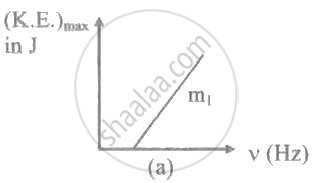
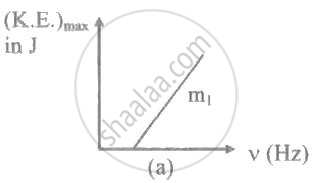
When the work function of a metal increases, maximum kinetic energy of emitted photoelectrons ____________.
Which one of the following graphs represents the variation of photoelectric current (i) with intensity (I) of the incident light?
The wavelength of light incident on a metal surface is reduced from 300 nm to 200 nm (both are less than threshold wavelength). What is the change in the stopping potential for photoelectrons emitted from the surface will be ______ V. (Take h = 6.6 × 10⁻³⁴ J-s)
A charged dust particle of radius 5 × 10⁻⁷ m is located in a horizontal electric field having an intensity of 6.28 × 10⁵ V/m. The surrounding medium is air with a coefficient of viscosity η = 1.6 × 10⁻⁵ N-s/m2. If the particle moves with a uniform horizontal speed of 0.02 m/s, the number of electrons on it is ______.
Light of two different frequencies whose photons have energies 1.3 eV and 2.8 eV respectively, successfully illuminate a metallic surface whose work function is 0.8 eV. The ratio of maximum speeds of emitted electrons will be ______.
Photoelectric emission is observed from a metallic surface for frequencies ν1 and ν2 of the incident light rays (ν1 > ν2). If the ratio of the maximum value of the kinetic energy of the photoelectrons emitted in the first case to that in the second case is 2 : K, then the threshold frequency of the metallic surface is ______.
Give Einstein's explanation of the photoelectric effect.
The threshold frequency for a certain metal for photoelectric effect is 1.7 x 10¹⁵ Hz. When a light of frequency 2.2 x 10¹⁵ Hz is incident on the metal surface, the kinetic energy of the emitted photoelectrons is 3.3 x.10-19 J. Calculate Planck's constant.
A parallel plate capacitor with air between the plates has capacitance 9 pF. The separation between the plates becomes thrice and the space between them is filled with a medium of dielectric constant 6. The capacitance becomes 'x' pF. The value of 'x' is ______.
