Advertisements
Advertisements
प्रश्न
What is plasmid?
Advertisements
उत्तर १
Plasmid is a circular, double stranded, self-replicating, extra-chromosomal DNA molecule.
उत्तर २
Plasmids are small, circular and duplex DNA molecules and their natural function is to confer antibiotic resistance to the host cell. They have several properties that make them extremely useful as cloning vectors.
APPEARS IN
संबंधित प्रश्न
How has the development of bioreactor helped in biotechnology?
One of the major contributions of biotechnology is to develop pest-resistant varieties of cotton plants. Explain how it has been made possible.
Write a short note on Electrophoresis.
Expand the following abbreviation: BAC
In vitro amplification of DNA or RNA segment is known as ___________.
ECoRI is obtained from ______.
What is the role of Taq-polymerase in PCR technology?
From the following list of cloning vectors used in rDNA technology identify the vectors that are the most commonly used.
Plasmids, bacteriophages (Ml3, lambda virus), cosmid, phagemid, BAC (bacterial artificial chromosome), YAC (yeast artificial chromosome), transposons, baculoviruses, and mammalian artificial chromosomes (MACs)
For which of the following reason Agrobacterium tumefaciens is most widely used for gene transfer in plants?
The time taken to complete one cycle of PCR is around ______.
Which of the following is an INCORRECT match?
Match the Column I (Restriction enzyme) with Column II (Recognition sequence) and select the correct option.
| column I (Restriction Enzyme) | column II (Recognition sequence) | ||
| i. | Alu | P. | 5'---G- ↓-G-A-T-C-C---3' 3'---C-C-T-A-G- -G---5 |
| ii. | BamHI | Q. | 5'--- A-G- ↓ -C-T---3' 3' ---T-C- G-A--- 5' |
| iii. | Eco RI | R. | 5'--G-T-C- ↓ -G-A-C--3' I 3'--C-A-G-t-C-T-G--5' |
| iv. | HindII | S. | 5'---G- ↓ -A-A-T-T-C---3' 3'---C-T-T-A-A- -G---5' |
Which of the following viruses has the capacity to produce lysozymes?
DNA fingerprinting refers to ______.
Annealing step of PCR operates at ______ °C.
| Oil spill is a major environmental issue. It has been found that different strains of Pseudomonas bacteria have genes to break down the four major groups of hydrocarbons in oil. Trials are underway to use different biotechnological tools to incorporate these genes and create a genetically engineered strain of Pseudomonas - a ‘super-bug’, to break down the four major groups of hydrocarbons in oil. Such bacteria might be sprayed onto surfaces polluted with oil to clean thin films of oil. |
(a) List two advantages of using bacteria for such biotechnological studies?
(b) For amplification of the gene of interest PCR was carried out. The PCR was run with the help of polymerase which was functional only at a very low temperature. How will this impact the efficiency of the PCR? Justify.
(c) If such bacteria are sprayed on water bodies with oil spills, how will this have a positive or negative effect on the environment? Discuss.
Which of the following statements are true about cloning vectors?
- Vectors are DNA molecules that carry a foreign DNA segment.
- The replicated DNA is introduced into the host cell.
- It possesses the origin of replication (Ori).
- Vectors may be plasmid, bacteriophage, Yeast artificial chromosomes (YACs), etc.
- Vectors do not require a selectable marker to identify and eliminate non-transformants.
Choose the correct answer from the options given below.
The structure below shows pUC18, which is similar to pBR322 in its function. However, they differ in some of their restriction sites and the number of ori. The ori number for pBR322 is approximately 20.

- How are puc18 and pBR322 used in biotechnological studies?
OR
What will be the impact if the ori in the above structure gets damaged? - The lac z gene has many recognition sites. Study the segment of DNA given below and answer the questions.
5’... ATC GTA AAG CTT CAT…3’
3’... TAG CAT TTC GAA GTA…5’
i) Applying your knowledge of palindrome sequences identify and mark the possible region where the restriction enzyme X will act.
ii) Restriction enzyme Y was used to extract a gene of interest from a plant. This gene needs to be inserted in the given DNA segment which has been treated with restriction enzyme X. Will there be a successful recombination? Explain with a reason. - Which one of the two (pUC18 and pBR322) would you prefer for biotechnological studies? Justify.
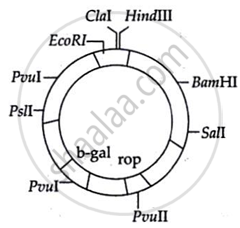
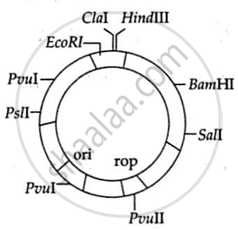
Suneeta is planning an experiment to clone a gene in a vector. So, she has to choose a good cloning vector.
Which one of the vectors shown below should she choose? Justify your answer by giving two reasons.
 |
 |
 |
| Vector A | Vector B | Vector C |
