मराठी

We need ______ coordinates for representing a point on the graph sheet.

Advertisements
Advertisements

प्रश्न

We need ______ coordinates for representing a point on the graph sheet.

रिकाम्या जागा भरा
Advertisements

उत्तर

We need pair of (or two) coordinates for representing a point on the graph sheet.

Explanation:

The x coordinate and the y co-ordinate are the two or a pair of point required to plot the point on graph paper.

The distance of point from x-axis makes y co-ordinate and distance of point from y-axis makes x co-ordinate.

shaalaa.com
  या प्रश्नात किंवा उत्तरात काही त्रुटी आहे का?
पाठ 12: Introduct To Graphs - Exercise [पृष्ठ ३७५]

APPEARS IN

एनसीईआरटी एक्झांप्लर Mathematics Exemplar [English] Class 8
पाठ 12 Introduct To Graphs
Exercise | Q 13. | पृष्ठ ३७५

व्हिडिओ ट्यूटोरियलVIEW ALL [1]

संबंधित प्रश्‍न

Draw the line passing through (2, 3) and (3, 2). Find the coordinates of the points at which this line meets the x-axis and y-axis.


Locate the points:

(2, 1), (2, 2), (2, 3), (2, 4)


Write the coordinates of each of the vertices of each polygon in Fig. 27.9.


A point which lies on both the axis is ______.


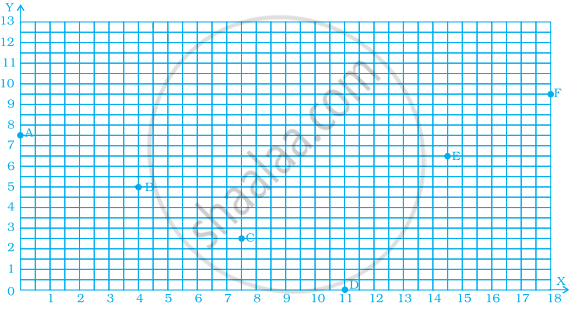
From the given graph, choose the letters that indicate the location of the points given below.

  1. (2, 0)
  2. (0, 4)
  3. (5, 1)
  4. (2, 6)
  5. (3, 3)

Write the x-coordinate (abscissa) of the given point.

(5, 7)


Study the graph given below of a person who started from his home and returned at the end of the day. Answer the questions that follow.

  1. At what time did the person start from his home?
  2. How much distance did he travel in the first four hours of his journey?
  3. What was he doing from 3 pm to 5 pm?
  4. What was the total distance travelled by him throughout the day?
  5. Calculate the distance covered by him in the first 8 hours of his journey.
  6. At what time did he cover 16 km of his journey?
  7. Calculate the average speed of the man from (a) A to B (b) B to C.
  8. At what time did he return home?

Draw a parallelogram ABCD on a graph paper with the coordinates given in Table I. Use this table to complete Tables II and III to get the coordinates of E, F, G, H and J, K, L, M.

Point (x, y)
A (1, 1)
B (4. 4)
C (8, 4)
D (5, 1)

     Table I

Point (0.5x, 0.5y)
E (0.5, 0.5)
F  
G  
H  

     Table II

Point (2x, 1.5y)
J (2, 1.5)
K  
L  
M  

    Table III

Draw parallelograms EFGH and JKLM on the same graph paper.

Plot the points (2, 4) and (4, 2) on a graph paper, then draw a line segment joining these two points.


This graph shows the per cent of students who dropped out of school after completing High School. The point labelled A shows that, in 1996, about 4.7% of students dropped out.

  1. In which year was the dropout the rate highest? In which year was it the lowest?
  2. When did the per cent of students who dropped out of high school first fall below 5%?
  3. About what per cent of students dropped out of high school in 2007? About what per cent of students stayed in high school in 2008?

Consider this input/output table.

Input 1 2 4 5 7
Output 2 5 11 14 20
  1. Graph the values from the table by taking Input along horizontal axis from 0 to 8 and Output along vertical axis from 0 to 24.
  2. Use your graph to predict the outputs for inputs of 3 and 8.

Share
Notifications

Englishहिंदीमराठी


      Forgot password?
Use app×