Advertisements
Advertisements
प्रश्न
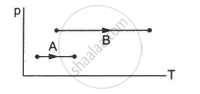
Consider two processes on a system as shown in figure.
The volumes in the initial states are the same in the two processes and the volumes in the final states are also the same. Let ∆W1 and ∆W2 be the work done by the system in the processes A and B respectively.
पर्याय
∆W1 > ∆W2
∆W1 = ∆W2
∆W1 < ∆W2
Nothing can be said about the relation between ∆W1 and ∆W2
Advertisements
उत्तर
∆W1 < ∆W2
Work done by the system, ∆W = P ∆ V
here,
P = Pressure in the process
∆V = Change in volume during the process
Let Vi and Vf be the volumes in the initial states and final states for processes A and B, respectively. Then,
\[\Delta W_1 = P_1 \Delta V_1 \]
\[\Delta W_2 = P_2 \Delta V_2 \]
But \[\Delta V_2 = \Delta V_1 ,.............\left[ \left( V_{f_1} - V_{i_1} \right) = \left( V_{f_2} - V_{i_2} \right) \right]\]
\[ \Rightarrow \frac{\Delta W_1}{\Delta W_2} = \frac{P_1}{P_2}\]
\[ \Rightarrow \Delta W_1 < \Delta W_2..........\left[ \because P_2 > P_1 \right]\]
APPEARS IN
संबंधित प्रश्न
Explain why Air pressure in a car tyre increases during driving.
Two cylinders A and B of equal capacity are connected to each other via a stopcock. A contains a gas at standard temperature and pressure. B is completely evacuated. The entire system is thermally insulated. The stopcock is suddenly opened. Answer the following:
Do the intermediate states of the system (before settling to the final equilibrium state) lie on its P-V-T surface?
Should the internal energy of a system necessarily increase if heat is added to it?
A cylinder containing a gas is lifted from the first floor to the second floor. What is the amount of work done on the gas? What is the amount of work done by the gas? Is the internal energy of the gas increased? Is the temperature of the gas increased?
A gas is contained in a metallic cylinder fitted with a piston. The piston is suddenly moved in to compress the gas and is maintained at this position. As time passes the pressure of the gas in the cylinder ______________ .
The pressure p and volume V of an ideal gas both increase in a process.
(a) Such a process is not possible.
(b) The work done by the system is positive.
(c) The temperature of the system must increase.
(d) Heat supplied to the gas is equal to the change in internal energy.
Figure shows three paths through which a gas can be taken from the state A to the state B. Calculate the work done by the gas in each of the three paths.
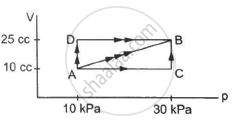
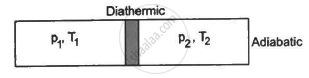
Figure shows a cylindrical tube of volume V with adiabatic walls containing an ideal gas. The internal energy of this ideal gas is given by 1.5 nRT. The tube is divided into two equal parts by a fixed diathermic wall. Initially, the pressure and the temperature are p1, T1 on the left and p2, T2 on the right. The system is left for sufficient time so that the temperature becomes equal on the two sides. (a) How much work has been done by the gas on the left part? (b) Find the final pressures on the two sides. (c) Find the final equilibrium temperature. (d) How much heat has flown from the gas on the right to the gas on the left?
Which of the following is correct, when the energy is transferred to a system from its environment?
Define heat.
An ideal gas is compressed at a constant temperature. Its internal energy will ____________.
Two samples A and B, of a gas at the same initial temperature and pressure are compressed from volume V to V/2; A isothermally and B adiabatically. The final pressure of A will be ______.
Two cylinders A and B of equal capacity are connected to each other via a stopcock. A contains a gas at standard temperature and pressure. B is completely evacuated. The entire system is thermally insulated. The stopcock is suddenly opened. Answer the following:
What is the final pressure of the gas in A and B?
Two cylinders A and B of equal capacity are connected to each other via a stopcock. A contains a gas at standard temperature and pressure. B is completely evacuated. The entire system is thermally insulated. The stopcock is suddenly opened. Answer the following:
What is the change in the temperature of the gas?
In thermodynamics, heat and work are ______.
If a gas is compressed adiabatically:
What is heat?
Explain the change in internal energy of a thermodynamic system (the gas) by heating it.
