Advertisements
Advertisements
प्रश्न
The radius of the innermost electron orbit of a hydrogen atom is 5.3 × 10⁻¹¹ m. What are the radii of the n = 2 and n = 3 orbits?
Advertisements
उत्तर
The radius of the innermost orbit of a hydrogen atom, r1 = 5.3 × 10⁻¹¹ m
Let r2 be the radius of the orbit at n = 2. It is related to the radius of the innermost orbit as:
r2 = (n)2r1
= (2)2 × 5.3 × 10−11
= 4 × 5.3 × 10−11
= 2.12 × 10⁻¹⁰ m
For n = 3, we can write the corresponding electron radius as:
r3 = (n)2r1
= (3)2 × 5.3 × 10−11
= 9 × 5.3 × 10−11
= 4.77 × 10⁻¹⁰ m
Hence, the radii of an electron for n = 2 and n = 3 orbits are 2.12 × 10⁻¹⁰ m and 4.77 × 10⁻¹⁰ m, respectively.
संबंधित प्रश्न
An electron is orbiting in 5th Bohr orbit. Calculate ionisation energy for this atom, if the ground state energy is -13.6 eV.
(i) State Bohr's quantization condition for defining stationary orbits. How does the de Broglie hypothesis explain the stationary orbits?
(ii) Find the relation between three wavelengths λ1, λ2 and λ3 from the energy-level diagram shown below.
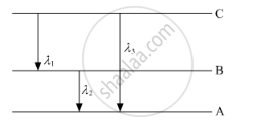
Explain, giving reasons, which of the following sets of quantum numbers are not possible.
- n = 0, l = 0, ml = 0, ms = + ½
- n = 1, l = 0, ml = 0, ms = – ½
- n = 1, l = 1, ml = 0, ms = + ½
- n = 2, l = 1, ml = 0, ms = – ½
- n = 3, l = 3, ml = –3, ms = + ½
- n = 3, l = 1, ml = 0, ms = + ½
The longest wavelength doublet absorption transition is observed at 589 and 589.6 nm. Calculate the frequency of each transition and energy difference between two excited states.
On the basis of Bohr's theory, derive an expression for the radius of the nth orbit of an electron of the hydrogen atom.
Using Bohr’s postulates, obtain the expressions for (i) kinetic energy and (ii) potential energy of the electron in stationary state of hydrogen atom.
Draw the energy level diagram showing how the transitions between energy levels result in the appearance of Lymann Series.
Using Bohr’s postulates, obtain the expression for total energy of the electron in the nth orbit of hydrogen atom.
Balmer series was observed and analysed before the other series. Can you suggest a reason for such an order?
If l3 and l2 represent angular momenta of an orbiting electron in III and II Bohr orbits respectively, then l3: l2 is :
How are various lines of Lyman series formed? Explain on the basis of Bohr’s theory.
Use Bohr’s model of hydrogen atom to obtain the relationship between the angular momentum and the magnetic moment of the revolving electron.
Which of these statements correctly describe the atomic model according to classical electromagnetic theory?
Ratio of longest to shortest wavelength in Balmer series is ______.
Calculate the energy and frequency of the radiation emitted when an electron jumps from n = 3 to n = 2 in a hydrogen atom.
Consider aiming a beam of free electrons towards free protons. When they scatter, an electron and a proton cannot combine to produce a H-atom ______.
- because of energy conservation.
- without simultaneously releasing energy in the from of radiation.
- because of momentum conservation.
- because of angular momentum conservation.
How will the energy of a hydrogen atom change if n increases from 1 to ∞?
State Bohr's postulate to explain stable orbits in a hydrogen atom. Prove that the speed with which the electron revolves in nth orbit is proportional to `(1/"n")`.
The value of angular momentum for He+ ion in the first Bohr orbit is ______.
The number of times larger the spacing between the energy levels with n = 3 and n = 8 spacing between the energy level with n = 8 and n = 9 for the hydrogen atom is ______.
For the reaction \[\ce{2NO2 (g) ⇌ N2O4(g)}\], when ΔS = −176.0 JK−1 and ΔH = −57.8 kj mol−1, the magnitude of ΔG at 298 K for the reaction is ______ kJ mol−1. (Nearest integer)
