Advertisements
Advertisements
प्रश्न
The inverse of the function
\[f : R \to \left\{ x \in R : x < 1 \right\}\] given by
\[f\left( x \right) = \frac{e^x - e^{- x}}{e^x + e^{- x}}\] is
पर्याय
\[\frac{1}{2} \log \frac{1 + x}{1 - x}\]
\[\frac{1}{2} \log \frac{2 + x}{2 - x}\]
\[\frac{1}{2} \log \frac{1 - x}{1 + x}\]
none of these
Advertisements
उत्तर
\[\text{Let} f^{- 1} \left( x \right) = y . . . \left( 1 \right)\]
\[ \Rightarrow f\left( y \right) = x\]
\[ \Rightarrow \frac{e^y - e^{- y}}{e^y + e^{- y}} = x\]
\[ \Rightarrow \frac{e^{- y} \left( e^{2y} - 1 \right)}{e^{- y} \left( e^{2y} + 1 \right)} = x\]
\[ \Rightarrow \left( e^{2y} - 1 \right) = x\left( e^{2y} + 1 \right)\]
\[ \Rightarrow e^{2y} - 1 = x e^{2y} + x\]
\[ \Rightarrow e^{2y} \left( 1 - x \right) = x + 1\]
\[ \Rightarrow e^{2y} = \frac{1 + x}{1 - x}\]
\[ \Rightarrow 2y = \log_e \left( \frac{1 + x}{1 - x} \right)\]
\[ \Rightarrow y = \frac{1}{2}l {og}_e \left( \frac{1 + x}{1 - x} \right)\]
\[ \Rightarrow f^{- 1} \left( x \right) = \frac{1}{2}l {og}_e \left( \frac{1 + x}{1 - x} \right) [\text{from}\left( 1 \right)]\]
So, the answer is (a).
APPEARS IN
संबंधित प्रश्न
Show that the function f : R* → R* defined by f(x) = `1/x` is one-one and onto, where R* is the set of all non-zero real numbers. Is the result true, if the domain R* is replaced by N with co-domain being same as R?
Check the injectivity and surjectivity of the following function:
f : Z → Z given by f(x) = x3
Give an example of a function which is one-one but not onto ?
Classify the following function as injection, surjection or bijection :
f : R → R, defined by f(x) = 3 − 4x
Let A = [-1, 1]. Then, discuss whether the following function from A to itself is one-one, onto or bijective : g(x) = |x|
Show that the logarithmic function f : R0+ → R given by f (x) loga x ,a> 0 is a bijection.
Find gof and fog when f : R → R and g : R → R is defined by f(x) = x2 + 2x − 3 and g(x) = 3x − 4 .
Let R+ be the set of all non-negative real numbers. If f : R+ → R+ and g : R+ → R+ are defined as `f(x)=x^2` and `g(x)=+sqrtx` , find fog and gof. Are they equal functions ?
Let f(x) = x2 + x + 1 and g(x) = sin x. Show that fog ≠ gof.
State with reason whether the following functions have inverse :
g : {5, 6, 7, 8} → {1, 2, 3, 4} with g = {(5, 4), (6, 3), (7, 4), (8, 2)}
If f : R → (−1, 1) defined by `f (x) = (10^x- 10^-x)/(10^x + 10 ^-x)` is invertible, find f−1.
If f : A → A, g : A → A are two bijections, then prove that fog is a surjection ?
Which of the following graphs represents a one-one function?
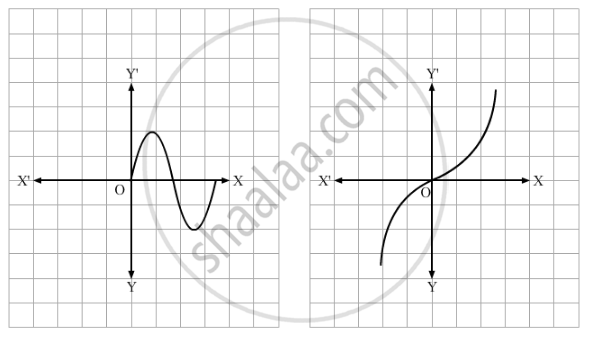
If A = {1, 2, 3} and B = {a, b}, write the total number of functions from A to B.
Write the total number of one-one functions from set A = {1, 2, 3, 4} to set B = {a, b, c}.
If f : R → R is defined by f(x) = 10 x − 7, then write f−1 (x).
Let f : R → R, g : R → R be two functions defined by f(x) = x2 + x + 1 and g(x) = 1 − x2. Write fog (−2).
Let f : R → R be defined as `f (x) = (2x - 3)/4.` write fo f-1 (1) .
Let A = {1, 2, 3, 4} and B = {a, b} be two sets. Write the total number of onto functions from A to B.
The function f : R → R defined by
`f (x) = 2^x + 2^(|x|)` is
Let M be the set of all 2 × 2 matrices with entries from the set R of real numbers. Then, the function f : M→ R defined by f(A) = |A| for every A ∈ M, is
Let
\[f : R - \left\{ n \right\} \to R\]
A function f from the set of natural numbers to the set of integers defined by
\[f\left( n \right)\begin{cases}\frac{n - 1}{2}, & \text{when n is odd} \\ - \frac{n}{2}, & \text{when n is even}\end{cases}\]
Which of the following functions from
\[A = \left\{ x \in R : - 1 \leq x \leq 1 \right\}\]
If \[F : [1, \infty ) \to [2, \infty )\] is given by
\[f\left( x \right) = x + \frac{1}{x}, then f^{- 1} \left( x \right)\]
Let
\[f : R \to R\] be given by \[f\left( x \right) = x^2 - 3\] Then, \[f^{- 1}\] is given by
Let R be the set of real numbers and f: R → R be the function defined by f(x) = 4x + 5. Show that f is invertible and find f–1.
Let N be the set of natural numbers and the function f: N → N be defined by f(n) = 2n + 3 ∀ n ∈ N. Then f is ______.
Let A = {0, 1} and N be the set of natural numbers. Then the mapping f: N → A defined by f(2n – 1) = 0, f(2n) = 1, ∀ n ∈ N, is onto.
The function f : R → R defined by f(x) = 3 – 4x is ____________.
Given a function If as f(x) = 5x + 4, x ∈ R. If g : R → R is inverse of function ‘f then
Let f: R → R defined by f(x) = x4. Choose the correct answer
Let [x] denote the greatest integer ≤ x, where x ∈ R. If the domain of the real valued function f(x) = `sqrt((|[x]| - 2)/(|[x]| - 3)` is (–∞, a) ∪ [b, c) ∪ [4, ∞), a < b < c, then the value of a + b + c is ______.
Number of integral values of x satisfying the inequality `(3/4)^(6x + 10 - x^2) < 27/64` is ______.
For x ∈ R, x ≠ 0, let f0(x) = `1/(1 - x)` and fn+1 (x) = f0(fn(x)), n = 0, 1, 2, .... Then the value of `f_100(3) + f_1(2/3) + f_2(3/2)` is equal to ______.
A function is onto when every element of the codomain has:
