Advertisements
Advertisements
प्रश्न
The centre of a circle is (2a, a – 7). Find the values of a if the circle passes through the point (11, – 9) and has diameter `10sqrt(2)` units.
Advertisements
उत्तर
By given condition,
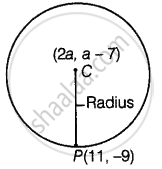
Distance between the centre C(2a, a – 7) and the point P(11, – 9), which lie on the circle = Radius of circle
∴ Radius of circle = `sqrt((11 - 2a)^2 + (-9 - a + 7)^2` ...(i) `[∵ "Distance between two points" (x_1, y_1) "and" (x_2, y_2) = sqrt((x_2 - x_1)^2 + (y_2 - y_1)^2)]`
Given that, length of diameter = `10sqrt(2)`
∴ Length of radius = `"Length of diameter"/2`
= `(10sqrt(2))/2`
= `5sqrt(2)`
Put this value in equation (i), we get
`5sqrt(2) = sqrt((11 - 2a)^2 + (-2 - a)^2`
Squaring on both sides, we get
50 = (11 – 2a)2 + (2 + a)2
⇒ 50 = 121 + 4a2 – 44a + 4 + a2 + 4a
⇒ 5a2 – 40a + 75 = 0
⇒ a2 – 8a + 15 = 0
⇒ a2 – 5a – 3a + 15 = 0 ...[By fractorisation method]
⇒ a(a – 5) – 3(a – 5) = 0
⇒ (a – 5)(a – 3) = 0
∴ a = 3, 5
Hence, the required values of a are 5 and 3.
APPEARS IN
संबंधित प्रश्न
If P and Q are two points whose coordinates are (at2 ,2at) and (a/t2 , 2a/t) respectively and S is the point (a, 0). Show that `\frac{1}{SP}+\frac{1}{SQ}` is independent of t.
Find the distance between the points (0, 0) and (36, 15). Can you now find the distance between the two towns A and B discussed in Section 7.2.
If Q (0, 1) is equidistant from P (5, − 3) and R (x, 6), find the values of x. Also find the distance QR and PR.
Prove that the points A(1, 7), B (4, 2), C(−1, −1) D (−4, 4) are the vertices of a square.
Find the value of y for which the distance between the points A (3, −1) and B (11, y) is 10 units.
The perimeter of a triangle with vertices (0, 4), (0, 0) and (3, 0) is ______.
Find the relation between x and y if the point M (x,y) is equidistant from R (0,9) and T (14 , 11).
A line segment of length 10 units has one end at A (-4 , 3). If the ordinate of te othyer end B is 9 , find the abscissa of this end.
Find the coordinates of O, the centre passing through A( -2, -3), B(-1, 0) and C(7, 6). Also, find its radius.
Prove that the points (1 , 1) , (-1 , -1) and (`- sqrt 3 , sqrt 3`) are the vertices of an equilateral triangle.
Prove that the points (5 , 3) , (1 , 2), (2 , -2) and (6 ,-1) are the vertices of a square.
ABCD is a square . If the coordinates of A and C are (5 , 4) and (-1 , 6) ; find the coordinates of B and D.
A point P (2, -1) is equidistant from the points (a, 7) and (-3, a). Find a.
The length of line PQ is 10 units and the co-ordinates of P are (2, -3); calculate the co-ordinates of point Q, if its abscissa is 10.
Calculate the distance between A (5, -3) and B on the y-axis whose ordinate is 9.
KM is a straight line of 13 units If K has the coordinate (2, 5) and M has the coordinates (x, – 7) find the possible value of x.
Show that the point (11, – 2) is equidistant from (4, – 3) and (6, 3)
The points A(–1, –2), B(4, 3), C(2, 5) and D(–3, 0) in that order form a rectangle.
Find the distance between the points O(0, 0) and P(3, 4).
