Advertisements
Advertisements
Question
The centre of a circle is (2a, a – 7). Find the values of a if the circle passes through the point (11, – 9) and has diameter `10sqrt(2)` units.
Advertisements
Solution
By given condition,
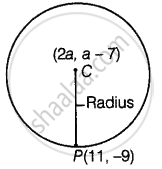
Distance between the centre C(2a, a – 7) and the point P(11, – 9), which lie on the circle = Radius of circle
∴ Radius of circle = `sqrt((11 - 2a)^2 + (-9 - a + 7)^2` ...(i) `[∵ "Distance between two points" (x_1, y_1) "and" (x_2, y_2) = sqrt((x_2 - x_1)^2 + (y_2 - y_1)^2)]`
Given that, length of diameter = `10sqrt(2)`
∴ Length of radius = `"Length of diameter"/2`
= `(10sqrt(2))/2`
= `5sqrt(2)`
Put this value in equation (i), we get
`5sqrt(2) = sqrt((11 - 2a)^2 + (-2 - a)^2`
Squaring on both sides, we get
50 = (11 – 2a)2 + (2 + a)2
⇒ 50 = 121 + 4a2 – 44a + 4 + a2 + 4a
⇒ 5a2 – 40a + 75 = 0
⇒ a2 – 8a + 15 = 0
⇒ a2 – 5a – 3a + 15 = 0 ...[By fractorisation method]
⇒ a(a – 5) – 3(a – 5) = 0
⇒ (a – 5)(a – 3) = 0
∴ a = 3, 5
Hence, the required values of a are 5 and 3.
APPEARS IN
RELATED QUESTIONS
If A(5, 2), B(2, −2) and C(−2, t) are the vertices of a right angled triangle with ∠B = 90°, then find the value of t.
If the point (x, y) is equidistant from the points (a + b, b – a) and (a – b, a + b), prove that bx = ay.
Find the distance between the following pair of points:
(-6, 7) and (-1, -5)
Find the distance between the points
A(-6,-4) and B(9,-12)
Using the distance formula, show that the given points are collinear:
(6, 9), (0, 1) and (-6, -7)
Find the distance between the following pair of points.
L(5, –8), M(–7, –3)
Determine whether the points are collinear.
L(–2, 3), M(1, –3), N(5, 4)
Find the value of y for which the distance between the points A (3, −1) and B (11, y) is 10 units.
Find the distance of the following point from the origin :
(8 , 15)
Find the relation between a and b if the point P(a ,b) is equidistant from A (6,-1) and B (5 , 8).
Prove that the points (4 , 6) , (- 1 , 5) , (- 2, 0) and (3 , 1) are the vertices of a rhombus.
Find the distance between the points (a, b) and (−a, −b).
What point on the x-axis is equidistant from the points (7, 6) and (-3, 4)?
Find a point on the y-axis which is equidistant from the points (5, 2) and (-4, 3).
Points A (-3, -2), B (-6, a), C (-3, -4) and D (0, -1) are the vertices of quadrilateral ABCD; find a if 'a' is negative and AB = CD.
The length of line PQ is 10 units and the co-ordinates of P are (2, -3); calculate the co-ordinates of point Q, if its abscissa is 10.
Find the distance of the following points from origin.
(5, 6)
The distance of the point P(–6, 8) from the origin is ______.
Name the type of triangle formed by the points A(–5, 6), B(–4, –2) and C(7, 5).
Find the value of a, if the distance between the points A(–3, –14) and B(a, –5) is 9 units.
