Advertisements
Advertisements
प्रश्न
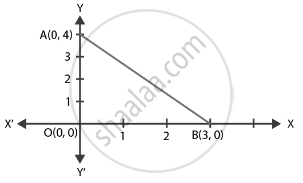
The perimeter of a triangle with vertices (0, 4), (0, 0) and (3, 0) is ______.
पर्याय
5 units
12 units
10 units
11 units
`7 + sqrt(5)` units
Advertisements
उत्तर
The perimeter of a triangle with vertices (0, 4), (0, 0) and (3, 0) is 12 units.
Explanation:
The vertices of a triangle are (0, 4), (0, 0) and (3, 0).
Now, perimeter of ΔAOB = Sum of the length of all its sides
= Distance between (OA + OB + AB)
Distance between the points (x1, y1) and (x2, y2) is given by,
d = `sqrt((x_2 - x_1)^2 + (y_2 - y_1)^2)`
To find:
Distance between A(0, 4) and O(0, 0) + Distance between O(0, 0) and B(3, 0) + Distance between A(0, 4) and B(3, 0)
= `sqrt((0 - 0)^2 + (0 - 4)^2) + sqrt((3 - 0)^2 + (0 - 0)^2) + sqrt((3 - 0)^2 + (0 - 4)^2)`
= `sqrt(0 + 16) + sqrt(9 + 0) + sqrt((3)^2 + (4)^2`
= `4 + 3 + sqrt(9 + 16)`
= `7 + sqrt(25)`
= 7 + 5
= 12
Therefore, the required perimeter of the triangle is 12.
संबंधित प्रश्न
Find the distance between the following pairs of points:
(−5, 7), (−1, 3)
Given a triangle ABC in which A = (4, −4), B = (0, 5) and C = (5, 10). A point P lies on BC such that BP : PC = 3 : 2. Find the length of line segment AP.
Find the distance between the points:
P(a + b, a - b) and Q(a - b, a + b)
Find the distance of the following points from the origin:
(i) A(5,- 12)
Find the distance of the following points from the origin:
(ii) B(-5,5)
Using the distance formula, show that the given points are collinear:
(-1, -1), (2, 3) and (8, 11)
Find the distance between the following pair of points.
R(0, -3), S(0, `5/2`)
Find the distances between the following point.
R(–3a, a), S(a, –2a)
Prove that the points (0,3) , (4,3) and `(2, 3+2sqrt 3)` are the vertices of an equilateral triangle.
Prove that the points (5 , 3) , (1 , 2), (2 , -2) and (6 ,-1) are the vertices of a square.
Prove that the points (0 , 0) , (3 , 2) , (7 , 7) and (4 , 5) are the vertices of a parallelogram.
Prove that the points (0 , -4) , (6 , 2) , (3 , 5) and (-3 , -1) are the vertices of a rectangle.
Find the distance between the points (a, b) and (−a, −b).
A point P (2, -1) is equidistant from the points (a, 7) and (-3, a). Find a.
Points A (-3, -2), B (-6, a), C (-3, -4) and D (0, -1) are the vertices of quadrilateral ABCD; find a if 'a' is negative and AB = CD.
The distances of point P (x, y) from the points A (1, - 3) and B (- 2, 2) are in the ratio 2: 3.
Show that: 5x2 + 5y2 - 34x + 70y + 58 = 0.
Show that the points (a, a), (-a, -a) and `(-asqrt(3), asqrt(3))` are the vertices of an equilateral triangle.
The distance of the point (α, β) from the origin is ______.
What type of a quadrilateral do the points A(2, –2), B(7, 3), C(11, –1) and D(6, –6) taken in that order, form?
|
In a GPS, The lines that run east-west are known as lines of latitude, and the lines running north-south are known as lines of longitude. The latitude and the longitude of a place are its coordinates and the distance formula is used to find the distance between two places. The distance between two parallel lines is approximately 150 km. A family from Uttar Pradesh planned a round trip from Lucknow (L) to Puri (P) via Bhuj (B) and Nashik (N) as shown in the given figure below.
|
Based on the above information answer the following questions using the coordinate geometry.
- Find the distance between Lucknow (L) to Bhuj (B).
- If Kota (K), internally divide the line segment joining Lucknow (L) to Bhuj (B) into 3 : 2 then find the coordinate of Kota (K).
- Name the type of triangle formed by the places Lucknow (L), Nashik (N) and Puri (P)
[OR]
Find a place (point) on the longitude (y-axis) which is equidistant from the points Lucknow (L) and Puri (P).

