Advertisements
Advertisements
प्रश्न
If the point A(x,2) is equidistant form the points B(8,-2) and C(2,-2) , find the value of x. Also, find the value of x . Also, find the length of AB.
Advertisements
उत्तर
As per the question
AB = AC
`⇒ sqrt((x-8)^2+(2+2)^2 ) = sqrt((x-2)^2 +(2+2)^2)`
Squaring both sides, we get
`(x-8)^2 +4^2 = (x - 2)^2 +4^2`
`⇒ x^2 -16x+64+16=x^2+4-4x+16`
`⇒ 16x-4x=64-4`
`⇒ x = 60/12=5`
Now,
`AB = sqrt((x-8)^2 +(2+2)^2)`
`= sqrt((5-8)^2 +(2+2)^2) (∵ x =2)`
`=sqrt((-3)^2 +(4)^2)`
`=sqrt(9+16) = sqrt(25)=5`
Hence, x = 5and AB = 5 units.
APPEARS IN
संबंधित प्रश्न
Show that the points (a, a), (–a, –a) and (– √3 a, √3 a) are the vertices of an equilateral triangle. Also find its area.
If P and Q are two points whose coordinates are (at2 ,2at) and (a/t2 , 2a/t) respectively and S is the point (a, 0). Show that `\frac{1}{SP}+\frac{1}{SQ}` is independent of t.
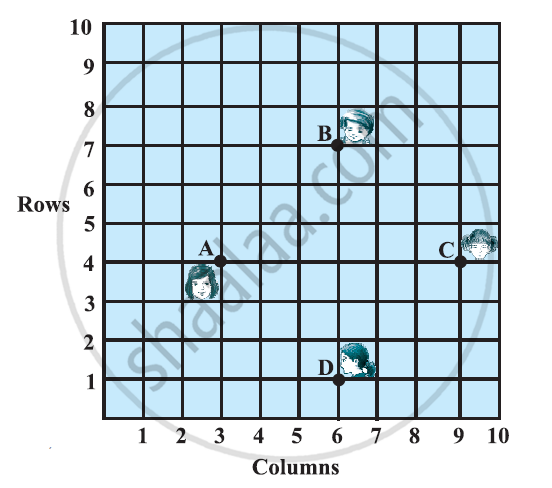
In a classroom, 4 friends are seated at the points A, B, C and D as shown in the following figure. Champa and Chameli walk into the class and after observing for a few minutes, Champa asks Chameli, “Don’t you think ABCD is a square?” Chameli disagrees.
Using distance formula, find which of them is correct.
Find a relation between x and y such that the point (x, y) is equidistant from the point (3, 6) and (−3, 4).
Given a triangle ABC in which A = (4, −4), B = (0, 5) and C = (5, 10). A point P lies on BC such that BP : PC = 3 : 2. Find the length of line segment AP.
Find the distance of a point (7 , 5) from another point on the x - axis whose abscissa is -5.
Find the distance of a point (12 , 5) from another point on the line x = 0 whose ordinate is 9.
Prove taht the points (-2 , 1) , (-1 , 4) and (0 , 3) are the vertices of a right - angled triangle.
Prove that the points (5 , 3) , (1 , 2), (2 , -2) and (6 ,-1) are the vertices of a square.
Find the distance between the origin and the point:
(-8, 6)
What point on the x-axis is equidistant from the points (7, 6) and (-3, 4)?
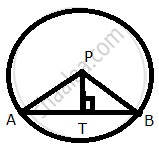
Point P (2, -7) is the centre of a circle with radius 13 unit, PT is perpendicular to chord AB and T = (-2, -4); calculate the length of AB.
KM is a straight line of 13 units If K has the coordinate (2, 5) and M has the coordinates (x, – 7) find the possible value of x.
The distance between points P(–1, 1) and Q(5, –7) is ______.
Show that P(–2, 2), Q(2, 2) and R(2, 7) are vertices of a right angled triangle.
Using distance formula decide whether the points (4, 3), (5, 1) and (1, 9) are collinear or not.
What type of a quadrilateral do the points A(2, –2), B(7, 3), C(11, –1) and D(6, –6) taken in that order, form?
Read the following passage:
|
Alia and Shagun are friends living on the same street in Patel Nagar. Shagun's house is at the intersection of one street with another street on which there is a library. They both study in the same school and that is not far from Shagun's house. Suppose the school is situated at the point O, i.e., the origin, Alia's house is at A. Shagun's house is at B and library is at C. |
Based on the above information, answer the following questions.
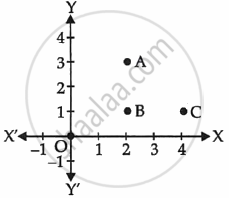
- How far is Alia's house from Shagun's house?
- How far is the library from Shagun's house?
- Show that for Shagun, school is farther compared to Alia's house and library.
OR
Show that Alia’s house, shagun’s house and library for an isosceles right triangle.
The distance of the point (5, 0) from the origin is ______.
