Advertisements
Advertisements
प्रश्न
Mention the factors that affect the rate of a chemical reaction.
Advertisements
उत्तर
(i) Nature of the reactant: The rate of reaction depends on the nature of the reactant. For example, ionic molecules react more quickly than covalent ones.
(ii) State of reactants: Solid reactions are slower, liquid reactions are faster, and gas reactions are very quick.
(iii) Temperature: The rate of reaction is mainly affected by temperature. Every 10°C rise in temperature increases the reaction rate by 2-3 times.
`(r_(t + 10))/r_t` = 2 − 3
This ratio is called the temperature coefficient.
There are two reasons why the reaction rate increases with temperature.
- Increasing temperature raises the average kinetic energy of reactant molecules, increasing the rate of collisions.
- As the temperature rises, the number of molecules with threshold energy increases, resulting in more active molecules. As a result, the number of effective collisions grows. As a result, the reaction rate increases.
(iv) Concentration: The rate of reaction depends on the concentration of reactants.
Rate = k × Cn
Where,
n = order of reaction
C = concentration of reactant
(v) Catalyst: The presence of a catalyst changes the rate of the reaction. It lowers the activation energy by producing a chemical intermediate, lowering the potential energy barrier. Thus, the reaction rate increases.
APPEARS IN
संबंधित प्रश्न
In a first order reaction x → y, 40% of the given sample of compound remains unreacted in 45 minutes. Calculate rate constant of the reaction.
Write molecularity of the following reaction:
2NO(g)+O2(g)→2NO2(g)
From the rate expression for the following reaction, determine the order of reaction and the dimension of the rate constant.
\[\ce{CH3CHO_{(g)} -> CH4_{(g)} + CO_{(g)}}\] Rate = k[CH3CHO]3/2
A reaction is second order with respect to a reactant. How is the rate of reaction affected if the concentration of the reactant is doubled?
A reaction is first order in A and second order in B. Write the differential rate equation.
Define the following terms:
Half-life period of reaction (t1/2).
Match the graph given in Column I with the order of reaction given in Column II. More than one item in Column I may link to the same item of Column II.
| Column I | Column II | |
| (i) | 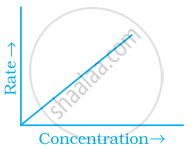 |
|
| (ii) | 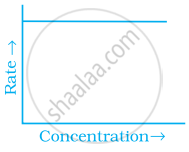 |
(a) 1st order |
| (iii) | 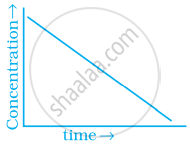 |
(b) Zero-order |
| (iv) | 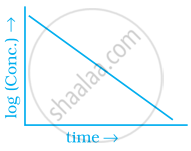 |
Assertion: Order and molecularity are same.
Reason: Order is determined experimentally and molecularity is the sum of the stoichiometric coefficient of rate determining elementary step.
Assertion: Rate constants determined from Arrhenius equation are fairly accurate for simple as well as complex molecules.
Reason: Reactant molecules undergo chemical change irrespective of their orientation during collision.
A catalyst in a reaction changes which of the following?
For a reaction R → p the concentration of reactant change from 0.03 m to 0.02 m in minute, calculate the average rate of the reaction using the unit of second.
The rate constant for the reaction \[\ce{2H2O5 -> 4NO2 + O2}\] is 30 × 10–5 sec–1. if the rate is 204 × 10–5 mol L–1 S–1, then the concentration of N2O5 (in mol–1) is-
The rate of a chemical reaction double for every 10° rise in temperature. If the temperature is raised. by 50°C, the rate of relation by about:-
For a reaction 1/2 A ⇒ 2B, rate of disappearance of A is related 't o the appearance of B by the expression:
For reaction 2A + B → BC + D which of the following does not Express the reaction rates
The half-life period of a. substance in a certain enzyme catalysed reaction is 138 s. The time required for the concentration of the substance to fall from 1.28 mol–1 to 0.04 mg L–1 is
On heating compound (A) gives a gas (B) which is constituent of air. The gas when treated with H2 in the presence of catalyst gives another gas (C) which is basic in nature, (A) should not be ______.
A drop of solution (volume 0.05 ml) contains 3.0 × 10⁻⁶ mole of H+. If the rate constant of disappearance of H+ is 1.0 × 10⁷ mole l-1s-1. It would take for H+ in drop to disappear in ______ × 10-9s.
