Advertisements
Advertisements
प्रश्न
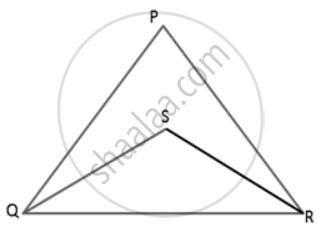
In ΔPQR is a triangle and S is any point in its interior. Prove that SQ + SR < PQ + PR.
Advertisements
उत्तर
In ΔPQR,
PQ + PR > QR ....(∵ Sum of two sides of a triangle is always greater than the third side.) ....(i)
Also, in ΔSQR,
SQ + SR > QR ....(∵ Sum of two sides of a triangle is always greater than the third side.) ....(ii)
Dividing (i) by (ii),
`"PQ + PR"/"SQ + SR" > "QR"/"QR"`
`"PQ + PR"/"SQ + SR" > 1`
PQ + PR > SQ + SR
i.e. SQ + SR < PQ + PR.
APPEARS IN
संबंधित प्रश्न
Show that in a right angled triangle, the hypotenuse is the longest side.
Complete the hexagonal and star shaped rangolies (see the given figures) by filling them with as many equilateral triangles of side 1 cm as you can. Count the number of triangles in each case. Which has more triangles?

In the following figure, write BC, AC, and CD in ascending order of their lengths.
In the following figure, ∠BAC = 60o and ∠ABC = 65o.

Prove that:
(i) CF > AF
(ii) DC > DF
“Caste inequalities are still prevalent in India.” Examine the statement.
Name the smallest angle in each of these triangles:
In ΔXYZ, XY = 6.2cm, XY = 6.8cm and YZ = 5cm
In a triangle ABC, BC = AC and ∠ A = 35°. Which is the smallest side of the triangle?
ΔABC is isosceles with AB = AC. If BC is extended to D, then prove that AD > AB.
ABCD is a trapezium. Prove that:
CD + DA + AB + BC > 2AC.
Prove that in an isosceles triangle any of its equal sides is greater than the straight line joining the vertex to any point on the base of the triangle.
