Advertisements
Advertisements
प्रश्न
Explain the reactions involved in the preparation of viscose rayon.
Advertisements
उत्तर
- Viscose rayon is a semisynthetic fibre which is regenerated cellulose.
- Cellulose in the form of wood pulp is transformed into viscose rayon. Cellulose is a linear polymer of glucose units and has the molecular formula [(C6H10O5)n]. A modified representation of the molecular formula of cellulose is Cell-OH.
- Method of preparation:
a. Cellulose in the form of wood pulp is treated with concentrated NaOH solution to get fluffy alkali cellulose.
b. It is then converted to xanthate by treating with carbon disulphide.
c. On mixing with dilute NaOH, it gives viscose solution which is extruded through spinnerets of the spinning machine into the acid bath when regenerated cellulose fibres precipitate. - Reactions involved in the preparation of viscose rayon:
\[\ce{\underset{\text{(Cellulose pulp wood)}}{Cell - OH + NaOH} -> \underset{\text{(Akali cellulose)}}{Cell - O- Na+} + H2O}\]
\[\begin{array}{cc}
\ce{Cell - O- Na+ + CS2 ->Cell - O - C - S- Na+}\\
\phantom{............................}||\\
\phantom{............................}\ce{\underset{\text{(Cellulose xanthate)}}{S}}
\end{array}\]
\[\begin{array}{cc}
\ce{Cell - O - C - S- Na+ + H2O -> Cell - O - C - SH + NaOH}\\
\phantom{..}||\phantom{..................................}||\phantom{.....}\\
\phantom{..}\ce{S}\phantom{..................................}\ce{S}\phantom{.....}
\end{array}\]
\[\begin{array}{cc}
\ce{Cell - O - C - SH + H2O -> \underset{\text{(Viscose rayon) (Regenerated cellulose filaments)}}{Cell - OH + CS2}}\\
||\phantom{.........................................}\\
\ce{S}\phantom{.........................................}
\end{array}\]
संबंधित प्रश्न
Write the reactions involved in the preparation of PVC
Write the chemical reaction to prepare novolac polymer.
The Zieglar-Natta catalyst is used in the preparation of _______.
(A) LDPE
(B) PHBV
(C) PAN
(D) HDPE
Write the structures of the monomers used for getting the following polymers
Melamine – formaldehyde polymer
Write the monomers of the following polymer :
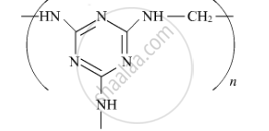
Choose the correct option from the given alternatives.
Which of the following is made up of polyamides?
Answer the following in one sentence.
Identify thermoplastic and thermosetting plastic from the following:
- PET
- Urea formaldehyde resin
- Polythene
- Phenol formaldehyde resin
Answer the following.
Write structure of natural rubber and neoprene rubber along with the name and structure of their monomers.
Answer the following.
Match the following pairs:
| Name of polymer | Monomer |
| 1. Teflon | a. CH2 = CH2 |
| 2. PVC | b. CF2 = CF2 |
| 3. Polyester | c. CH2 = CHCl |
| 4. Polythene | d. C6H5OH and HCHO |
| 5. Bakelite | e. Dicarboxylic acid and polyhydoxyglycol |
Answer the following.
Draw the structures of polymers formed from the following monomers
H2N–(CH2)5 – COOH
Name and draw structure of the repeating unit in natural rubber.
Identify condensation polymers and addition polymers from the following.
\[\begin{array}{cc}\ce{-(CH2 - CH -)_{n}}\\
\phantom{....}|\\\ce{\phantom{.......}C6H5}
\end{array}\]
Identify condensation polymers and addition polymers from the following.

Write the reaction involved in the formation of bakelite.
Write preparation, properties, and uses of Teflon.
Monomers ethylene glycol and terephthalic acid undergo condensation polymerization to give polymer called ___________
Write chemical reactions for the preparation of high-density polythene.
Write two uses and two properties of polythene.
The following structure represents the polymer:
\[\begin{array}{cc}
\ce{[-C-CH2-NH-C-(-CH2)5 NH -]_{{n}}}\\
\phantom{}||\phantom{.............}||\phantom{................}\\
\phantom{}\ce{O}\phantom{.............}\ce{O}\phantom{................}
\end{array}\]
How many isoprene units are present in abscisic acid?
Identify the CORRECT statement regarding the following polymer.
\[\begin{array}{cc}
\phantom{....}\ce{O}\phantom{............}\ce{O}\phantom{...................}\ce{H}\phantom{.....}\\
\phantom{....}||\phantom{.............}||\phantom{...................}|\phantom{......}\\
\ce{-[C - (CH2)4 - C - NH - (CH2)6 - N -]_{{n}}}
\end{array}\]
The INCORRECT match for the polymer with its application is:
Identify the INCORRECT match.
Which of the following is the monomer of neoprene?
Which of the following polymers is a heteropolymer?
Which among the following polymers can NOT be remoulded?
Which of the following compounds is used to prepare orlon?
Which among the following polymers is obtained from CH2 = CH – CN by polymerisation?
Which among the following catalysts is used in the preparation of dacron?
Identify the monomers used in the preparation of Novolac.
Identify the catalyst used in the manufacture of high density polythene.
Which of the following pair of compounds is used as monomers for bakelite?
Which among the following polymers is used to manufacture chemical containers?
Match the polymers given in Column I with the type of linkage present in them given in Column II.
| Column I | Column II |
| (i) Terylene | (a) Glycosidic linkage |
| (ii) Nylon | (b) Ester linkage |
| (iii) Cellulose | (c) Phosphodiester linkage |
| (iv) Protein | (d) Amide linkage |
| v) RNA |
Which of the following products is formed when benzaldehyde is treated with CH3MgBr and the addition product so obtained is subjected to acid hydrolysis?
Which of the following polymer has ester linkage?
Trans - form of poly isoprene is:-
Polymer used in bullet proof glass is ______.
Which of the following polymers do not involve cross linkages?
Which of the following polymer is used for manufacturing of buckets, dustbins, pipes, etc?
Which among the following polymers has high tensile strength and is used to obtain tyre cords?
Identify the monomer used to prepare neoprene.
Answer the following.
Name and draw structure of the repeating unit in natural rubber.
Answer the following.
Write the structure of isoprene and the polymer obtained from it.
Name and draw the structure of the repeating unit in natural rubber.
Name the compound which reacts with formaldehyde to produce ethyl alcohol.
Write the preparation of viscose rayon.
Write the name of the monomer of natural rubber.
Write the structure of isoprene and the polymer obtained from it.
Name and draw structure of the repeating unit in natural rubber.
Name and draw structure of the repeating unit in natural rubber.
Name and draw structure of the repeating unit in natural rubber.
