Advertisements
Advertisements
प्रश्न
Draw figure to show the splitting of d orbitals in an octahedral crystal field.
Advertisements
उत्तर
- Let the six ligands approach the central metal ion symmetrically along the Cartesian axes (x, y, z), with the metal ion positioned at the origin.
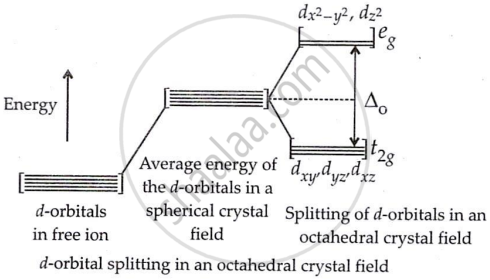
- As the ligands approach, there is an initial elevation in the energy of d-orbitals compared to that of the free ion, analogous to the behaviour observed in a spherical field.
- The (`d_(z^2)` and `d_(x^2 - y^2)`) orbitals point directly along the axes (in the direction of the approaching ligands). They experience stronger repulsion and are raised in energy. The dxy, dyz and dzx orbitals point between the axes. They experience less repulsion and remain lower in energy.
- In a spherical field, no splitting happens at all. All five d-orbitals remain completely equal in energy (degenerate). The splitting into higher- and lower-energy groups happens only because of the octahedral crystal field.
- Therefore, the degenerate set of d-orbitals splits into two groups: the low energy orbital group t2g and the high energy orbital group eg separated by energy Δo.
APPEARS IN
संबंधित प्रश्न
Why are low spin tetrahedral complexes rarely observed?
The colour of the coordination compounds depends on the crystal field splitting. What will be the correct order of absorption of wavelength of light in the visible region, for the complexes, \[\ce{[Co(NH3)6]^{3+}}\], \[\ce{[Co(CN)6]^{3-}}\], \[\ce{[Co(H2O)6]^{3+}}\]
The CFSE for octahedral \[\ce{[CoCl6]^{4-}}\] is 18,000 cm–1. The CFSE for tetrahedral \[\ce{[CoCl4]^{2-}}\] will be ______.
Atomic number of \[\ce{Mn}\], \[\ce{Fe}\] and \[\ce{Co}\] are 25, 26 and 27 respectively. Which of the following inner orbital octahedral complex ions are diamagnetic?
(i) \[\ce{[Co(NH3)6]^{3+}}\]
(ii) \[\ce{[Mn(CN)6]^{3-}}\]
(iii) \[\ce{[Fe(CN)6]^{4-}}\]
(iv) \[\ce{[Fe(CN)6]^{3-}}\]
An aqueous pink solution of cobalt (II) chloride changes to deep blue on addition of excess of HCl. This is because:
(i) \[\ce{[Co(H2O)6]^{2+}}\] is transformed into \[\ce{[CoCl6]}^{4-}\]
(ii) \[\ce{[Co(H2O)6]^{2+}}\] is transformed into \[\ce{[CoCl4]}^{2-}\]
(iii) tetrahedral complexes have smaller crystal field splitting than octahedral complexes.
(iv) tetrahedral complexes have larger crystal field splitting than octahedral complex.
On the basis of crystal field theory explain why Co(III) forms paramagnetic octahedral complex with weak field ligands whereas it forms diamagnetic octahedral complex with strong field ligands.
Match the complex ions given in Column I with the hybridisation and number of unpaired electrons given in Column II and assign the correct code:
| Column I (Complex ion) | Column II (Hybridisation, number of unpaired electrons) |
| A. \[\ce{[Cr(H2O)6]^{3+}}\] | 1. dsp2, 1 |
| B. \[\ce{[Co(CN)4]^{2-}}\] | 2. sp3d2, 5 |
| C. \[\ce{[Ni(NH3)6]^{2+}}\] | 3. d2sp3, 3 |
| D. \[\ce{[MnF6]^{4-}}\] | 4. sp3, 4 |
| 5. sp3d2, 2 |
Using crystal field theory, draw energy level diagram, write electronic configuration of the central metal atom/ion and determine the magnetic moment value in the following:
\[\ce{[CoF6]^{3-}, [Co(H2O)6]^{2+}, [Co(Cn)6]^{3-}}\]
The CFSE for octahedral [CoCl6]−4 is 18,000 cm−1. What will be the CFSE for tetrahedral [CoCl3]−2?
[Ni(H2O)6]2+ (aq) is green in colour whereas [Ni(H2O)4 (en)]2+ (aq)is blue in colour, give reason in support of your answer.
In a coordination entity, the electronic configuration of the central metal ion is t2g3 eg1
Draw the crystal field splitting diagram for the above complex.
Crystal field stabilising energy for high spind4 octahedral complex is:-
Using crystal field theory, write the electronic configuration of d5 ion, if Δ0 > P.
What is the difference between a weak field ligand and a strong field ligand?
The complex that has highest crystal field splitting energy (Δ) is ______.
On the basis of crystal field theory, write the electronic configuration for d4 with a strong field ligand for which Δ0 > P.
The correct order of the wavelength of light absorbed by the following complexes is:
- [Co(NH3)6]3+
- [Co(CN)6]3−
- [Cu(H2O)4]2+
- [Ti(H2O)6]3+
Choose the correct answer from the options given below:
