Advertisements
Advertisements
प्रश्न
Atomic number of \[\ce{Mn}\], \[\ce{Fe}\] and \[\ce{Co}\] are 25, 26 and 27 respectively. Which of the following inner orbital octahedral complex ions are diamagnetic?
(i) \[\ce{[Co(NH3)6]^{3+}}\]
(ii) \[\ce{[Mn(CN)6]^{3-}}\]
(iii) \[\ce{[Fe(CN)6]^{4-}}\]
(iv) \[\ce{[Fe(CN)6]^{3-}}\]
Advertisements
उत्तर
(i) \[\ce{[Co(NH3)6]^{3+}}\]
(iii) \[\ce{[Fe(CN)6]^{4-}}\]
Explanation:
(i) Molecular orbital electronic configuration of \[\ce{Co^{3+}}\] in \[\ce{[Co(NH3)6]^{3+}}\] is
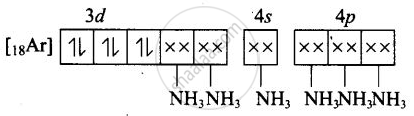
Number of unpaired electron = 0
Magnetic property = Diamagnetic
(ii) Molecular orbital electronic configuration of \[\ce{Mn^{3+}}\] in \[\ce{[Mn(CN)6]^{3-}}\]
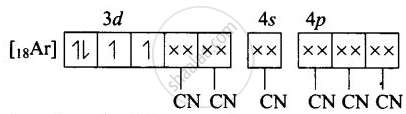
Number of unpaired electron = 2
Magnetic property = Paramagnetic
(iii) Molecular orbital electronic configuration of \[\ce{Fe^{3+}}\] in \[\ce{[Fe(CN)6]^{4-}}\] is
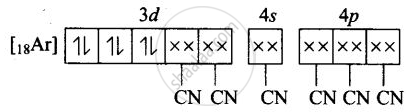
Number of unpaired electron = 0
Magnetic property = Diamagnetic
(iv) Molecular orbital electronic configuration of \[\ce{Fe^{3+}}\] in \[\ce{[Fe(CN)6]^{3-}}\]
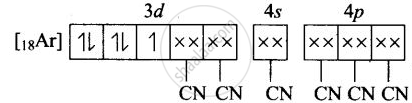
Number of unpaired electron = 1
Magnetic property = Paramagnetic
APPEARS IN
संबंधित प्रश्न
On the basis of crystal field theory, write the electronic configuration for d4 ion if ∆0 < P.
Why are low spin tetrahedral complexes rarely observed?
Write the electronic configuration of Fe(III) on the basis of crystal field theory when it forms an octahedral complex in the presence of (i) strong field, and (ii) weak field ligand. (Atomic no.of Fe=26)
Complete and balance the following reactions:
\[\ce{P4 + H2SO4 ->}\] ______ + ______ + ______
Atomic number of \[\ce{Mn, Fe, Co}\] and Ni are 25, 26, 27 and 28 respectively. Which of the following outer orbital octahedral complexes have same number of unpaired electrons?
(i) \[\ce{[MnCl6]^{3-}}\]
(ii) \[\ce{[FeF6]^{3-}}\]
(iii) \[\ce{[CoF6]^{3-}}\]
(iv) \[\ce{[Ni(NH3)6]^{2+}}\]
An aqueous pink solution of cobalt (II) chloride changes to deep blue on addition of excess of HCl. This is because:
(i) \[\ce{[Co(H2O)6]^{2+}}\] is transformed into \[\ce{[CoCl6]}^{4-}\]
(ii) \[\ce{[Co(H2O)6]^{2+}}\] is transformed into \[\ce{[CoCl4]}^{2-}\]
(iii) tetrahedral complexes have smaller crystal field splitting than octahedral complexes.
(iv) tetrahedral complexes have larger crystal field splitting than octahedral complex.
Why are low spin tetrahedral complexes not formed?
Give the electronic configuration of the following complexes on the basis of Crystal Field Splitting theory.
\[\ce{[CoF6]^{3-}, [Fe(CN)6]^{4-} and [Cu(NH3)6]^{2+}}\].
\[\ce{CuSO4 . 5H2O}\] is blue in colour while \[\ce{CuSO4}\] is colourless. Why?
In a coordination entity, the electronic configuration of the central metal ion is t2g3 eg1
Draw the crystal field splitting diagram for the above complex.
The CFSE of [CoCl6]3– is 18000 cm–1 the CFSE for [CoCl4]– will be ______.
The correct order of intensity of colors of the compounds is ______.
On the basis of Crystal Field theory, write the electronic configuration for the d5 ion with a strong field ligand for which Δ0 > P.
The correct order of the wavelength of light absorbed by the following complexes is:
- [Co(NH3)6]3+
- [Co(CN)6]3−
- [Cu(H2O)4]2+
- [Ti(H2O)6]3+
Choose the correct answer from the options given below:
