Advertisements
Advertisements
प्रश्न
Does father lose hope?
Advertisements
उत्तर
No, father doesn’t lose hope because he had confidence in his skill of climbing up a tree.
संबंधित प्रश्न
Discuss in group and answer the following question in two or three paragraphs (100
−150 words)
Of the three, Jerome, George and Harris, who do you think is the best or worst packer?
Support your answer with details from the text.
Has Lushkoff become a beggar by circumstance or by choice?
Answer the following question in one or two sentences.
Had Abdul Kalam earned any money before that? In what way?
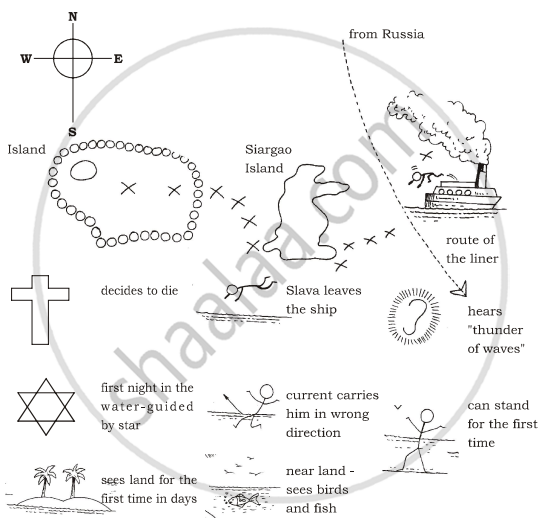
Given below is a map of the area in which Slava Kurilov faced his ordeal. You will also see the major events in the story, in mixed order, each accompanied by a symbol. After you have read ‘Ordeal in the Ocean’, draw the appropriate symbol against each x mark. (One is already drawn for you.) Draw the symbols or number the symbols, and transfer them to the map.)
At Denver there was an influx of passengers into the coaches on the eastbound B. & M. express. In one coach there sat a very pretty young woman dressed in elegant taste and surrounded by all the luxurious comforts of an experienced traveler. Among the newcomers were two young men, one of handsome presence with a bold, frank countenance and manner; the other a ruffled, glum-faced person, heavily built and roughly dressed. The two were handcuffed together.
As they passed down the aisle of the coach the only vacant seat offered was a reversed one facing the attractive young woman. Here the linked couple seated themselves. The young woman’s glance fell upon them with a distant, swift disinterest; then with a lovely smile brightening her countenance and a tender pink tingeing her rounded cheeks, she held out a little gray-gloved hand. When she spoke her voice, full, sweet, and deliberate, proclaimed that its owner was accustomed to speak and be heard.
“Well, Mr. Easton, if you will make me speak first, 1 suppose 1 must. Don’t vou ever recognize old friends when you meet them in the West?”
The younger man roused himself sharply at the sound of her voice, seemed to struggle with a slight embarrassment which he threw off instantly, and then clasped her fingers with his left hand.
He slightly raised his right hand, bound at the wrist by the shining “bracelet” to the left one of his companion.
Read the extract given below and answer the question that follow.
What was the reaction of the young women to them initially? Why did her manner change?
This woman had been despised, scoffed at, and angrily denounced by nearly every man, woman, and child in the village; but now, as the fact of, her death was passed from lip to lip, in subdued tones, pity took the place of anger, and sorrow of denunciation.
Neighbours went hastily to the old tumble-down hut, in which she had secured little more than a place of shelter from summer heats and winter cold: some with grave-clothes for a decent interment of the body; and some with food for the half-starving children, three in number. Of these, John, the oldest, a boy of twelve, was a stout lad, able to earn his living with any farmer. Kate, between ten and eleven, was bright, active girl, out of whom something clever might be made, if in good hands; but poor little Maggie, the youngest, was hopelessly diseased. Two years before a fall from a window had injured her spine, and she had not been able to leave her bed since, except when lifted in the arms of her mother.
“What is to be done with the children?” That was the chief question now. The dead mother would go underground, and be forever beyond all care or concern of the villagers. But the children must not be left to starve.
Read the extract given below and answer the question that follow.
Why did the neighbour’s attitude change when they heard the news of her death?
Mrs. Thompson did not reply, but presently turned towards the little chamber where her husband had deposited Maggie; and, pushing open the door, went quietly in. Joe did not follow; he saw that, her state had changed, and felt that it would be best to leave her alone with the child. So he went to his shop, which stood near the house, and worked until dusky evening released him from labor. A light shining through the little chamber windows was the first object that attracted Joe’s attention on turning towards the house: it was a good omen. The path led him by this windows and, when opposite, he could not help pausing to look in. It was now dark enough outside to screen him from observation. Maggie lay, a little raised on the pillow with the lamp shining full upon her face. Mrs. Thompson was sitting by the bed, talking to the child; but her back was towards the window, so that her countenance was not seen. From Maggie’s face, therefore, Joe must read the character of their intercourse. He saw that her eyes were intently fixed upon his wife; that now and then a few words came, as if in answers from her lips; that her expression was sad and tender; but he saw nothing of bitterness or pain. A deep-drawn breath was followed by one of relief, as a weight lifted itself from his heart.
Read the extract given below and answer the question that follow.
Why was Joe relieved?
From the day, perhaps a hundred years ago when he sun had hatched him in a sandbank, and he had broken his shell, and got his head out and looked around, ready to snap at anything, before he was even fully hatched-from that day, when he had at once made for the water, ready to fend for himself immediately, he had lived by his brainless craft and ferocity. Escaping the birds of prey and the great carnivorous fishes that eat baby crocodiles, he has prospered, catching all the food he needed, and storing it till putrid in holes in the bank. Tepid water to live in and plenty of rotted food grew him to his great length. Now nothing could pierce the inch-?thick armoured hide. Not even rifle bullets,
which would bounce off. Only the eyes and the soft underarms offered a place. He lived well in the river, sunning himself sometimes with other crocodiles-muggers, as well as the long-? snouted fish-?eating gharials-on warm rocks and sandbanks where the sun dried the clay on them quite white, and where they could plop off into the water in a moment if alarmed. The big crocodile fed mostly on fish, but also on deer and monkeys come to drink, perhaps a duck or two.
Read the extract given below and answer the question that follow.
How did he survive as a baby crocodile from the day he was hatched.
Match items in List A with their meanings in List B.
Use any three of the above words in sentences of your own. You may change the form of the word
A B
wounded got up from sleep
awoke give back
forgive small patches of ground for plants
faithful severely injured
pity pardon
beds loyal
return feel sorry for
What was the king’s reaction when he came to know that he had lost the challenge?
Why did the lady chain the bear on Sundays?
To what use a mother puts the trees?
Why does the poet say, “I hope it doesn’t matter”?
What does mother Warn him?
Use the clues given below to complete this crossword puzzle.
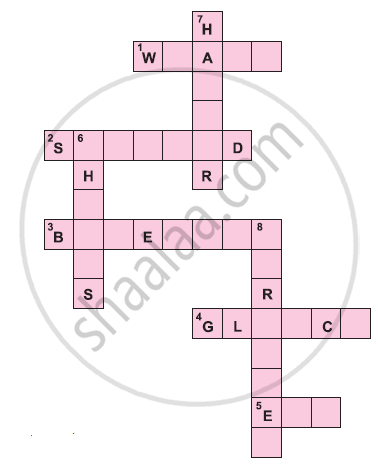
Across
1. very tired
2. had an angry look on the face
3. short trousers
4. a fault in a machine that prevents it from working properly
5. a small and naughty boy-fairy
Down
6. work that must be done every day, often boring
7. a basket with a lid
8. gave a short, high-pitched cry
Word in the box given below indicates a large number of… For example, ‘a herd of cows’ refers to many cows. Complete the following phrase with a suitable word from the box.
a ________________ of sheep
Multiple Choice Question:
The word ‘stucco’ means the same as ________
Answer the following question.
Which of the following sums up the story best?
(i) “I also know that you will not kill your conscience for the sake of friendship.”
(ii) “Let no one deviate from the path of justice and truth for friendship or enmity.”
(iii) “The voice of the Panch is the voice of God.” Give a reason for your choice.
The words helper, companion, partner and accomplice have very similar meanings, but each word is typically used in certain phrases. Can you fill in the blanks below with the most commonly used words? A dictionary may help you.
tennis / golf / bridge …………….
Referring closely to the short story, The Sound Machine, give specific instances to show how Klausner was obsessed with sound.
