Advertisements
Advertisements
प्रश्न
Thinking about Language
Here are some sentences from the text. Say which of them tell you, that the author:
(a) was afraid of the snake, (b) was proud of his appearance, (c) had a sense of humour,
(d) was no longer afraid of the snake.
1. I was turned to stone.
2. I was no mere image cut in granite.
3. The arm was beginning to be drained of strength.
4. I tried in my imagination to write in bright letters outside my little heart the words, ‘O
God’.
5. I didn’t tremble. I didn’t cry out.
6. I looked into the mirror and smiled. It was an attractive smile.
7. I was suddenly a man of flesh and blood.
8. I was after all a bachelor, and a doctor too on top of it!
9. The fellow had such a sense of cleanliness…! The rascal could have taken it and used it
after washing it with soap and water.
10. Was it trying to make an important decision about growing a moustache or using eye
shadow and mascara or wearing a vermilion spot on its forehead?
Advertisements
उत्तर
| (a) was afraid of the snake | (b) was proud of his appearance | (c) had a sense of humour | (d) was no longer afraid of the snake | |
| 1 | I was turned to stone. |
|||
| 2 | I was no mere image cut in granite. | |||
| 3 | The arm was beginning to be drained of strength. |
|||
| 4 | I tried in my imagination to write in bright letters outside my little heart the words, ‘O God’. |
I tried in my imagination to write in bright letters outside my little heart the words, ‘O God’. | ||
| 5 | I didn’t tremble. I didn’t cry out. |
|||
| 6 | I looked into the mirror and smiled. It was an attractive smile. |
|||
| 7 | I was suddenly a man of flesh and blood. | |||
| 8 | I was after all a bachelor, and a doctor too on top of it! |
|||
| 9 | The fellow had such a sense of cleanliness…! The rascal could have taken it and used it after washing it with soap and water. |
|||
| 10 | Was it trying to make an important decision about growing a moustache or using eye shadow and mascara or wearing a vermilion spot on its forehead. |
संबंधित प्रश्न
Thinking about the Text
Answer these question.
What is Gerrard’s profession? Quote the parts of the play that support your answer.
Thinking about the poem
What do you think the last two lines of the poem mean? (Looking back, does the poet regret his choice or accept it?)
Now rewrite the pair of sentences given below as one sentence.
I never thought of quitting. I knew what I wanted.
Notices
Read the following captions
. Change them into active (voice) and explain their meaning.
e.g. All credit cards accepted.
We accept credit cards.
Meaning: The organization accepts credit cards from customers for all their transactions.
1. Domestic help required
_______________________________________
2. All types of computer servicing undertaken.
_______________________________________
3. Using cell phones is not allowed (University Campus)
_______________________________________
4. Spoken English classes conducted.
_______________________________________
5. All Recharge Coupons sold here.
_______________________________________
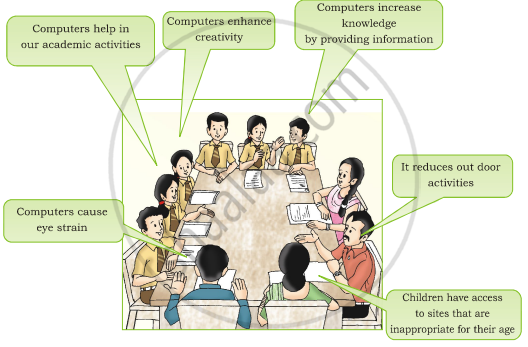
This is a meeting of the school’s Parent-Teacher Association. Some student representatives have also been invited to participate to discuss the role that Information technology/computers play in the growth and development of children.
What does he plant who plants a tree?
He plants cool shade and tender rain,
And seed and bud of days to be,
And years that fade and flush again;
He plants the glory of the plain;
He plants the forest's heritage;
The harvest of a coming age;
The joy that unborn eyes shall see___
These things he plants who plants a tree.
Read the lines given above and answer the question that follow:
List two phrases which refer to the future.
Some are like fields of sunlit corn,
Meet for a bride on her bridal morn,
Some, like the flame of her marriage fire,
Or, rich with the hue of her heart's desire,
Tinkling,luminous,tender, and clear,
Like her bridal laughter and bridal tear.
Read the lines given above and answer the question that follow.
The poet has used several expressions which form pictures in the readers mind “fields of sunlit corn” and “circles of light”. Pick out more such expressions from the poem.
Easton, with a little laugh, as if amused, was about to speak again when the other forestalled him. The glum-faced man had been watching the girl’s countenance with veiled glances from his keen, shrewd eyes.
“You’ll excuse me for speaking, miss, but, I see you’re acquainted with the marshall here. If you’ll ask him to speak a word for me when we get to the pen he’ll do it, and it’ll make things easier for me there. He’s taking me to Leavenworth prison. It’s seven years for counterfeiting.”
“Oh!” said the girl, with a deep breath and returning color. “So that is what you are doing out here? A marshal!”
“My dear Miss Fairchild,” said Easton, calmly, “I had to do something. Money has a way of taking wings unto itself, and you know it takes money to keep step with our crowd in Washington. I saw this opening in the West, and—well, a marshalship isn’t quite as high a position as that of ambassador, but—”
Read the extract given below and answer the question that follow.
What did the glum faced man tell the young woman ? What effect did it have on her?
Answer the following question.
Why was the bear looking sorry for himself in the evening? Why did the cook get angry with her mistress?
The following sentence has two blanks. Fill in the blanks with appropriate forms of the word given in bracket.
It’s a fairly simple question to__________,butwill you accept my________ as final? (answer)
"Here comes someone running". Who has been referred to in this sentence?
How did the other governors try to humiliate the new governor (the shepherd)?
When did “the unfriendly face” of the visitor turn truly friendly?
Who were the two last-minute shoppers to Ray’s shop?
What did Miss Beam tell the author about the game being played among the friends?
Multiple Choice Question:
What does the expression leave their greens’ mean?
The words given against the sentences below can be used both as nouns and verbs. Use them appropriately to fill in the blanks.
(i) The two teams have ____________ three matches already. (play)
(ii) The last day’s ____________ was excellent.
What does he carry in his hand?
The lane is dark and lonely because __________.
Read the following extract from Maya Angelou's poem, 'I Know Why the Caged Bird Sings' and answer the questions that follow:
|
But a caged bird stands on the grave of dreams |
- How does Angelou describe the state of the free bird in the opening lines of the poem? [3]
- Give a brief description of the caged bird's physical and mental condition. [3]
- Explain the phrase, 'grave of dreams' in your own words.
What does the caged bird sing about? [3] - The 'free bird' and the 'caged bird' in the poem represent different groups of people. Name them.
Name any one group of people that you would call 'caged birds' in today's world. [3] - What does the title of the poem, 'I Know Why the Caged Bird Sings', tell us about Maya Angelou's life?
Mention two ways in which the world of the caged bird differs from that of the free bird. [4]
