Advertisements
Advertisements
प्रश्न
Complete the following sentences by adding the appropriate parts of the sentences given below.
Someone suggested that there should be a council of wise men______________________.
पर्याय
but the bleeding would not stop.
to answer three questions.
but their answers were so varied that the king was not satisfied.
and follow it strictly.
to help the king act at the right time.
Advertisements
उत्तर
Someone suggested that there should be a council of wise men to help the king act at the right time.
संबंधित प्रश्न
Match the meanings with the words/expressions in italic, and write the appropriate
meaning next to the sentence.
You really gave me a fright when you crept up behind me like that.
Discuss in group and answer the following question in two or three paragraphs (100
−150 words)
Of the three, Jerome, George and Harris, who do you think is the best or worst packer?
Support your answer with details from the text.
The cat and the author are very fond of each other. How has this been shown in the story? Where was the cat after the fire? Who brings it back and how?
“So that is what you are doing out here? A marshal!” “My dear Miss Fairchild,” said ’ Easton, calmly, “I had to do something. Money has & way of taking wings unto itself, and
you know it takes money to keep step with our crowd in Washington. I saw this opening in the West, and—well, a marshalship isn’t quite as high a position as that of ambassador, but—” “The ambassador,” said the girl, warmly, “doesn’t call any more. He needn’t ever have done so. You ought to know that. And so now you are one of these dashing Western heroes, and you ride and shoot and go into all kinds of dangers. That’s different from the Washington life. You have been missed from the old crowd.” The girl’s eyes, fascinated, went back, widening a little, to rest upon the glittering handcuffs. “Don’t you worry about them, miss,” said the other man. “All marshals handcuff themselves to their prisoners to keep them from getting away. Mr. Easton knows his business.” “Will we see you again soon in Washington?” asked the girl. “Not soon, I think,” said Easton. “My butterfly days are over, I fear.”
Read the extract given below and answer the question that follow.
What reason does Easton give for not keeping up with their crowd in Wahington?
She lighted another match, and then she found herself sitting under a beautiful Christmas-tree. It was larger and more beautifully decorated than the one which she had seen through the glass door at the rich merchant’s. Thousands of tapers were burning upon the green branches, and colored pictures, like those she had seen in the show- windows, looked down upon it all. The little one stretched out her hand towards them, and the match went out.
The Christmas lights rose higher and higher, till they looked to her like the stars in the sky. Then she saw a star fall, leaving behind it a bright streak of fire. “Someone is dying,” thought the little girl, for her old grandmother, the only one who had ever loved her, and who was now dead, had told her that when a star falls, a soul was going up to God.
Read the extract given below and answer the question that follow.
What did she see when she lighted another match?
I was in for a surprise. When the time came for the broad-jump trials, I was startled to see a tall boy hitting the pit at almost 26 feet on his practice leaps! He turned out to be a German named Luz Long. 1 was told that Hitler hoped to win the jump with him. I guessed that if Long won, it would add some new support to the Nazis’ “master race” (Aryan superiority) theory. After all, I am a Negro. Angr about Hitler’s ways, 1 determined to go out there and really show Der Fuhrer and his master race who was superior and who wasn’t. An angry athlete is an athlete who will make mistakes, as any coach will tell you. I was no exception. On the first of my three qualifying jumps, I leaped from several inches beyond the takeoff board for a foul. On the second jump, I fouled even worse. “Did I come 3,000 miles for this?” I thought bitterly. “To foul out of the trials and make a fool of myself ?” Walking a few yards from the pit, 1 kicked disgustedly at the dirt.
Read the extract given below and answer the question that follow.
What shattered the confidence of Jesse Owens?
Read the extract given below and answer the questions that follow:
There’s nobody on the house-tops now …..
Just a palsied few at the windows set;
For the best of the sight is, all allow,
At the Shambles’ Gate …… or, better yet,
By the very scaffold’s foot, I trow.
– The Patriot, Robert Browning
(i) Who is the speaker? Where is he being taken? Why?
(ii) Describe the scene when he had walked down the same street a year ago.
(iii) Where does the speaker think all the people had gathered that day? Why does he think so?
(iv) Describe the speaker's physical condition.
(v) What is the central message of the poem? Does the poem and on a note of hope or despair? Give one reason for your answer.
Describe the boots made by Mr Gessler.
Who looks after the grubs and how?
Where and by which community cricket was initially played in India?
Why did the farmer bring a baby mongoose into the house?
How did the other governors try to humiliate the new governor (the shepherd)?
Complete the following sentence
The chatter is electrical because ______
Is there a “talking fan’ in your house? Create a dialogue between the fan and a mechanic.
Why is one unable to see a rabbit initially?
Why does the snake kill insects?
Use the clues given below to complete this crossword puzzle.
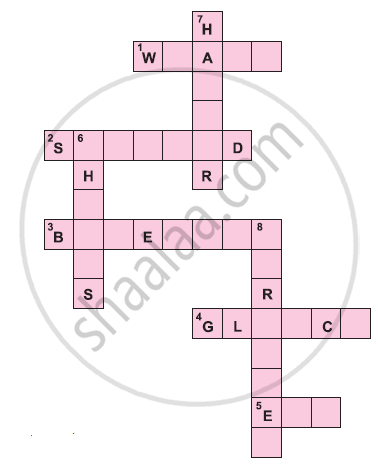
Across
1. very tired
2. had an angry look on the face
3. short trousers
4. a fault in a machine that prevents it from working properly
5. a small and naughty boy-fairy
Down
6. work that must be done every day, often boring
7. a basket with a lid
8. gave a short, high-pitched cry
Who is the speaker in the poem?
Work in small groups. Ask your partner the questions given below. If possible, ask him/her a reason for saying Yes or No. Then tick Yes/ No, whichever is proper.
1. Do you have a separate room for sleep and study? Yes/No
2. Would you prefer to live in a joint family? Yes/No
3. Do you get on with people? Yes/No
4. Do you like the area you live in? Yes/No
5. Do you find the place overcrowded? Yes/No
6. Do you use public transport? Yes/No
7. Would you like a vehicle of our own? Yes/No
8. Do you like reading? Yes/No
9. Would you like to be a teacher/doctor/engineer/architect? Yes/No
Read the following extract from Maya Angelou's poem, 'I Know Why the Caged Bird Sings' and answer the questions that follow:
|
But a caged bird stands on the grave of dreams |
- How does Angelou describe the state of the free bird in the opening lines of the poem? [3]
- Give a brief description of the caged bird's physical and mental condition. [3]
- Explain the phrase, 'grave of dreams' in your own words.
What does the caged bird sing about? [3] - The 'free bird' and the 'caged bird' in the poem represent different groups of people. Name them.
Name any one group of people that you would call 'caged birds' in today's world. [3] - What does the title of the poem, 'I Know Why the Caged Bird Sings', tell us about Maya Angelou's life?
Mention two ways in which the world of the caged bird differs from that of the free bird. [4]
