Advertisements
Advertisements
प्रश्न
Encircle the correct article.
Take (a/an/the) red one in (a/an/the) fruit bowl. You may take (a/an/the) orange also, if you like.
Advertisements
उत्तर
Take the red one in the fruit bowl. You may take an orange also, if you like.
संबंधित प्रश्न
Answer following question in short.
How did the duck force the kangaroo to fulfil his desire?
Now, it is your turn. Write and produce your own radio programme. You will need to select your own content. The following are some ideas. You are free, of course, to add your own ideas. Remember, the programme must be in English.
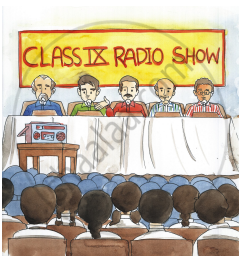
- News stories: about people in your class, about school, about sports (school and local), about the local community
- Comedy: jokes, short plays
- Interviews: with teachers, with exstudents of your school, with a Class IX student who has recently done something very interesting
- Games: general knowledge quiz, panel game, word game
- Advertisements: for shops/industries in the local community, things ‘for sale’ and ‘wanted’ by students
- Local sites: monuments/sites of historical importance and of tourist interest
- Special reports: e.g. safety at school, examination results, school uniform, school assemblies
- Interesting people: role-play interviews with film stars, sports personalities, TV personalities, etc.
- Entertainment reviews: music, films, videos, books, etc.
- Plays
- Songs with lyrics
- Speeches on important personalities
- Tele conference video conference with students, teachers, experts
Abou Ben Adhem (may his tribe increase!)
Awoke one night from a deep dream of peace,
And saw, within the moonlight in his room,
Making it rich, and like a lily in bloom,
An angel writing in a book of gold:-
Read the lines given above and answer the following question.
What did Ben Adhem see one night in his room, when he was awakened?
The boy looked up. He took his hands from his face and looked up at his teacher. The light from Mr. Oliver’s torch fell on the boy’s face, if you could call it a face. He had no eyes, ears, nose or mouth. It was just a round smooth head with a school cap on top of it.
And that’s where the story should end, as indeed it has for several people who have had similar experiences and dropped dead of inexplicable heart attacks. But for Mr. Oliver, it did not end there. The torch fell from his trembling hand. He turned and scrambled down the path, running blindly through the trees and calling for help. He was still running towards the school buildings when he saw a lantern swinging in the middle of the path. Mr. Oliver had never before been so pleased to see the night watchman. He stumbled up to the watchman, gasping for breath and speaking incoherently.
What is it, Sahib? Asked the watchman, has there been an accident? Why are you running?
I saw something, something horrible, a boy weeping in the forest and he had no face.
No face, Sahib?
No eyes, no nose, mouth, nothing.
Do you mean it was like this, Sahib? asked the watchman, and raised the lamp to his own face. The watchman had no eyes, no ears, no features at all, not even an eyebrow. The wind blew the lamp out and Mr. Oliver had his heart attack.
Read the extract given below and answer the question that follow.
What was strange about the watchman? What happened to Mr Oliver when the watchman raised the lantern to show his face?
When there was a strong wind, the pine trees made sad, eerie sounds that kept most people to the main road. But Mr. Oliver was not a nervous or imaginative man. He carried a torch – and on the night I write of, its pale gleam, the batteries were running down – moved fitfully over the narrow forest path. When its flickering light fell on the figure of a boy, who was sitting alone on a rock, Mr. Oliver stopped.
Boys were not supposed to be out of school after seven P.M. and it was now well past nine. What are you doing out here, boy, asked Mr. Oliver sharply, moving closer so that he could recognize the miscreant.
Read the extract given below and answer the question that follow.
Why did the people keep to the main road instead of taking the shortcut?
“Do the scientists really know? Will it happen today, will it ?”
“Look, look; see for yourself !”The children pressed to each other like so many roses, so many weeds, intermixed, peering out for a look at the hidden sun. It rained. It had been raining for seven years; thousands upon thousands of days compounded and filled from one end to the other with rain, with the drum and gush of water, with the sweet crystal fall of showers and the concussion of storms so heavy they were tidal waves come over the islands. A thousand forests had been crushed under the rain and grown up a thousand times to be crushed again. And this was the way life was forever on the planet Venus, and this was the schoolroom of the children of the rocket men and women who had come to a raining world to set up civilization and live out their lives.
Read the extract given below and answer the question that follow.
Describe the rain and its effect on life on Venus.
Answer the following question.
Kari helped himself to all the bananas in the house without anyone noticing it. How did he do it?
What were the hermit’s answers to the three questions? Write each answer separately. Which answer do you like most, and why?
Describe the king in your own words.
What did Mr Nath thought Nishad had come to his place the second time for?
Give the character sketch of Soapy.
Why do you think he had come to the shop?
A. Strike off the words in the box below that are not suitable.
Taro wanted to give his old parents everything they needed.
This shows that he was …
|
thoughtful |
hardworking |
loving |
honest |
|
considerate |
trustworthy |
efficient |
kind |
Answer the following question.
What was the purpose of these special days?
Multiple Choice Question:
What does the expression Whatif mean?
Look at the following phrases and their meanings. Use the phrase to fill in the blank in the sentence given below.
We should _____________ a little money every month.
How did the old aunt get justice?
Which of the following characters can be described as quick-witted, daring and loyal?
Referring closely to the short story, The Sound Machine, give specific instances to show how Klausner was obsessed with sound.
Discuss the absence of human characters in the story, There Will Come Soft Rains. How does this absence contribute to the overall tone and message of the narrative? Answer in 200-250 words.
