Advertisements
Advertisements
प्रश्न
How does the guru mange to save his disciple’s life?
Advertisements
उत्तर
Since the guru had magical powers, he saw in a vision that the disciple was praying to him. As soon as he arrived to save him, he whispered something to him. He then went to the king and asked who was greater, the guru or the disciple. The king answered that the guru was greater. Immediately, the guru asked the king to put him to the stake first and then his disciple. The disciple understood the guru’s trick and began saying that he was brought there first and therefore, he should be put to death first.
The guru and disciple got into a fight. The king was puzzled. He knew there was something mysterious about the fight. So, he promised the guru that he would put him to death first if he told him what the mystery was. The guru told him that he and his disciple had been all over the world, but they had never found a city like that or a king like him. The stake was the stake of the god of justice. It was new and a criminal had never been put on it. Whoever would die on it first would be reborn as the king of that kingdom and whoever would die next, would be the future minister. The guru said that they were tired of their ascetic lives. Hence, they wanted to be reborn as king and minister.
The king started thinking immediately. He did not want to lose his kingdom to someone else in the next life. He postponed the execution till the next day and talked to his minister and decided that they would go on the stakes themselves and would be reborn as king and minister. The king and the minister secretly released the guru and his disciple and took their place and got executed on the stake. Hence, the guru used his cleverness to save his disciple’s life.
संबंधित प्रश्न
Imagine that you are the poet, William Wordsworth. You continue on your walk, and when you reach home you tell a friend what you saw and felt. Which of the following best describes your experience? (Work in pairs, then have a class discussion.)
|
When we write informal letters (to a friend, or to a member of our family), we use this layout.
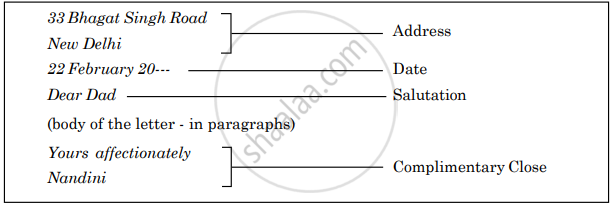
More complex Connectors
Read through the following text. Pay special attention to the underlined words. These help the reader to understand the relationship between sentences, or the parts of sentences, clearly.
Select as many appropriate words as possible from the list given below to replace the underlined words. Be careful not to change the basic meaning too much.
| to his amazement | even though |
| although | in actual fact |
| as a matter of fact | lastly |
| generally | usually |
| however | nevertheless |
| besides | to his surprise |
| asarule | all the same. |
Martin’s Picture
Margin wasn’t a very bright boy. Normally, he never came more than second from the bottom in any test. But, that morning in the art lesson, he had drawn a beautiful picture of a scarecrow in a field of yellow corn. To his astonishment, the drawing was the only one given full marks – ten out of ten – which made him for the first time in his life the best in the class! He had proudly pinned the picture up on the wall behind his desk, where it could be admired by all. It seemed though, that not everyone admired it. Some unknown member of the class had, in fact, taken a violent dislike to it.
During the lunch break, when the classroom had been deserted, the picture had been torn off the wall. Moreover, it had been trodden or stamped on. As if that wasn’t enough, the words ‘ROTTEN RUBBISH’ had been written on the back in big round letters. And finally, the paper was so creased that it looked as though it had been screwed up into a tight ball and perhaps thrown about the room.
“Who could have done it?” Martin wondered.
Now rewrite the text.
Martin’s picture
Martin wasn’t a very bright boy.
Usually,
Generally
As a rule, He never came more than second from the bottom in any test.
However,…. ______________________
Unleashing the goats from the drumstick tree, Muni started out, driving them ahead and uttering weird cries from time to time in order to urge them on. Me passed through the village with his head bowed in thought. He did not want to look at anyone or be accosted. A couple of cronies lounging in the temple corridor hailed him, but he ignored their call. They had known him in the days of affluence when he lorded over a flock of fleecy sheep, not the miserable grawky goats that he had today.
Read the extract given below and answer the question that follow.
What did Muni do to urge the goats to move on?
The village consisted of less than thirty houses, only one of them built with brick and cement. Painted a brilliant yellow and blue all over with gorgeous carvings of gods and gargoyles on its balustrade, it was known as the Big House. The other houses, distributed in four streets, were generally of bamboo thatch, straw, mud, and other unspecified material. Muni’s was the last house in the fourth street, beyond which stretched the fields. In his prosperous days Muni had owned a flock of forty sheep and goats and sallied forth every morning driving the flock to the highway a couple of miles away.
Read the extract given below and answer the question that follow.
What did Muni’s wife cook for him in the morning? How did she cook it?
After washing from his hands and face the dust and soil of work, Joe left the kitchen, and went to the little bedroom. A pair of large bright eyes looked up at him from the snowy bed; looked at him tenderly, gratefully, pleadingly. How his heart swelled in his bosom! With what a quicker motion came the heart-beats! Joe sat down, and now, for the first time, examining the thin free carefully under the lamp light, saw that it was an attractive face, and full of a childish sweetness which suffering had not been able to obliterate.
“Your name is Maggie?” he said, as he sat down and took her soft little hand in his.
“Yes, sir.” Her voice struck a chord that quivered in a low strain of music.
“Have you been sick long?”
“Yes, sir.” What a sweet patience was in her tone!
“Has the doctor been to see you?”
“He used to come”
“But not lately?”
“No, sir.”
Read the extract given below and answer the questions that follow.
What was Joe’s reaction to the look Maggie gave him’
I was in for a surprise. When the time came for the broad-jump trials, I was startled to see a tall boy hitting the pit at almost 26 feet on his practice leaps! He turned out to be a German named Luz Long. 1 was told that Hitler hoped to win the jump with him. I guessed that if Long won, it would add some new support to the Nazis’ “master race” (Aryan superiority) theory. After all, I am a Negro. Angr about Hitler’s ways, 1 determined to go out there and really show Der Fuhrer and his master race who was superior and who wasn’t. An angry athlete is an athlete who will make mistakes, as any coach will tell you. I was no exception. On the first of my three qualifying jumps, I leaped from several inches beyond the takeoff board for a foul. On the second jump, I fouled even worse. “Did I come 3,000 miles for this?” I thought bitterly. “To foul out of the trials and make a fool of myself ?” Walking a few yards from the pit, 1 kicked disgustedly at the dirt.
Read the extract given below and answer the question that follow.
Why did Owens become hot under the collar before the trials?
De Levis: Social Blackmail?
H'm ' Canynge: Not at all - simple warning. If you consider it necessary in your interests to start this scandal-no matter how we shall consider it necessary in ours to dissociate ourselves completely from one who so recklessly disregards the unwritten code.
(i) Where are the speakers at present? What is referred to as Social Black-mail?
What jobs are new ants trained for?
Discuss the following topic in groups.
Do you think there is life on other planets? Can you guess what kind of people there may be on them? In what ways are they likely to be different from us?
Describe the music teacher, as seen from the window.
Complete the sentence below by appropriately using anyone of the following:
if you want to/if you don’t want to/if you want him to
Don’t eat it____________________.
Why was Ravi dragging Mridu towards the backyard?
What happened when the king hear his courtiers talking about Hilsa fish?
Which all houses are characterised by the term ‘meadow houses’?
Multiple Choice Question:
When does the flier have to run?
Answer the question.
How does the poet plan to find out? What will he do once he finds out?
Replace the italicised portion of the sentence below with a suitable phrase from the box. Make necessary changes, wherever required.
He has been told not to take risks while driving a car through a crowded street.
What is the job of a watchman?
Referring to the poem Tithonus, show how his immortality becomes a curse. Answer in 100-150 words incorporating the following details.
- Circumstances leading to Tithonus receiving a boon
- Reasons for the boon becoming a curse
