Advertisements
Advertisements
प्रश्न
Why did the king want to know answers to three questions?
Advertisements
उत्तर
The king wanted to know the answers to the three questions because he thought that he would never fail once he knew the answers to these questions.
संबंधित प्रश्न
Answer of these question in a short paragraph (30–40 words).
Name the various places and causes for which Evelyn performs.
Discuss in pair and answer question below in a short paragraph (30 − 40 words.
Why did Jerome have to reopen the packed bag?
Thinking about the Poem
What do the last four lines of the poem mean to you?
Thinking about Poem
Can a “simple jab of the knife” kill a tree? Why not?
Look at the following sentences. They each have two clauses, or two parts each with their own subject and verb or verb phrase. Often, one part (italicised) tells us when or why something happened.
• I reached the market when most of the shops had closed. (Tells us when I reached.)
• When Rahul Dravid walked back towards the pavilion, everyone stood up. (Tells us when everyone stood up.)
• The telephone rang and Ganga picked it up. (Tells us what happened next.)
• Gunjan has been with us ever since the school began. (Tells us for how long he has been with us.)
I. Identify the two parts in the sentences below by underlining the part that gives us the information in brackets.
1. Where other girls wore traditional Indian dresses, Santosh preferred shorts.
(Contrasts her dress with that of others)
2. She left home and got herself enrolled in a school in Delhi. (Tells us what happened after the first action.)
3. She decided to fight the system when the right moment arrived. (Tells us when she was going to fight the system.)
4. Little Maria had not yet celebrated her tenth birthday when she was packed off to train in the United States. (Tells us when Maria was sent to the U.S.)
Look for information on how to find out whether a snake is harmful.
Taking hints from B.3, write a paragraph describing the burglar.
Now, it is your turn. Write and produce your own radio programme. You will need to select your own content. The following are some ideas. You are free, of course, to add your own ideas. Remember, the programme must be in English.
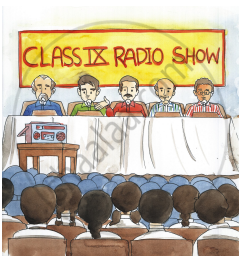
- News stories: about people in your class, about school, about sports (school and local), about the local community
- Comedy: jokes, short plays
- Interviews: with teachers, with exstudents of your school, with a Class IX student who has recently done something very interesting
- Games: general knowledge quiz, panel game, word game
- Advertisements: for shops/industries in the local community, things ‘for sale’ and ‘wanted’ by students
- Local sites: monuments/sites of historical importance and of tourist interest
- Special reports: e.g. safety at school, examination results, school uniform, school assemblies
- Interesting people: role-play interviews with film stars, sports personalities, TV personalities, etc.
- Entertainment reviews: music, films, videos, books, etc.
- Plays
- Songs with lyrics
- Speeches on important personalities
- Tele conference video conference with students, teachers, experts
“If you are rested I would go,” I urged. “Get up and try to walk now.”
“Thank you,” he said and got to his feet, swayed from side to side and then sat down backwards in the dust.
“I was taking care of animals,” he said dully, but no longer to me. “I was only taking care of animals.”
There was nothing to do about him. It was Easter Sunday and the Fascists were advancing toward the Ebro. It was a grey overcast day with a low ceiling so their planes were not up. That and the fact that cats know how to look after themselves was all the good luck that the old man would ever have.
Read the extract given below and answer the question that follow.
Why might the old man need good luck at the end of the story?
Of the seven hundred villages dotting the map of India, in which the majority of India’s five hundred million live, flourish and die, Kritam was probably the tiniest, indicated on the district survey map by a microscopic dot, the map being meant more for the revenue official out to collect tax than for the guidance of the motorist, who in any case could not hope to reach it since it sprawled far from the highway at the end of a rough track furrowed up by the iron-hooped wheels of bullock carts. But its size did not prevent its giving itself the grandiose name Kritam, which meant in Tamil coronet or crown on the brow of the subcontinent. The village consisted of fewer than thirty houses, only one of them built from brick and cement and painted a brilliant yellow and blue all over with
gorgeous carvings of gods and gargoyles on its balustrade, it was known as the Big House. The other houses, distributed in four streets, were generally of bamboo thatch, straw, mud and other unspecified material. Muni’s was the last house in the fourth street, beyond which stretched the fields. In his prosperous days Muni had owned a flock of sheep and goats and sallied forth every morning driving the flock to the highway a couple of miles away.
Read the extract given below and answer the question that follow.
Describe the other houses.
Lights were shining from every window, and there was a savoury smell of roast goose, for it was New-year’s eve—yes, she remembered that. In a corner, between two houses, one of which projected beyond the other, she sank down and huddled herself together. She had drawn her little feet under her, but she could not keep off the cold; and
she dared not go home, for she had sold no matches, and could not take home even a penny of money. Her father would certainly beat her; besides, it was almost as cold at home as here, for they had only the roof to cover them, through which the wind howled, although the largest holes had been stopped up with straw and rags. Her little hands were almost frozen with the cold. Ah! perhaps a burning match might be some good, if she could draw it from the bundle and strike it against the wall, just to warm her fingers. She drew one out—“scratch!” how it sputtered as it burnt! It gave a warm, bright light, like a little candle, as she held her hand over it. It was really a wonderful light. It seemed to the little girl that she was sitting by a large iron stove, with polished brass feet and a brass ornament. How the fire burned! and seemed so beautifully warm that the child stretched out her feet as if to warm them, when, lo! the flame of the match went out, the stove vanished, and she had only the remains of the half-burnt match in her hand.
Read the extract given below and answer the question that follow.
Describe her home.
How did the king promise to reward the person who would answer his questions correctly?
Bristlecone pine trees live the longest. Whom did Mr Wonka asked Charlie to confirm his fact with?
Word in the box given below indicates a large number of… For example, ‘a herd of cows’ refers to many cows. Complete the following phrase with a suitable word from the box.
a _______________ of cattle
The little elf was a nag. How did it tell Patrick’s health?
Who is the speaker in the poem Whatif? What is she worried about? Can you suggest ways to get rid of silly fears?
Look at the following phrases and their meanings. Use the phrase to fill in the blank in the sentence given below.
You should buy some woollens before winter ________.
What does the word ‘chasing in the extract mean?
Write ‘True’ or ‘False’ against each of the following sentences.
Gopal was too poor to afford decent clothes.________
- Notice the way Mr Gessler speaks English. His English is influenced by his mother tongue. He speaks English with an accent.
- When Mr Gessler speaks, p, t, k, sound like b,d,g. Can you say these words as Mr Gessler would say them?
It comes and never stops. Does it bother me? Not at all. Ask my brother, please.
