Advertisements
Advertisements
प्रश्न
How does Iswaran describe the uprooted tree on the highway? What effect does he want to create in his listeners?
Advertisements
उत्तर
Iswaran’s descriptions were greatly influenced by the Tamil thrillers he read. When he came across an uprooted tree on the highway, he said very dramatically that the road was deserted and he was all alone. Suddenly, he spotted something that “looked like an enormous bushy beast lying sprawled across the road.” He was half-inclined to turn and go back. However, as he came closer, he saw that it was a fallen tree with its dry branches spread out.
Even if he was narrating the smallest of incidents, he tried to introduce suspense and a surprise ending to the story.
संबंधित प्रश्न
Answer of these question in two or three paragraphs (100–150 words).
Why did Margie hate school? Why did she think the old kind of school must have been
fun?
Tick the right answer.
When we come to terms with something, it is (still upsetting/no longer upsetting).
Listen carefully while your teacher reads out the description of a villa on sale mentioned on page 146. Based on the information, draw the sketch of the Villa being described.
In groups of six, work on one of the mysteries given below by surfing the net and through other sources. Create a power point presentation/a photo essay.
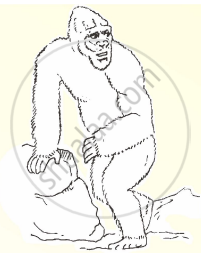
- Yeti, the abominable snowman
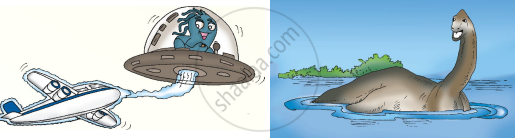
- Loch Ness Monster
- UFOs (Unidentified Flying Objects)
- Lost city of Atlantis
- Crop circles
- Nazca lines
He looked at me very blankly and tiredly, and then said, having to share his worry with someone, “The cat will be all right, I am sure. There is no need to be unquiet about the cat. But the others. Now what do you think about the others?”
“Why they’ll probably come through it all right.”
“You think so?”
“Why not,” I said, watching the far bank where now there were no carts.
“But what will they do under the artillery when I was told to leave because of the artillery?”
“Did you leave the dove cage unlocked?” I asked.
“Yes.”
“Then they’ll fly.”
“Yes, certainly they’ll fly. But the others. It’s better not to think about the others,” he said.
Read the extract given below and answer the question that follow.
How does the soldier console the old man? Does it affect the old man in a positive way?
When there was a strong wind, the pine trees made sad, eerie sounds that kept most people to the main road. But Mr. Oliver was not a nervous or imaginative man. He carried a torch – and on the night I write of, its pale gleam, the batteries were running down – moved fitfully over the narrow forest path. When its flickering light fell on the figure of a boy, who was sitting alone on a rock, Mr. Oliver stopped.
Boys were not supposed to be out of school after seven P.M. and it was now well past nine. What are you doing out here, boy, asked Mr. Oliver sharply, moving closer so that he could recognize the miscreant.
Read the extract given below and answer the question that follow.
Why did Mr Oliver take the shortcut? What did he carry with him?
Sibia sprang.
From boulder to boulder she came leaping like a rock goat. Sometimes it had seemed difficult to cross these stones, especially the big gap in the middle where the river coursed through like a bulge of glass. But now she came on wings, choosing her footing in midair without even thinking about it, and in one moment she was beside the shrieking woman. In the boiling bloody water, the face of the crocodile, fastened round her leg, was tugging to and fro, and smiling. His eyes rolled on to Sibia. One slap of the tail could kill her. He struck. Up shot the water, twenty feet, and fell like a silver chain. Again! The rock jumped under the blow. But in the daily heroism of the jungle, as common as a thorn tree, Sibia did not hesitate. She aimed at the reptile’s eyes. With all the force of her little body, she drove the hayfork at the eyes, and one prong went in—right in— while its pair scratched past on the horny cheek. The crocodile reared up in convulsion, till half his lizard body was out of the river, the tail and nose nearly meeting over his stony back. Then he crashed back, exploding the water, and in an uproar of bloody foam he disappeared. He would die. Not yet, but presently, though his death would not be known for days; not till his stomach, blown with gas, floated him. Then perhaps he would be found upside down among the logs at the timber boom, with pus in his eye. Sibia got arms round the fainting woman, and somehow dragged her from the water.
Read the extract given below and answer the question that follow.
How does Sibia save the woman?
“Do the scientists really know? Will it happen today, will it ?”
“Look, look; see for yourself !”The children pressed to each other like so many roses, so many weeds, intermixed, peering out for a look at the hidden sun. It rained. It had been raining for seven years; thousands upon thousands of days compounded and filled from one end to the other with rain, with the drum and gush of water, with the sweet crystal fall of showers and the concussion of storms so heavy they were tidal waves come over the islands. A thousand forests had been crushed under the rain and grown up a thousand times to be crushed again. And this was the way life was forever on the planet Venus, and this was the schoolroom of the children of the rocket men and women who had come to a raining world to set up civilization and live out their lives.
Read the extract given below and answer the question that follow.
What is supposed to happen on this particular day?
Complete the following sentences by adding the appropriate parts of the sentences given below.
Someone suggested that there should be a council of wise men______________________.
What did the narrator do with the hatchet?
What went wrong when the tortoises, snakes and lizards left the forest?
What is the story’s underlying message or advice to the readers? Do you also support the author’s view?
Quote words that Vijay Singh uses to insult and demoralise the ghost.
How did Vijay Singh outwit the ghost with his wit and wisdom?
Answer the following question. (Refer to that part of the text whose number is given against the question. This applies to the comprehension questions throughout the book.)
In what subjects did the little man need help to do Patrick’s homework? (5, 6)
Multiple Choice Question:
Which of the following words means opposite to punished’?
Replace the italicised portion of the sentence below with a suitable phrase from the box. Make necessary changes, wherever required.
He has been told not to take risks while driving a car through a crowded street.
What does a rebel do when nobody talks during the class?
Which of the following words would best describe Abou Ben Adhem?
Read the passage given below and answer the questions (i), (ii) and (iii) that follow:
|
(1) |
Something happens to cats after we have enjoyed a delicious meal. Call it a feline sugar hit or a rush of good feelings. Abandoning our usually sedentary nature, we transform into crazy beasts who thunder down corridors, spring from one piece of furniture to another, or pounce from behind half-closed doors to attack the shoelaces of unsuspecting passersby. It is as though we are temporarily possessed. |
5 |
|
(2) |
That, at least, is my excuse, dear reader - and the only explanation I can offer for my entirely unplanned global TV debut. |
|
|
(3) |
To be fair, I had no way of knowing that my master was receiving visitors that particular afternoon. Nor that he was being interviewed live, let alone by one of America’s most famous journalists. |
10 |
|
(4) |
All I knew was that, a few minutes after gorging myself on a favourite treat of creamy pudding, I felt that sudden, primal explosion of energy. I made my way back to the suite of rooms that I shared with my master and felt an overpowering compulsion to do something completely mad. I wanted to run like a furious jungle cat, at that particular moment. |
15 |
|
(5) |
Bursting through the door of the room in which my master received visitors, I tore up the carpet as I raced towards the sofa opposite where he was sitting. I ripped its fabric as I scrambled up its side like a savage creature clawing its way up a perilous cliff. Then with a final, frenzied burst, I launched myself off one arm of the sofa, leaping towards the other. |
20 |
|
(6) |
It was only at this point that I realised the sofa was occupied by the journalist. She was halfway through a sentence, and my abrupt appearance caught my master's guest completely by surprise. |
|
|
(7) |
You know, when something truly unexpected happens, time can seem to slow down. Well, that’s how it was. As I flew past the woman's face, her expression turned from one of calm engagement to that of total surprise. |
25 |
|
(8) |
I As she pushed back in her seat to avoid me, the shock on her face could not have been more evident. |
|
|
(9) |
But, dear reader, she was not more shaken than me. I had not been expecting anyone on the sofa, let alone a TV celebrity, nor one who was mid-interview. As I headed towards the opposite end of the sofa, for the first time I observed the lighting, the cameras and the crew watching the action from the shadows. By the time I landed on the other arm of the sofa, all the energy that had propelled me was gone. |
30
35 |
|
(10) |
I was, no longer, a furious jungle cat. |
|
|
(11) |
The journalist looked at me. I looked at her. Both of us were taking in what had just happened. I was also conscious of the cameras still rolling as well as many pairs of eyes watching me at that moment. My moment of global glory. |
|
|
|
Adapted from: The Dalai Lama's Cat Omnibus |
|
(i)
- Given below are three words and phrases. Find the words which have a similar meaning in the passage: [3]
- inactive
- eating in a greedy manner
- dangerous
- For each of the words given below, write a sentence of at least ten words using the same word unchanged in form, but with a different meaning from that which it carries in the passage: [3]
- thunder (line 3)
- spring (line 3)
- past (line 26)
(ii) Answer the following questions in your own words as briefly as possible:
- What is the usual nature of the narrator's kind? How is it differently presented in the passage? [2]
- What did the 'favourite treat of creamy pudding' do to the narrator? [2]
- Describe the actions of the narrator after bursting into the visitors' room. [2]
- How did the journalist react when the narrator 'flew past' her face? [2]
(iii) Summarise how the narrator became a global celebrity (paragraphs 4 to 11). You are required to write the summary in the form of a connected passage in about 100 words. Failure to keep within the word limit will be penalised. [6]
