मराठी

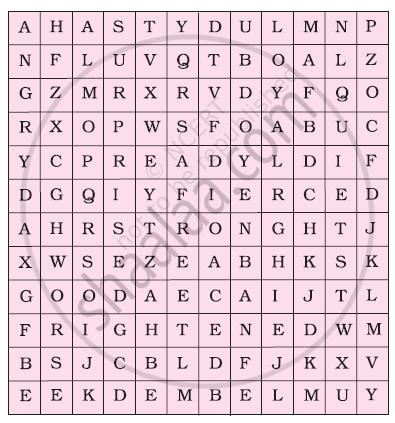
There are twelve words hidden in this table. Six can be found horizontally and the remaining six vertically. All of them are describing words like ‘good’, ‘happy’, etc. The first letters of the words

Advertisements
Advertisements

प्रश्न

There are twelve words hidden in this table.  Six can be found horizontally and the remaining six vertically.  All of them are describing words like ‘good’, ‘happy’, etc.  The first letters of the words are given below:
Horizontal: H R F F S G
Vertical: A W S F L Q 2020
टीपा लिहा
Advertisements

उत्तर

Horizontal words:
1. Hasty
2.ready
3. Fierce
4.Frightened
5.strong
6.good

Vertical Words:
1.Angry
2.Worse
3.Surprised
4.Free
5.Loyal
6.Quiet

shaalaa.com
Reading
  या प्रश्नात किंवा उत्तरात काही त्रुटी आहे का?
पाठ 2.1: How the Dog Found Himself a New Master! - Working with Language [पृष्ठ २३]

APPEARS IN

एनसीईआरटी English - Honeysuckle Class 6
पाठ 2.1 How the Dog Found Himself a New Master!
Working with Language | Q 1 | पृष्ठ २३

संबंधित प्रश्‍न

 Answer the following with reference to the story.

“Sure they had a teacher, but it wasn’t a regular teacher. It was a man.”

  1. Who does ‘they’ refer to?
  2.  What does ‘regular’ mean here?
  3. What is it contrasted with?

Some are like fields of sunlit corn,
Meet for a bride on her bridal morn,
Some, like the flame of her marriage fire,
Or, rich with the hue of her heart's desire,
Tinkling,luminous,tender, and clear,
Like her bridal laughter and bridal tear.

Read the lines given above and answer the question that follow.

Mention the colours of the bangles in this stanza. What do they represent?


"My father lived at Blenheim then,
Yon little stream hard by;
They burnt his dwelling to the ground,
And he was forced to fly;
So with his wife and child he fled,
Nor had he where to rest his head.
"With fire and sword the country round
Was wasted far and wide,
And many a childing mother then,
And new-born baby died;
But things like that, you know, must be
At every famous victory;

Read the lines given above and answer the question that follow.

Explain with reference to context.


Of the seven hundred villages dotting the map of India, in which the majority of India’s five hundred million live, flourish and die, Kritam was probably the tiniest, indicated on the district survey map by a microscopic dot, the map being meant more for the revenue official out to collect tax than for the guidance of the motorist, who in any case could not hope to reach it since it sprawled far from the highway at the end of a rough track furrowed up by the iron-hooped wheels of bullock carts. But its size did not prevent its giving itself the grandiose name Kritam, which meant in Tamil coronet or crown on the brow of the subcontinent. The village consisted of fewer than thirty houses, only one of them built from brick and cement and painted a brilliant yellow and blue all over with

gorgeous carvings of gods and gargoyles on its balustrade, it was known as the Big House. The other houses, distributed in four streets, were generally of bamboo thatch, straw, mud and other unspecified material. Muni’s was the last house in the fourth street, beyond which stretched the fields. In his prosperous days Muni had owned a flock of sheep and goats and sallied forth every morning driving the flock to the highway a couple of miles away.

Read the extract given below and answer the question that follow.

How many houses were there in the village?


Easton, with a little laugh, as if amused, was about to speak again when the other forestalled him. The glum-faced man had been watching the girl’s countenance with veiled glances from his keen, shrewd eyes.

“You’ll excuse me for speaking, miss, but, I see you’re acquainted with the marshall here. If you’ll ask him to speak a word for me when we get to the pen he’ll do it, and it’ll make things easier for me there. He’s taking me to Leavenworth prison. It’s seven years for counterfeiting.”

“Oh!” said the girl, with a deep breath and returning color. “So that is what you are doing out here? A marshal!”

“My dear Miss Fairchild,” said Easton, calmly, “I had to do something. Money has a way of taking wings unto itself, and you know it takes money to keep step with our crowd in Washington. I saw this opening in the West, and—well, a marshalship isn’t quite as high a position as that of ambassador, but—”

Read the extract given below and answer the question that follow.

How did the young woman react when she saw the handcuffs on her friend’s wrist?


This woman had been despised, scoffed at, and angrily denounced by nearly every man, woman, and child in the village; but now, as the fact of, her death was passed from lip to lip, in subdued tones, pity took the place of anger, and sorrow of denunciation.

Neighbours went hastily to the old tumble-down hut, in which she had secured little more than a place of shelter from summer heats and winter cold: some with grave-clothes for a decent interment of the body; and some with food for the half-starving children, three in number. Of these, John, the oldest, a boy of twelve, was a stout lad, able to earn his living with any farmer. Kate, between ten and eleven, was bright, active girl, out of whom something clever might be made, if in good hands; but poor little Maggie, the youngest, was hopelessly diseased. Two years before a fall from a window had injured her spine, and she had not been able to leave her bed since, except when lifted in the arms of her mother.

“What is to be done with the children?” That was the chief question now. The dead mother would go underground, and be forever beyond all care or concern of the villagers. But the children must not be left to starve.

Read the extract given below and answer the question that follow.

What was a matter of concern now that the woman was dead?


She again rubbed a match on the wall, and the light shone round her; in the brightness stood her old grandmother, clear and shining, yet mild and loving in her appearance. “Grandmother,” cried the little one, “O take me with you; I know you will go away when the match burns out; you will vanish like the warm stove, the roast goose, and the large, glorious Christmas-tree.” And she made haste to light the whole bundle of matches, for she wished to keep her grandmother there. And the matches glowed with a light that was brighter than the noon-day, and her grandmother had never appeared so large or so beautiful. She took the little girl in her arms, and they both flew upwards in brightness and joy far above the earth, where there was neither cold nor hunger nor pain, for they were with God.

In the dawn of morning there lay the poor little one, with pale cheeks and smiling mouth, leaning against the wall; she had been frozen to death on the last evening of the year; and the New-year’s sun rose and shone upon a little corpse! The child still sat, in the stiffness of death, holding the matches in her hand, one bundle of which was burnt. “She tried to warm herself,” said some. No one imagined what beautiful things she had seen, nor into what glory she had entered with her grandmother, on New-year’s day.

Read the extract given below and answer the question that follow.

What happened to the little girl? What did the people think?


It was the summer of 1936. The Olympic Games were being held in Berlin. Because Adolf Hitler childishly insisted that his performers were members of a “master race,” nationalistic feelings were at an all-time high.

I wasn’t too worried about all this. I’d trained, sweated and disciplined myself for six years, with the Games in mind. While I was going over on the boat, all I could think about was taking home one or two of those gold medals. I had my eyes especially on the running broad jump. A year before, as a sophomore at the Ohio State, I’d set the world’s record of 26 feet 8 1/4 inches. Nearly everyone expected me to win this event.

Read the extract given below and answer the question that follow.

Why were nationalistic feelings running high during the 1936 Berlin Olympics?


Margot stood alone. She was a very frail girl who looked as if she had been lost in the rain for years and the rain had washed out the blue from her eyes and the red from her mouth and the yellow from her hair. She was an old photograph dusted from an album, whitened away, and if she spoke at all her voice would be a ghost. Now she stood, separate, staring at the rain and the loud wet world beyond the huge glass. “What’re you looking at ?” said William. Margot said nothing. “Speak when you’re spoken to.” He gave her a shove. But she did not move; rather she let herself be moved only by him and nothing else. They edged away from her, they would not look at her. She felt them go away. And this was because she would play no games with them in the echoing tunnels of the underground city. If they tagged her and ran, she stood blinking after them and did not follow. When the class sang songs about happiness and life and games her lips barely moved. Only when they sang about the sun and the summer did her lips move as she watched the drenched windows.

Read the extract given below and answer the question that follow.

Why did they behave in this manner towards Margot?


 Who had agreed to act as an intermediary between the Animal Farm and the outside world ' Describe h~ 


Discuss the following topic in groups.

Why did the wise old bird say, “Chandni is the winner”?


What were the hermit’s answers to the three questions? Write each answer separately. Which answer do you like most, and why?


The king helped the hermit in digging the beds. He even slept on the floor of the hut and lived like a simple man in the hermit’s hut. What lesson we learn from this?


Why was Ravi upset with the elders?


Why a newspaper or stick lying in the open does not catch fire on its own?


How did the bear grow up a vegetarian?


Speak the following sentences clearly but as quickly as you can learn them by heart.

1. How much wood would a woodchuck chuck if a woodchuck would chuck wood.

2. Betty bought a bit of butter, but the bit of butter was a little bitter so she bought some better butter to make the bitter butter better.


Answer the following question.

Why do you think the writer visited Miss Beam’s school?


With your partner, complete the following sentence in your own word using the ideas in the poem.
English is a __________________ with words that everyone can play.


Multiple Choice Question:
How is English a wonderful game?


Share
Notifications

Englishहिंदीमराठी


      Forgot password?
Use app×