Advertisements
Advertisements
प्रश्न
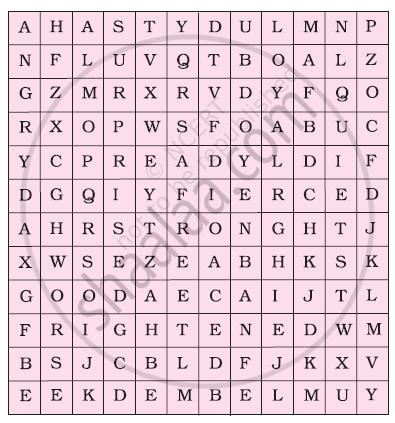
There are twelve words hidden in this table. Six can be found horizontally and the remaining six vertically. All of them are describing words like ‘good’, ‘happy’, etc. The first letters of the words are given below:
Horizontal: H R F F S G
Vertical: A W S F L Q 2020
Advertisements
उत्तर
Horizontal words:
1. Hasty
2.ready
3. Fierce
4.Frightened
5.strong
6.good
Vertical Words:
1.Angry
2.Worse
3.Surprised
4.Free
5.Loyal
6.Quiet
APPEARS IN
संबंधित प्रश्न
Answer of these question in a short paragraph (about 30 words).
What characteristics does he say he inherited from his parents?
Based on your reading of the story, answer the following question by choosing the correct option:
Mrs. Bramble was a proud woman because.
Based on your reading of the story, answer the following question by choosing the correct option:
Harold had defied the laws of heredity by
a) Read the second stanza again, in which Wordsworth compares the solitary
reaper's song with the song of the nightingale and the cuckoo. On the basis of
your reading (and your imagination), copy and complete the table below. (Work
in groups of four, then have a brief class discussion.
| Place | Heard by | Impact on listener | |
| Solitary Reaper | Scottish Highlands | the poet | holds him spellbound |
| Nightingale | |||
| Cuckoo |
b) Why do you think Wordsworth has chosen the song of the nightingale and the
cuckoo, for comparison with the solitary reaper's song?
c) As you read the second stanza, what images come to your mind? Be ready to
describe them in your own words, to the rest of the class. (Be imaginative
enough and go beyond what the poet has written.)
Now it is your turn. Write and produce your own radio programme. You will need to select your own content. The following are some ideas. You are free, of course, to add your own ideas. Remember, the programme must be in English.
• News stories: about people in your class, about school, about sports (school and local), about the local community
• Comedy: jokes, short plays
• Interviews: with teachers, with exstudents of your school, with a Class IX student who has recently done something very interesting
• Games: general knowledge quiz, panel game, word game
• Advertisements: for shops/ industries in the local community, things 'for sale' and 'wanted' by students
• Local sites: monuments / sites of historical importance and of tourist interest
• Special reports: e.g. safety at school, examination results, school uniform, school assemblies
• Interesting people: role-play interviews with film stars, sports personalities, TV personalities, etc.
• Entertainment reviews: music, films, videos, books, etc.
• Plays
• Songs with lyrics
• Speeches on important personalities
• Tele conference with students, teachers, experts.
The following are the dictionary entries for some of the words that appear in 'The Mystery of Bermuda Triangle'. Study the words and their meanings before you read the mystery for better comprehension.
• Halloween/halau in/ : the night of 31st October when it was believed in the past that dead people appeared from their graves. This is now celebrated in the US, Canada and Britain by children who dress as ghosts and witches.
• vector/'vekta/: an insect or animal which carries a disease from one animal or plant to another; a course taken by an aircraft; a quantity, such as velocity, completely specified by a magnitude and direction.
• crackle/' krak(a)l/: to make short sharp sounds .
• ascent/ a' sent/: the act of climbing or moving up .
• roger/' rod3a /: in communication by radio to show that they have understood a message; an expression of agreement.
• probe/praub/: to ask questions in order to find out some secret or hidden information; an exploratory action; expedition, or device, especially one designed to investigate and obtain information on a remote or unknown region.
• abduct/ ab' dAkt/ : to take somebody away illegally, by using force.
• time warp/ taimwarp /: a situation in which it is possible for people or things from the past or the future to move to the present.
• phenomenon/ fa' nomrnan/: a fact or an event in nature or society, especially one that is not fully understood.
• erratic/ I' rat.Ik/: not happening at regular times.
• engulf /In· g /\ If/,/ &n · g /\ If/: to surround or to cover somebody or something completely.
The angel wrote and vanished.
The next night, It came again with a great wakening light,
And show's the names whom love of God had blest,
And Lo! Bin Adhem's name led all the rest.
Read the lines given above and answer the following question.
Where was Abou’s name written amongst those who loved God?
After considering the matter, and talking it over with his wife, farmer Jones said that he would take John, and do well by him, now that his mother was out of the way; and Mrs. Ellis, who had been looking out for a bound girl, concluded that it would be charitable in her to make choice of Katy, even though she was too young to be of much use for several years.
“I could do much better, I know,” said Mrs. Ellis; “but as no one seems inclined to take her, I must act from a sense of duty expect to have trouble with the child; for she’s an undisciplined thing—used to having her own way.”
But no one said “I’ll take Maggie.” Pitying glances were cast on her wan and wasted form and thoughts were troubled on her account. Mothers brought cast-off garments and, removing her soiled and ragged clothes, dressed her in clean attire. The sad eyes and patient face of the little one touched many hearts, and even knocked at them for entrance. But none opened to take her in. Who wanted a bed-ridden child?
“Take her to the poorhouse,” said a rough man, of whom the question “What’s to be done with Maggie?” was asked. “Nobody’s going to be bothered with her.”
“The poorhouse is a sad place for a sick and helpless child,” answered one.
“For your child or mine,” said the other, lightly speaking; “but for tis brat it will prove a blessed change, she will be kept clean, have healthy food, and be doctored, which is more than can be said of her past condition.”
Read the extract given below and answer the question that follow.
What solution did the rough man suggest for Maggie? Why would the poorhouse be a good place for Maggie?
So after that, dimly, dimly, she sensed it, she was different and they knew her difference and kept away. There was talk that her father and mother were taking her back to Earth next year; it seemed vital to her that they do so, though it would mean the loss of thousands of dollars to her family. And so, the children hated her for all these reasons of big and little consequence. They hated her pale snow face, her waiting silence, her thinness, and her possible future. “Get away 1” The boy gave her another push. “What’re you waiting for?”Then, for the first time, she turned and looked at him. And what she was waiting for was in her eyes. “Well, don’t wait around here !” cried the boy savagely. “You won’t see nothing!” Her lips moved. “Nothing 1” he cried. “It was all a joke, wasn’t it?” He turned to the other children. “Nothing’s happening today. Is it ?”
Read the extract given below and answer the question that follow.
What is the ‘it’ referred to by William?
Who is Nerissa? What does she say to cheer up Portia?
Read the following passage carefully and answer the questions that follow:
Richard Parker was so named because of a clerical error.
A panther was terrorizing the Khulna district of Bangladesh, just outside the Sundarbans. It had recently carried off a little girl. She was the seventh person killed in two months by the animal. And it was growing bolder. The previous victim was a man who had been attacked in broad daylight in his field. The beast dragged him off into the forest, and his corpse was later found hanging from a tree. The villagers kept a watch nearby that night, hoping to surprise the panther and kill it, but it never appeared.
The Forest Department hired a professional hunter. He set up a small, hidden platform in a free near a river where two of the attacks had taken place. A goat was tied to a stake on the river’s bank. The hunter waited several nights. He assumed the panther would be an old, wasted male with worn teeth, incapable of catching anything more difficult than a human. But it was a sleek tiger that stepped into the open one night: a female with a single cub. The goat bleated. Oddly, the cub, who looked to be about three months old, paid little attention to the goat. It raced to the water’s edge, where it drank eagerly. Its mother followed it. Of hunger and thirst, thirst is the greater urge. Only once the tiger had quenched her thirst did she turn to the goat to satisfy her hunger.
The hunter had two rifles with him: one with real bullets, the other with immobilizing darts. This animal was not the man-eater, but so close to human habitation she might pose a threat to the villagers, especially as she was with cub. He picked up the gun with the darts. He fired as the tiger was about to attack the goat. The tiger reared up and snarled and raced away. But immobilizing darts don’t bring on sleep gently—they knock the creature out without warning. A burst of activity on the animal’s part makes it act all the faster. The hunter called his assistants on the radio. They found the tiger about two hundred yards from the river. She was still conscious. Her back legs had given way and her balance on her front legs was shaky. When the men got close, she tried to get away but could not manage it. She turned on them, lifting a paw that was meant to kill. It only made her lose her balance. She collapsed and the Pondicherry Zoo had two new tigers. The cub was found in a bush close by, meowing with fear.
The hunter, whose name was Richard Parker, picked it up with his bare hands and, remembering how it had rushed to drink in the river, named it Thirsty. But the shipping clerk at the Howrah train station was evidently a man both confused and diligent. All the papers received with the cub clearly stated that its name was Richard Parker, that the hunter’s first name was Thirsty add that his family name was None Given. Richard Parker’s name stuck. I don’t know if the hunter was ever called Thirsty None Given!
(a) Give the meaning of each of the following words as used in the passage.
One word answers ob short phrases will be accepted.
- corpse (line 6)
- quenched (line 16)
- reared (line 20)
(b) Answer the following questions briefly in your own words.
- Why does the author say that the panther ‘was getting bolder’?
- Why did the Forest Department hire a professional hunter?
- What did the hunter expect to encounter? What did he actually encounter?
- What did the tiger do before turning to attack the goat? Why did it do that?
- Why did the hunter decide to shoot the tiger though he knew it was not the man-eater?
- What name did the hunter give to the cub? Why?
(c)
(i) In not more than 60 words narrrate how the hunter and his assistants captured the tiger and her cub.
(ii) Give a suitable title to your summary in 3(c). Give a reason to justify your choice.
Did the wise men win the reward? If not, why not?
Read the following.
A group of children in your class are going to live in a hostel.
•They have been asked to choose a person in the group to share a room with.
•They are asking each other questions to decide who they would like to share a room with. Ask one another questions about likes/dislikes/preferences/hobbies/personal characteristics.
Use the following questions and sentence openings.
(i) What do you enjoy doing after school?
I enjoy...
(ii) What do you like in general?
I like...
(iii) Do you play any game?
I don’t like...
(iv) Would you mind if I listened to music after dinner?
I wouldn’t...
(v) Will it be all right if I...?
It’s fine with me...
(vi) Is there anything you dislike, particularly? Well, I can’t share...
(vii) Do you like to attend parties?
Oh, I...
(viii) Would you say you are...?
I think...
According to Charlie, what lives the longest.
Why did the farmer bring a baby mongoose into the house?
Give a character sketch of the shepherd. What qualities pleased the king?
Why do you think Prem wants to tell the story of the reptiles to the people of his village?
Multiple Choice Question:
When does the kite lose all its glory?
Multiple Choice Question:
What are these doubts and worries called?
Read the extract given below and answer the questions that follow:
| Brutus: | I did send to you For certain sums of gold, which you denied me; For I can raise no money by vile means: By heaven, I had rather coin my heart, And drop my blood for drachmas, than to wring From the hard hands of peasants their vile trash By any indirection. |
- To whom are these words addressed?
Why is Brutus angry with this person? [3] - How does this person feel when he hears these words?
What does he say to defend himself? [3] - Why did Brutus need ‘certain sums of gold’?
Why was he unable to raise these sums of money? [3] - Earlier in this scene, Brutus refers to Lucius Pella.
What had he been accused of?
Who had supported him and how? [3] - Mention any two aspects of Brutus’ character that are revealed in the above extract.
What do you understand about the relationship between Brutus and the person he addresses? [4]
