Advertisements
Advertisements
प्रश्न
Pick out word from the text that mean the same as the following word or expression. (Look in the paragraph indicated.)
took to be true without proof : _________
Advertisements
उत्तर
took to be true without proof : Assumed
संबंधित प्रश्न
Answer these question in a few words or a couple of sentence.
What do you think a telebook is?
The Shehnai of Bismillah Khan Thinking about the text :
Tick the right answer.
Bismillah Khan’s paternal ancestors were (barbers, professional musicians).
Now rewrite the pair of sentences given below as one sentence.
You have nothing. That makes you very determined.
Based on your reading of the story answer the following question by choosing the correct option:
“_______ even Duke’s presence didn’t reach Chuck”. Why?
a) Read the second stanza again, in which Wordsworth compares the solitary
reaper's song with the song of the nightingale and the cuckoo. On the basis of
your reading (and your imagination), copy and complete the table below. (Work
in groups of four, then have a brief class discussion.
| Place | Heard by | Impact on listener | |
| Solitary Reaper | Scottish Highlands | the poet | holds him spellbound |
| Nightingale | |||
| Cuckoo |
b) Why do you think Wordsworth has chosen the song of the nightingale and the
cuckoo, for comparison with the solitary reaper's song?
c) As you read the second stanza, what images come to your mind? Be ready to
describe them in your own words, to the rest of the class. (Be imaginative
enough and go beyond what the poet has written.)
On the basis of your understanding of the poem, answer the following question
by ticking the correct option.
The tone and mood of the rain in the poem reflects its_________.
Read the comic strip based on. H.G. Wells' novells.


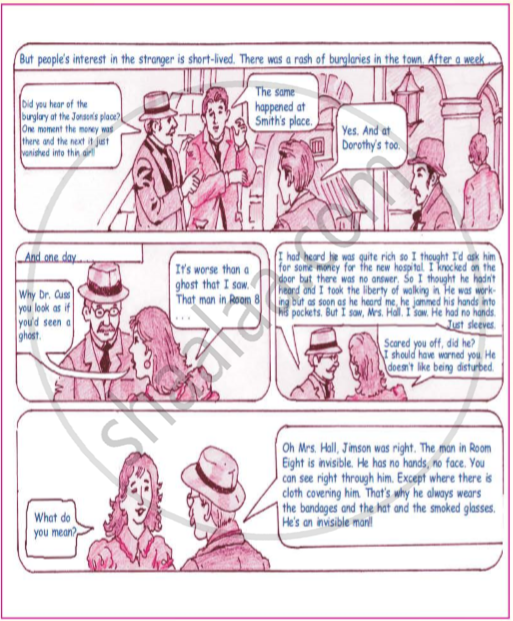
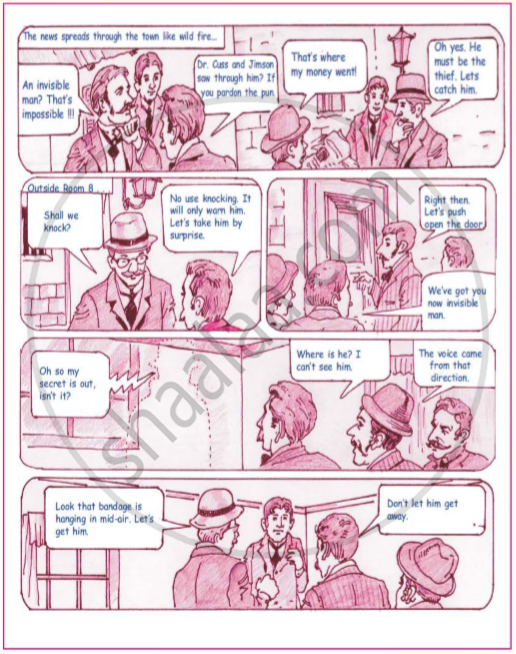
Answer the questions by ticking the correct option.
(a) The strange-looking man wanted ....
(i) the best room at the inn.
(ii} a room with a fire and a good lock.
(iii} a room with a good view.
(iv) a room where he could work quietly.
(b) Jimson was suspicious of the stranger because ...
(i} he did not answer Jimson's questions.
(ii} he did not want to talk about the weather.
(iii} he kept his back turned towards Jimson at all times.
(iv) he shouted atJimson when he entered his room.
(c) The people of the town gossiped about the stranger as ...
(i} he did not go out or talk to anyone in the town.
(ii} he had met with an accident and his face was bandaged.
(iii} he was new to the town and behaved rudely.
(iv) he stayed in his room and did not show his face to anyone.
(d) 'There was a rush of burglaries in the town. This means that ________
(i} there were many robberies in the town.
(ii) a few people in the town had seen a rob her.
(iii} the burglaries in the town were done in a rush.
(iv) the burglar was a rash and careless man.
(e) Although Jimson and Dr Cuss are suspicious of the strange guest, Mrs Hall tolerates him because ....
(i} she is not superstitious or ignorant.
(ii) she is sorry for the stranger who is bandaged.
(iii} the stranger is paying her a good amount of money for the room.
(iv} the stranger is polite and kind to Mrs Hall at all times.
(f) The stranger who was staying at the inn can be described as being ....
(I} violent
(ii} upright
(iii} dishonest
(iv) sensible
Exchange information with another group and record it. Then in groups of four discuss the results of the following:
- Do boys and girls spend the same amount of time at the computer?
- Do their tastes and preferences change as they grow older?
- Are the number of hours spent at the computer/studying at home/leisure/internet different between boys and girls?
- Do the number of hours per week spent at the computer/studying at home/internet/leisure activities change as students grow up?
What does he plant who plants a tree?
He plants, in sap and leaf and wood,
In love of home and loyalty
And far-cast thought of civic good____
His blessing on the neighbourhood,
Who in the hollow of his hand
Holds all the growth of all our land____
A nation's growth from sea to sea
Stirs in his heart who plants a tree.
Read the lines given above and answer the question that follow:
Does the man plant a tree because of his love of society and his nation?
So after that, dimly, dimly, she sensed it, she was different and they knew her difference and kept away. There was talk that her father and mother were taking her back to Earth next year; it seemed vital to her that they do so, though it would mean the loss of thousands of dollars to her family. And so, the children hated her for all these reasons of big and little consequence. They hated her pale snow face, her waiting silence, her thinness, and her possible future. “Get away 1” The boy gave her another push. “What’re you waiting for?”Then, for the first time, she turned and looked at him. And what she was waiting for was in her eyes. “Well, don’t wait around here !” cried the boy savagely. “You won’t see nothing!” Her lips moved. “Nothing 1” he cried. “It was all a joke, wasn’t it?” He turned to the other children. “Nothing’s happening today. Is it ?”
Read the extract given below and answer the question that follow.
What was Margot waiting for? Why did William say it was a joke?
Read the extract given below and answer the questions that follow:
"Now tell us what it was all about"
Young Peterkin, he cries.
And little Willhelmines looks up
With wonder - waiting eyes,
"Now tell us all about the war,
And what they fought each other for".
- After Blenheim, Robert Southey
(i) Who are Peterkin and Wilhelmine? How does the poet describe the scene at the beginning of the poem?
(ii) What did Young Peterkin find and where? Describe it?
(iii) Who is referred to as "each other"? What did they fight for?
(iv) To whom are the words in the extract addressed? How was this person's family affected by the war?
(v) What, according to the poet, are the consequences that are often associated with great and famous victories? What message does the poet want to convey to the readers?
Answer the following question.
Finding good twigs for Kari took a long time. Why?
How did the other bird greet the king?
Why did the farmer’s wife strike the mongoose with her basket?
How do we know that Akbar was fond of Tansen? Give two reasons.
It is said that Tansen was a naughty child. What prank did he play?
Look at the following phrases and their meanings. Use the phrase to fill in the blank in the sentence given below.
You should buy some woollens before winter ________.
Encircle the correct article.
Would you like (a/an/the) apple or (a/an/the) banana?
What else do you think Nishad and Maya will find out about him? How? Will they ever be friends? Think about these questions and write a paragraph or two to continue the story.
What made Jesse Owens one of the best remembered athletes of all time?
