Advertisements
Advertisements
प्रश्न
How did the fishmongers lure the customers to buy Hilsa?
Advertisements
उत्तर
The fishmongers lured the customers by saying that the price had been down that day.
APPEARS IN
संबंधित प्रश्न
Complete the following statement.
When she finished college, Santosh had to write a letter of apology to her father because _________
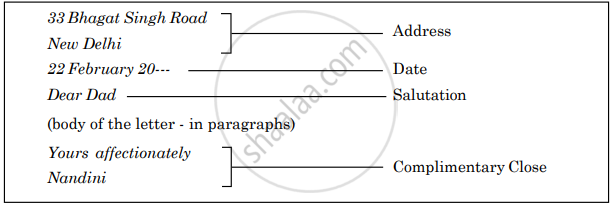
When we write informal letters (to a friend, or to a member of our family), we use this layout.
The black man's face bespoke revenge
As the fire passed from his sight.
For all he saw in his stick of wood
Was a chance to spite the white.
The last man of this forlorn group
Did nought except for gain.
Giving only to those who gave
Was how he played the game.
Their logs held tight in death's still hands
Was proof of human sin.
They didn't die from the cold without
They died from the cold within.
Read the lines given above and answer the question that follow.
What happened to the six humans? Why?
The village consisted of less than thirty houses, only one of them built with brick and cement. Painted a brilliant yellow and blue all over with gorgeous carvings of gods and gargoyles on its balustrade, it was known as the Big House. The other houses, distributed in four streets, were generally of bamboo thatch, straw, mud, and other unspecified material. Muni’s was the last house in the fourth street, beyond which stretched the fields. In his prosperous days Muni had owned a flock of forty sheep and goats and sallied forth every morning driving the flock to the highway a couple of miles away.
Read the extract given below and answer the question that follow.
What did Muni’s wife cook for him in the morning? How did she cook it?
Easton, with a little laugh, as if amused, was about to speak again when the other forestalled him. The glum-faced man had been watching the girl’s countenance with veiled glances from his keen, shrewd eyes.
“You’ll excuse me for speaking, miss, but, I see you’re acquainted with the marshall here. If you’ll ask him to speak a word for me when we get to the pen he’ll do it, and it’ll make things easier for me there. He’s taking me to Leavenworth prison. It’s seven years for counterfeiting.”
“Oh!” said the girl, with a deep breath and returning color. “So that is what you are doing out here? A marshal!”
“My dear Miss Fairchild,” said Easton, calmly, “I had to do something. Money has a way of taking wings unto itself, and you know it takes money to keep step with our crowd in Washington. I saw this opening in the West, and—well, a marshalship isn’t quite as high a position as that of ambassador, but—”
Read the extract given below and answer the question that follow.
What was the crime of the prisoner? And what is the punishment.
How, according to Portia, can the Duke of Saxony’s nephew be made to choose the wrong casket? What do these suitors ultimately decide? Why?
What was the inscription on the golden casket? How do the actions of the martlet illustrate this inscription?
"Here comes someone running". Who has been referred to in this sentence?
What distinction Mr Gessler’s shop had?
What happens when the adults give too many instructions to their children?
Complete the following sentence
The chatter is electrical because ______
Read the newspaper report to find the following facts about Columbia’s ill-fated voyage.
Height at which it lost contact: ____________
Answer the following question.
“Each term every child has one blind day, one lame day…” Complete the line. Which day was the hardest? Why was it the hardest?
Answer the question.
Why does the poet want to know where the teachers go at four o’clock?
Sit in a circle so that you can see each other. Each one must talk to complete the following sentence in his own way. “What makes me very angry is …”. Remember to listen with respect and without comment to each person as he/she speaks.
Answer the following question.
What was Jumman’s verdict as head Panch? How did Algu take it?
Your partner and you may now be able to answer the question.
The speaker in this poem is a school-going child. Every day he happens to meet the hawker selling bangles, the gardener digging away at the garden, and the watchman walking the street all night.
Select the option that shows the correct relationship between statements (1) and (2) from William Sleator’s short story, ‘The Elevator’.
Statement 1: Terrified of the fat lady in the elevator, Martin ran down the dark stairs, fell and broke his leg.
Statement 2: Angry and disappointed that his son had behaved like a fool and a coward, Martin’s father did not talk to him on the way to the hospital.
Read the extract given below and answer the questions that follow:
| Caesar: | Are we all ready? What is now amiss, That Caesar and his Senate must redress? |
| Metellus: | Most high, most mighty, and most puissant Caesar, Metellus Cimber throws before thy seat A humble heart, .... [He kneels] |
- Where are the speakers?
What does ‘puissant’ mean?
Explain: ‘Metellus Cimber throws before thy seat a humble heart’. [3] - At the beginning of the scene, Caesar says, ‘The Ides of March are come.’
Why do you think Caesar said this?
What does the Soothsayer say in response? [3] - What specific duties do the conspirators allot to Trebonius and Casca?
Why does Cassius become nervous when Popilius Lena speaks to him as they enter? [3] - What does Artemidorus want of Caesar?
How does Caesar respond to his plea? [3] - Shortly after this exchange, Caesar is stabbed to death by the conspirators. Whom do you sympathise with — Julius Caesar or the conspirators? Give reasons for your choice. [4]
What is Macbeth's reaction when he sees Banquo’s ghost at the banquet?
