Advertisements
Advertisements
प्रश्न
Encircle the correct article.
Take (a/an/the) red one in (a/an/the) fruit bowl. You may take (a/an/the) orange also, if you like.
Advertisements
उत्तर
Take the red one in the fruit bowl. You may take an orange also, if you like.
संबंधित प्रश्न
What did Einstein call his desk drawer at the patent office? Why?
Of the seven hundred villages dotting the map of India, in which the majority of India’s five hundred million live, flourish and die, Kritam was probably the tiniest, indicated on the district survey map by a microscopic dot, the map being meant more for the revenue official out to collect tax than for the guidance of the motorist, who in any case could not hope to reach it since it sprawled far from the highway at the end of a rough track furrowed up by the iron-hooped wheels of bullock carts. But its size did not prevent its giving itself the grandiose name Kritam, which meant in Tamil coronet or crown on the brow of the subcontinent. The village consisted of fewer than thirty houses, only one of them built from brick and cement and painted a brilliant yellow and blue all over with
gorgeous carvings of gods and gargoyles on its balustrade, it was known as the Big House. The other houses, distributed in four streets, were generally of bamboo thatch, straw, mud and other unspecified material. Muni’s was the last house in the fourth street, beyond which stretched the fields. In his prosperous days Muni had owned a flock of sheep and goats and sallied forth every morning driving the flock to the highway a couple of miles away.
Read the extract given below and answer the question that follow.
Name the village in which Muni lived.
The boy looked up. He took his hands from his face and looked up at his teacher. The light from Mr. Oliver’s torch fell on the boy’s face, if you could call it a face. He had no eyes, ears, nose or mouth. It was just a round smooth head with a school cap on top of it.
And that’s where the story should end, as indeed it has for several people who have had similar experiences and dropped dead of inexplicable heart attacks. But for Mr. Oliver, it did not end there. The torch fell from his trembling hand. He turned and scrambled down the path, running blindly through the trees and calling for help. He was still running towards the school buildings when he saw a lantern swinging in the middle of the path. Mr. Oliver had never before been so pleased to see the night watchman. He stumbled up to the watchman, gasping for breath and speaking incoherently.
What is it, Sahib? Asked the watchman, has there been an accident? Why are you running?
I saw something, something horrible, a boy weeping in the forest and he had no face.
No face, Sahib?
No eyes, no nose, mouth, nothing.
Do you mean it was like this, Sahib? asked the watchman, and raised the lamp to his own face. The watchman had no eyes, no ears, no features at all, not even an eyebrow. The wind blew the lamp out and Mr. Oliver had his heart attack.
Read the extract given below and answer the question that follow.
What did the watchman ask Mr Oliver? ‘
Read the extract given below and answer the questions that follow:
Baldeo, the watchman, was awake. He stretched himself, slowly unwinding the heavy shawl that covered him like a shroud. It was close on midnight and the chill air made him shiver. The station, a small shack backed by heavy jungle, was a station in name only; for trains only stopped there, if at all, for a few seconds before entering the deep cutting that led to the tunnel. Most trains only slowed down before taking the sharp curve before the cutting.
(i) What were Baldeo’s duties as a watchman? What question did his son ask him before he left for his nightly errand?
(ii) Describe the axe that Baldeo carried with him. Who had made the axe?
(iii) Which sound made Baldeo realize that the tiger was close by?
Why was he worried that the tiger may be going in the opposite direction? Why didn’t the tiger fear the man?
(iv) Give an account of the encounter between Baldeo and the tiger.
(v) How did the tiger die? Point out a similarity in the characters of Baldeo and his son Tembu. Give an example for each to justify your answer.
What are the 'present wants'? Who is its need of I~ 'present wants'? Why?
Read the extract given below and answer the questions that follow:
Where the mind is without fear and the head is held high
Where knowledge is free
Where the world has not been broken up into fragments
By narrow domestic walls (Where the Mind is Without Fear: Rabindranath Tagore)
(i) To whom is the poet praying? Whose mind is the poet referring to at the beginning of the poem? Why?
(ii) In which situation is the lead held high? What does he mean by 'knowledge is free'? What are 'narrow domestic walls'?
(iii) What does the poet mean by 'tireless striving'? What does 'clear stream' refer to? Explain.
(iv) What is meant by 'dead habit'? What is 'dead habits' compared to and why?
(v) What does ti» poet wish for al the end ~f the poem? What does tl1e poem tell the readers about the poet? Give a reason to justify yow· answer.
What jobs are new ants trained for?
Why did the king send two messengers throughout his kingdom?
Describe the boots made by Mr Gessler.
What does the phrase, “he ran as still as Water” mean?
Use the clues given below to complete this crossword puzzle.
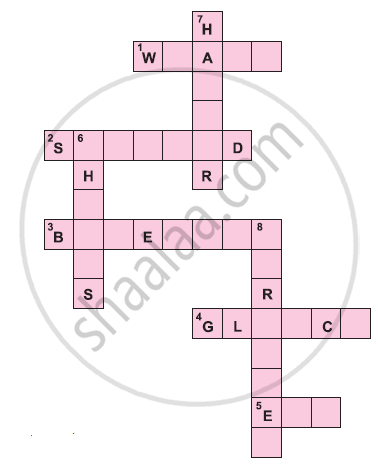
Across
1. very tired
2. had an angry look on the face
3. short trousers
4. a fault in a machine that prevents it from working properly
5. a small and naughty boy-fairy
Down
6. work that must be done every day, often boring
7. a basket with a lid
8. gave a short, high-pitched cry
Make noun from the word given below by adding –ness, ity, ty or y
kind ___________.
Multiple Choice Question:
The word ‘caring’ in the passage means ______
Sit in a circle so that you can see each other. Each one must talk to complete the following sentence in his own way. “What makes me very angry is …”. Remember to listen with respect and without comment to each person as he/she speaks.
What does the poet tell you about the world of words? Do you agree with him?
Look at the following phrases and their meanings. Use the phrase to fill in the blank in the sentence given below.
You should buy some woollens before winter ________.
Find out the different kinds of work done by the people in your neighbourhood. Make different cards for different kinds of work. You can make the card colourful with pictures of the persons doing the work.
Why do you think that the spider web hanging on the door was no longer there?
Add im- or in- to each of the following words and use them in place of the italicised words in the sentences given below.
| patient, proper, possible, sensitive, competent |
He appears to be without sensitivity. In fact, he is very emotional.
How does Malcolm’s character grow and change over the course of the play? Incorporate the following details and write your answer in a short paragraph of about 100-150 words.
- Malcolm’s testing of Macduff in Act IV
- His generalship and the restoration of order through Macduff
