Advertisements
Advertisements
प्रश्न
We should not mess up with things that belong to others. Elaborate.
Advertisements
उत्तर
We should treat things that belongs to others with utmostcare. We should treat them even more cautiously than we would have treated our things.
There are many things around us that we consider dear to us. Similarly people are also emotional about their things and we must respect their feelings.
Treating other’s thing’s callously will make them lose their trust on us and they might not lend their things to us again. We should take uttermost care while handling things belonging to others and must return them at once when our job is done.
संबंधित प्रश्न
Match the meanings with the words/expressions in italic, and write the appropriate
meaning next to the sentence.
I got a fright when I realised how close I was to the cliff edge.
Thinking about the Text
On the following map mark out the route, which the author thought of but did not take, to Delhi.
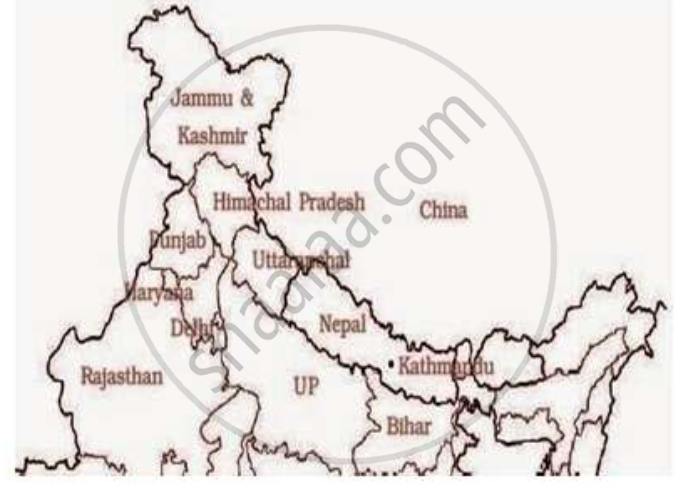
Now read the text
Six humans trapped by happenstance
In black and bitter cold.
Each one possessed a stick of wood,
Or so the story's told.
Their dying fire in need of logs;
The first man held his back.
For on the faces around the fire,
He noticed one was black.
Read the lines given above and answer the question that follow:
Explain with reference to context
The black man's face bespoke revenge
As the fire passed from his sight.
For all he saw in his stick of wood
Was a chance to spite the white.
The last man of this forlorn group
Did nought except for gain.
Giving only to those who gave
Was how he played the game.
Their logs held tight in death's still hands
Was proof of human sin.
They didn't die from the cold without
They died from the cold within.
Read the lines given above and answer the question that follow.
Who are ‘they’ referred to here ? Where were they ?
What test had Portia’s father devised for her suitors? What oath did the suitors have to take before making their choice?
Read the extract given below and answer the questions that follow:
The buoy of the Inchcape Bell was seen
A darker speck on the ocean green;
Sir Ralph the Rover walked his deck,
And fixed eye on the darker speck.
(The Inchcape Rock: Robert Southey)
(i) Contrast the weather when Sir Ralph the Rover passed the Inchcape Rock the first time with the weather when he returned to the place.
(ii) Why had the Abbot of Aberbrothok hung a bell on the Inchcape Rock?
(iii) Why did Sir Ralph cut the bell from the Inchcape Rock? Describe the manner in which it sank underwater.
(iv) What did Sir Ralph say to reassure his men when it became very dark? What opinion did one of the sailors have about their location? What did they all wish for?
(v) How did the ship sink? What sound did Sir Ralph imagine he could hear in his dying moments? What is the message of the poem?
Read the extract given below and answer tire questions that follow:
Trotter: (Leaning on the refectory table) Those simple actions took you rather a long time, didn’t they, Mr Ralston?
Giles: I don’t think so. (He moves away to the stairs)
Trotter: I should say you definitely - took your time over them.
Giles: I was thinking about something.
Trotter: Very well. Now then, Mr Wren, I’ll have your account of where you were.
(i) What 'simple actions' of Giles was Trotter referring to? Where had Giles been? Who had sent him there?
(ii) How did Christopher Wren account for his whereabouts at the time of tire murder?
(iii} Where was Paravicini at that time? What was he doing?
(iv) Whom did Giles accuse of having committed the murder? On what did he base this accusation?
(v) Mollie shared her suspicions regarding the identity of the murderer with Trotter, later in this scene. Whom did she suspect of being the murderer? What reasons did she give for the suspicion?
Read the extract given below and answer the questions that follow :
One Sunday morning Squealer announced that the hens, who just come in to lay again, must surrender their eggs.
(i) Why were the hens required to surrender their eggs?
(ii) How did the hens react to receiving this information?
(iii) The three young black Minorca pullets led the other hens in 'something resembling a rebellion'. How exactly did they do this?
(iv) What steps did Napoleon take to put down this 'rebellion'?
(v) How long did the rebellion last? Describe the consequences of the rebellion. What do you learn of Napoleon's character from the way in which he dealt with the rebellion?
Why does the poet say the squirrel “wore a question mark for tail”? Draw a squirrel, or find a picture of a squirrel sitting on the ground. How would you describe its tail?
What happened when the king hear his courtiers talking about Hilsa fish?
Whose knucklebones were collected by Willy Wonka?
Why was Tilloo escorted back home?
Discuss these questions in small groups before you answer them.
When is a grown-up likely to say this?
Don’t talk with your mouth full.
A. Strike off the words in the box below that are not suitable.
Taro wanted to give his old parents everything they needed.
This shows that he was …
|
thoughtful |
hardworking |
loving |
honest |
|
considerate |
trustworthy |
efficient |
kind |
Complete the following sentence.
In the spring, the banyan tree ________________, and _______________ would come there.
Multiple Choice Question:
What effect does blowing of winds and falling of raindrops create?
Answer the question.
What are the things normal people do that the poet talks about?
How does the child finally decide to observe his teacher’s activities at home?
What does the poem Whatif talk about? Give a few examples of some of the child’s worries or cynical fears.
