Advertisements
Advertisements
प्रश्न
Why was all the ‘mystery’ spoilt?
Advertisements
उत्तर
The poet Could hear the chatter of the fan, though she could not understand it. But Soon, the Scope to decode and comprehend it was lost as the fan’s motor was oiled by Someone. Thereafter, the talking fan became silent.
संबंधित प्रश्न
Answer the following question in 30 to 40 words.
How was the problem of what to do with Bruno finally solved?
Thinking about the Text
Answer these question.
What is Gerrard’s profession? Quote the parts of the play that support your answer.
Read the comic strip based on. H.G. Wells' novells.


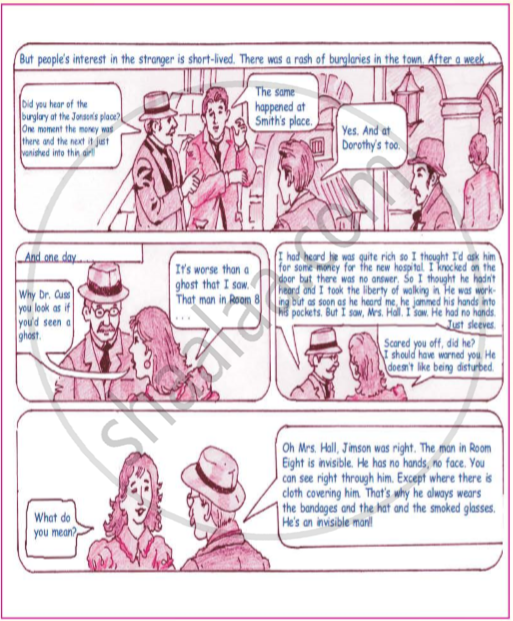
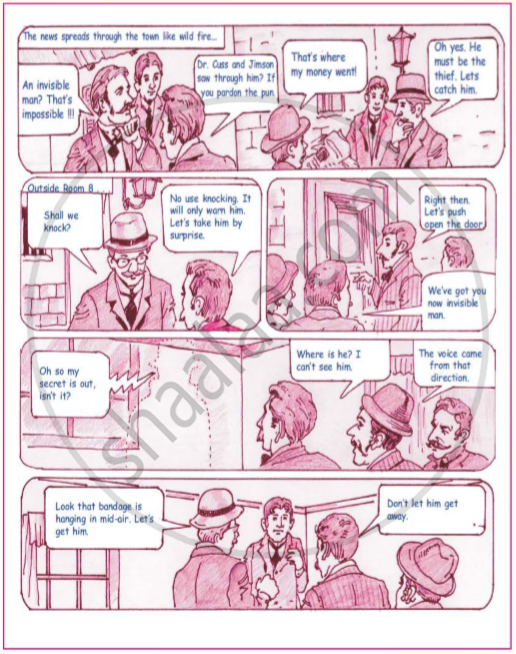
Answer the questions by ticking the correct option.
(a) The strange-looking man wanted ....
(i) the best room at the inn.
(ii} a room with a fire and a good lock.
(iii} a room with a good view.
(iv) a room where he could work quietly.
(b) Jimson was suspicious of the stranger because ...
(i} he did not answer Jimson's questions.
(ii} he did not want to talk about the weather.
(iii} he kept his back turned towards Jimson at all times.
(iv) he shouted atJimson when he entered his room.
(c) The people of the town gossiped about the stranger as ...
(i} he did not go out or talk to anyone in the town.
(ii} he had met with an accident and his face was bandaged.
(iii} he was new to the town and behaved rudely.
(iv) he stayed in his room and did not show his face to anyone.
(d) 'There was a rush of burglaries in the town. This means that ________
(i} there were many robberies in the town.
(ii) a few people in the town had seen a rob her.
(iii} the burglaries in the town were done in a rush.
(iv) the burglar was a rash and careless man.
(e) Although Jimson and Dr Cuss are suspicious of the strange guest, Mrs Hall tolerates him because ....
(i} she is not superstitious or ignorant.
(ii) she is sorry for the stranger who is bandaged.
(iii} the stranger is paying her a good amount of money for the room.
(iv} the stranger is polite and kind to Mrs Hall at all times.
(f) The stranger who was staying at the inn can be described as being ....
(I} violent
(ii} upright
(iii} dishonest
(iv) sensible
It was a summer evening,
Old Kaspar's work was done,
And he before his cottage door
Was sitting in the sun,
And by him sported on the green
His little grandchild Wilhelmine.
She saw her brother Peterkin
Roll something large and round,
Which he beside the rivulet
In playing there had found;
He came to ask what he had found,
That was so large, and smooth, and round.
Read the lines given above and answer the question that follow.
What was Peterkin doing?
The waves beside them danced, but they
Out-did the sparkling leaves in glee;
A poet could not be but gay,
In such a jocund company!
I gazed-and gazed-but little thought
What wealth the show to me had brought:
Read the lines given above and answer the question that follow.
Which wealth is referred to by the poet?
Read the extract give below and answer the questions that follow:
All around the field spectators were gathered Cheeril!g on all the young women and men Then the final event of the day was approaching The last race about the beginning.
- Nine Gold Medals, David Roth
(i) Where had the 'young women and men' come from? What had brought them together? How had they prepared themselves for the event?
(ii) What was the last event of the day? How many athletes were participating in this event? What signal were they waiting for?
(iii) What happened to the youngest athlete halfway through the race? How did he respond?
(iv) What 'strange' tum did the story take at this point?
(v) Why does the poet say that the banner - 'Special Olympics' could not have been nearer the mark? What human quality does the poem celebrate?
Grandmother’s prophecy was that the tiger
Mark the right answer.
Do we usually say that an animal ‘wears’ a tail? What do we say? (Think: Does an animal wear a coat? Consulta dictionary if you like, and find out how ‘wear’ is used in different ways
Read the following.
A group of children in your class are going to live in a hostel.
•They have been asked to choose a person in the group to share a room with.
•They are asking each other questions to decide who they would like to share a room with. Ask one another questions about likes/dislikes/preferences/hobbies/personal characteristics.
Use the following questions and sentence openings.
(i) What do you enjoy doing after school?
I enjoy...
(ii) What do you like in general?
I like...
(iii) Do you play any game?
I don’t like...
(iv) Would you mind if I listened to music after dinner?
I wouldn’t...
(v) Will it be all right if I...?
It’s fine with me...
(vi) Is there anything you dislike, particularly? Well, I can’t share...
(vii) Do you like to attend parties?
Oh, I...
(viii) Would you say you are...?
I think...
Which phrase in the poem expresses Dad’s self-confidence best?
Which word in the extract means, ‘holes’?
The little elf was a nag. How did it tell Patrick’s health?
Multiple Choice Question:
Which one of the following is not associated with the kite’s movement?
Sit in a circle so that you can see each other. Each one must talk to complete the following sentence in his own way. “What makes me very angry is …”. Remember to listen with respect and without comment to each person as he/she speaks.
What does the word ‘chasing in the extract mean?
How did Rasheed lose all his money at the Lucky shop?
Give a synonym for ‘like’ in the context of the poem.
What did the dog do to lead the farmer to the hidden gold?
Why did the daimio reward the farmer, but punish his neighbour for the same act?
Why did the Gujar women strike the big brass gurrahs with stick?
