Advertisements
Advertisements
प्रश्न
Who was Gopal? What was the challenge given to him by the king? How he won it?
Advertisements
उत्तर
Gopal was one of the wise men in the king’s court. When the king was fed up with ongoing talks about Hilsa fish he challenged Gopal.
Gopal happily accepted the challenge of buying a huge Hilsa fish from the market and to ensure on the way from the market to the palace no one should talk to him about the fish.
He was an intelligent man. He dressed up like a mad man and his appearance caught everyone’s attention. He reached the court without anyone talking about the fish as every one was drawn towards his appearance.
संबंधित प्रश्न
Answer the following question in one or two sentences.
What was Kezia’s father’s routine
(i) before going to his office?
(ii) after coming back from his office?
(iii) on Sundays?
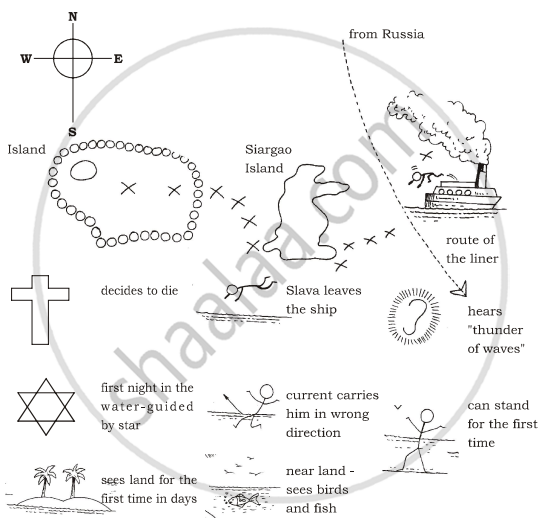
Given below is a map of the area in which Slava Kurilov faced his ordeal. You will also see the major events in the story, in mixed order, each accompanied by a symbol. After you have read ‘Ordeal in the Ocean’, draw the appropriate symbol against each x mark. (One is already drawn for you.) Draw the symbols or number the symbols, and transfer them to the map.)
Read the following conversation:
Malavika and Deepak are looking through some photographs of Malavika’s family.
| Malavika: | Now ... this is my brother Shantanu. Shantanu is in Class VIII. Shantanu is brilliant at playing tennis. Shantanu is also good at singing. Shantanu sings a lot. |
| Deepak: | Shantanu sounds interesting. I’d like to meet Shantanu. I’m looking for someone to play tennis with. |
| Malavika: | Well ... why don’t you come around tonight and meet Shantanu? My parents will be out. My parents always go out on Tuesdays. |
Improve the above conversation by using suitable pronouns where required.
Read the following story
There lived a wise old man in Purkul, Dehradun. The villagers looked up to him and approached him for all their problems. Three naughty boys Amar, Naveen and Praveen wanted to test the old man's wisdom. One fine morning they caught a butterfly while playing in the garden. Amar had the
butterfly in his hand. He said, "We will go to the old man and ask him ifthe butterfly is dead or alive. If the old man says, 'the butterfly is dead', I will open my hands and release the butterfly. It will fly away." "If he says it is alive?" asked N aveen looking at Amar with a smirk. "I will crush the butterfly and show him the dead insect," said Amar. The three of them set forth with their wonderful plan.
Amar went to the old man and said, "Sir, the villagers say you can predict the future. Now tell us if the butterfly in my hand is dead or alive?" The old man looked at the three boys with a serene smile and said, "It is in your hands."
"My father lived at Blenheim then,
Yon little stream hard by;
They burnt his dwelling to the ground,
And he was forced to fly;
So with his wife and child he fled,
Nor had he where to rest his head.
"With fire and sword the country round
Was wasted far and wide,
And many a childing mother then,
And new-born baby died;
But things like that, you know, must be
At every famous victory;
Read the lines given above and answer the question that follow.
What does Kasper’s attitude signify?
The waves beside them danced, but they
Out-did the sparkling leaves in glee;
A poet could not be but gay,
In such a jocund company!
I gazed-and gazed-but little thought
What wealth the show to me had brought:
Read the lines given above and answer the question that follow.
Which jocund company is the poet referring to ?
Sibia sprang.
From boulder to boulder she came leaping like a rock goat. Sometimes it had seemed difficult to cross these stones, especially the big gap in the middle where the river coursed through like a bulge of glass. But now she came on wings, choosing her footing in midair without even thinking about it, and in one moment she was beside the shrieking woman. In the boiling bloody water, the face of the crocodile, fastened round her leg, was tugging to and fro, and smiling. His eyes rolled on to Sibia. One slap of the tail could kill her. He struck. Up shot the water, twenty feet, and fell like a silver chain. Again! The rock jumped under the blow. But in the daily heroism of the jungle, as common as a thorn tree, Sibia did not hesitate. She aimed at the reptile’s eyes. With all the force of her little body, she drove the hayfork at the eyes, and one prong went in—right in— while its pair scratched past on the horny cheek. The crocodile reared up in convulsion, till half his lizard body was out of the river, the tail and nose nearly meeting over his stony back. Then he crashed back, exploding the water, and in an uproar of bloody foam he disappeared. He would die. Not yet, but presently, though his death would not be known for days; not till his stomach, blown with gas, floated him. Then perhaps he would be found upside down among the logs at the timber boom, with pus in his eye. Sibia got arms round the fainting woman, and somehow dragged her from the water.
Read the extract given below and answer the question that follow.
Describe how Sibia flew to save the woman.
Suddenly all the tension seemed to ebb out of my body as the truth of what he said hit me. Confidently, I drew a line a full foot in back of the board and proceeded to jump from there. I qualified with almost a foot to spare.
That night I walked over to Luz Long’s room in the Olympic village to thank him. I knew that if it hadn’t been for him I probably wouldn’t be jumping in the finals the following day. We sat in his quarters and talked for two hours—about track and field, ourselves, the world situation, a dozen other things.
When I finally got up to leave, we both knew that a real friendship had been formed. Luz would go out to the field the next day trying to beat me if he could. But I knew that he wanted me to do my best—even if that meant my winning.
Read the extract given below and answer the question that follow.
How did the rivalry of Owens and Long end?
Read the extract given below and answer the questions that follow :
Duke: You hear the team’d Bellario, what he writes:
And here, I take it, is the doctor come.
[Enter Portia, dressed like a Doctor of Laws]
Give me your hand. Come you from old Bellario”?
Portia: I did, my lord.
Duke: You are welcome : take your place.
Are you acquainted with the difference
That holds this present question in the court?
(i) Where is this scene set? Why was Portia there?
(ii) What reason had Bellario given for his absence? Whom had he sent in this stead?
(iii) Bellario's letter stated that he had taken some measures to prepare the 'young and learned doctor' to deal with the case. What were they?
(iv) What was the 'difference' between Shylock the Jew and Antonio the merchant that the Duke was unable to resolve?
(v) How does Portia succeed in saving Antonio? What does this reveal of her character?
During which time of the day would the hermit would leave the forest and go out?
Why was Ravi dragging Mridu towards the backyard?
How did the author said to encourage his friend to fix the gear-case?
What was customary for the mongoose?
Why was the crocodile’s wife annoyed with her husband one day?
In what respect was the wrestling match strange? Who were the two rivals? Who was the winner?
What happens when the adults give too many instructions to their children?
Complete the following sentence.
In the spring, the banyan tree ________________, and _______________ would come there.
Where are rattlesnakes found?
Who says this to whom and why?
“My wife knows best how to run the house.”
In the poem, The Darkling Thrush, the poet uses the words “evensong" and “carolling” to describe the thrush's song because ______.
