Advertisements
Advertisements
प्रश्न
Each of the following words contains the sound ‘sh’ (as in shine) in the beginning or in the middle or at the end. First speak out all the words clearly. Then arrange the words in three groups in the table below
sheep trash marsh fashion
anxious shriek shore fish
portion ashes sure nation
shoe pushing polish moustache
| initial | medial | final |
Advertisements
उत्तर
| initial | medial | final |
| sheep | fashion | trash |
| shreik | anxious | marsh |
| shore | portion | fish |
| sure | ashes | polish |
| shoe | nation | |
| pushing | ||
| moustache |
संबंधित प्रश्न
The Shehnai of Bismillah Khan Thinking about the text :
Tick the right answer.
Bismillah Khan learnt to play the shehnai from (Ali Bux, Paigambar Bux, Ustad Faiyaaz
Khan).
What does he plant who plants a tree?
He plants, in sap and leaf and wood,
In love of home and loyalty
And far-cast thought of civic good____
His blessing on the neighbourhood,
Who in the hollow of his hand
Holds all the growth of all our land____
A nation's growth from sea to sea
Stirs in his heart who plants a tree.
Read the lines given above and answer the question that follow:
Does the man plant a tree because of his love of society and his nation?
It was a summer evening,
Old Kaspar's work was done,
And he before his cottage door
Was sitting in the sun,
And by him sported on the green
His little grandchild Wilhelmine.
She saw her brother Peterkin
Roll something large and round,
Which he beside the rivulet
In playing there had found;
He came to ask what he had found,
That was so large, and smooth, and round.
Read the lines given above and answer the question that follow.
What was Peterkin doing?
So please, oh please, we beg, we pray,
Go throw your TV set away,
And in its place you can install
A lovely bookshelf on the wall.
Then fill the shelves with lots of books,
Ignoring all the dirty looks,
The Screams and yells,the bites and kicks,
And children hitting you with sticks-
Fear not, because we promise you
That, in about a week ot two
Of having nothing else to do,
They'll now begin to feel the need
Of having something to read.
And once they start - oh boy, oh boy!
You watch the slowly growing joy
That fills their hearts. They'll grow so keen
They'll wonder what they'd ever seen
In that ridiculous machine,
That nauseating, foul, unclean,
Repulsive television screen!
And later, each and every kid
Will love you more for what you did.
Read the lines given above and answer the question given below.
What does Dahl ask the parents to do?
I wandered lonely as a Cloud
That floats on high o'er vales and Hills,
When all at once I saw a crowd,
A host, of golden Daffodils;
Beside the Lake, beneath the trees,
Fluttering and dancing in the breeze.
Read the lines given above and answer the question that follow.
Where were the daffodils and what where they doing ?
Its a cruel thing to leave her so.”
“Then take her to the poorhouse: she’ll have to go there,” answered the blacksmith’s wife, springing away, and leaving Joe behind.
For a little while the man stood with a puzzled air; then he turned back, and went into the hovel again. Maggie with painful effort, had raised herself to an upright position and was sitting on the bed, straining her eyes upon the door out of which all had just departed, A vague terror had come into her thin white face.
“O, Mr. Thompson!” she cried out, catching her suspended breath, “don’t leave me here all alone!” ,
Though rough in exterior, Joe Thompson, the wheelwright, had a heart, and it was very tender in some places. He liked children, and was pleased to have them come to his shop, where sleds and wagons were made or mended for the village lads without a draft on their hoarded sixpences.
“No, dear,” he answered, in a kind voice, going to the bed, and stooping down over the child, “You she’n’t be left here alone.” Then he wrapped her with the gentleness almost of a woman, in the clean bedclothes which some neighbor had brought; and, lifting her in his strong arms, bore her out into the air and across the field that lay between the hovel and his home.
Read the extract given below and answer the question that follow.
What did Maggie say to Mr Thompson? What do her words show?
Its a cruel thing to leave her so.”
“Then take her to the poorhouse: she’ll have to go there,” answered the blacksmith’s wife, springing away, and leaving Joe behind.
For a little while the man stood with a puzzled air; then he turned back, and went into the hovel again. Maggie with painful effort, had raised herself to an upright position and was sitting on the bed, straining her eyes upon the door out of which all had just departed, A vague terror had come into her thin white face.
“O, Mr. Thompson!” she cried out, catching her suspended breath, “don’t leave me here all alone!” ,
Though rough in exterior, Joe Thompson, the wheelwright, had a heart, and it was very tender in some places. He liked children, and was pleased to have them come to his shop, where sleds and wagons were made or mended for the village lads without a draft on their hoarded sixpences.
“No, dear,” he answered, in a kind voice, going to the bed, and stooping down over the child, “You she’n’t be left here alone.” Then he wrapped her with the gentleness almost of a woman, in the clean bedclothes which some neighbor had brought; and, lifting her in his strong arms, bore her out into the air and across the field that lay between the hovel and his home.
Read the extract given below and answer the question that follow.
What idea do we get of the character of Mr Thompson?
Most terribly cold it was; it snowed, and was nearly quite dark, and evening— the last evening of the year. In this cold and darkness there went along the street a poor little girl, bareheaded, and with naked feet. When she left home she had slippers on, it is true; but what was the good of that? They were very large slippers, which her mother had hitherto worn; so large were they; and the poor little thing lost them as she scuffled away across the street, because of two carriages that rolled by dreadfully fast.
One slipper was nowhere to be found; the other had been laid hold of by an urchin, and off he ran with it; he thought it would do capitally for a cradle when he some day or other should have children himself. So the little maiden walked on with her tiny naked feet, that were quite red and blue from cold. She carried a quantity of matches in an old apron, and she held a bundle of them in her hand. Nobody had bought anything of her the whole livelong day; no one had given her a single farthing. She crept along trembling with cold and hunger—a very picture of sorrow, the poor little thing!
Read the extract given below and answer the question that follow.
What did the girl carry in her pocket?
Answer the following questions with reference to Jack London's, 'The Call of the Wild'.
(i) How was Thornton talked into a wager that involved Buck, during a conversation in the Eldorado Saloon?
(ii) How did Thornton feel after he had committed Buck to the wager?
(iii) Give a brief description of how Buck managed to win the wager for Thornton.
Answer the following question.
When was the bear tied up with a chain? Why?
Who is Mridu and with whom Mridu went to Rukku Manni’s place?
What was the king’s reaction when he came to know that he had lost the challenge?
What was Maya doing on her unexpected holiday?
How did the crocodile plan to please his wife? How did the monkey use his wits and save his life?
Why does the poet say, “I hope it doesn’t matter”?
Answer the following question. (Refer to that part of the text whose number is given against the question. This applies to the comprehension questions throughout the book.)
How did Patrick help him? (7)
There are twelve words hidden in this table. Six can be found horizontally and the remaining six vertically. All of them are describing words like ‘good’, ‘happy’, etc. The first letters of the words are given below:
Horizontal: H R F F S G
Vertical: A W S F L Q 2020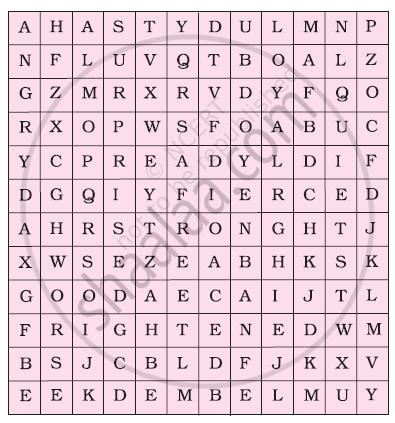
Why did the Dog decide to lose his freedom?
Write ‘True’ or ‘False’ against each of the following sentences.
Gopal was too poor to afford decent clothes.________
Complete the following sentence by providing a reason.
In the poem, Telephone Conversation, the speaker resented the landlady asking him about the colour of his skin because ______.
