Advertisements
Advertisements
प्रश्न
Thinking about Language
Here are some sentences from the text. Say which of them tell you, that the author:
(a) was afraid of the snake, (b) was proud of his appearance, (c) had a sense of humour,
(d) was no longer afraid of the snake.
1. I was turned to stone.
2. I was no mere image cut in granite.
3. The arm was beginning to be drained of strength.
4. I tried in my imagination to write in bright letters outside my little heart the words, ‘O
God’.
5. I didn’t tremble. I didn’t cry out.
6. I looked into the mirror and smiled. It was an attractive smile.
7. I was suddenly a man of flesh and blood.
8. I was after all a bachelor, and a doctor too on top of it!
9. The fellow had such a sense of cleanliness…! The rascal could have taken it and used it
after washing it with soap and water.
10. Was it trying to make an important decision about growing a moustache or using eye
shadow and mascara or wearing a vermilion spot on its forehead?
Advertisements
उत्तर
| (a) was afraid of the snake | (b) was proud of his appearance | (c) had a sense of humour | (d) was no longer afraid of the snake | |
| 1 | I was turned to stone. |
|||
| 2 | I was no mere image cut in granite. | |||
| 3 | The arm was beginning to be drained of strength. |
|||
| 4 | I tried in my imagination to write in bright letters outside my little heart the words, ‘O God’. |
I tried in my imagination to write in bright letters outside my little heart the words, ‘O God’. | ||
| 5 | I didn’t tremble. I didn’t cry out. |
|||
| 6 | I looked into the mirror and smiled. It was an attractive smile. |
|||
| 7 | I was suddenly a man of flesh and blood. | |||
| 8 | I was after all a bachelor, and a doctor too on top of it! |
|||
| 9 | The fellow had such a sense of cleanliness…! The rascal could have taken it and used it after washing it with soap and water. |
|||
| 10 | Was it trying to make an important decision about growing a moustache or using eye shadow and mascara or wearing a vermilion spot on its forehead. |
संबंधित प्रश्न
Answer these question in 30–40 words.
Why did Aurangzeb ban the playing of the pungi?
Discuss these question in class with your teacher and then write down your answer
in two or three paragraphs .
Kezia’s efforts to please her father resulted in displeasing him very much. How did this
happen?
Why does the world remember Einstein as a “world citizen”?
Thinking about the Poem
Which country or countries do you think “the Northland” refers to?
When does he realize that he has lost his way? How have his anxiety and insecurity been described?
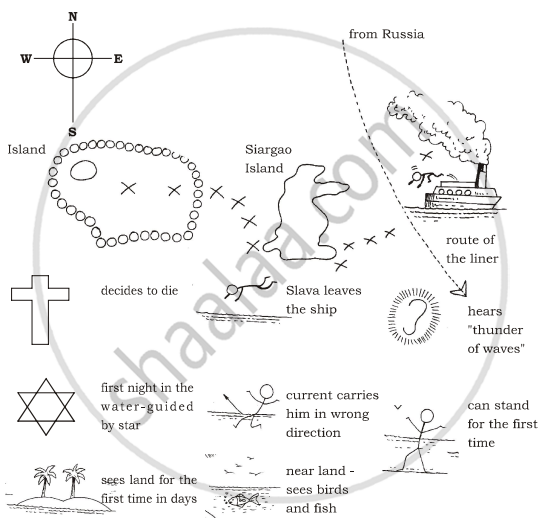
Given below is a map of the area in which Slava Kurilov faced his ordeal. You will also see the major events in the story, in mixed order, each accompanied by a symbol. After you have read ‘Ordeal in the Ocean’, draw the appropriate symbol against each x mark. (One is already drawn for you.) Draw the symbols or number the symbols, and transfer them to the map.)
'All right!' you 'll cry.'All right!' you'll say,
'But if we take the set away,
What shall we do to entertain
Our darling children?Please explain!'
We'll answer this by asking you,
'What used the darling ones to do?
'How used they keep themselves contented
Before this monster was invented?'
Have you forgotten? Don't you know?
We'll say it very loud and slow:
THEY ... USED ... TO ... READ! They'd READ and READ,
AND READ and READ, and then proceed
To READ some more. Great Scott! Gadzooks!
One half their lives was reading books!
The nursery shelves held books galore!
Books cluttered up the nursery floor!
And in the bedroom, by the bed,
More books were waiting to be read!
Read the lines given above and answer the question given below.
How according to the poet, can children benefit from reading books?
To us the ashes of our ancestors are sacred and their resting place is hallowed ground. You wander far from the graves of your ancestors and seemingly without regret. Your religion was written upon tablets of stone by the iron finger of your God so that you could not forget. The Red Man could never comprehend or remember it. Our religion is the traditions of our ancestors — the dreams of our old men, given them in solemn hours of the night by the Great Spirit; and the visions of our sachems, and is written in the hearts of our people.
Day and night cannot dwell together. The Red Man has ever fled the approach of the White Man, as the morning mist flees before the morning sun. However, your proposition seems fair and I think that my people will accept it and will retire to the reservation you offer them. Then we will dwell apart in peace, for the words of the Great White Chief seem to be the words of nature speaking to my people out of dense darkness.
Read the extract given below and answer the question that follow.
How do the White feel about their dead people?
He flungs himself down in a corner to recoup from the fatigue of his visit to the shop. His wife said, “You are getting no sauce today, nor anything else. I can’t find anything to give you to eat. Fast till the evening, it’ll do you good. Take the goats and be gone now,” she cried and added, “Don’t come back before the sun is down.”
Read the extract given below and answer the question that follow.
Where had Muni gone and why?
She again rubbed a match on the wall, and the light shone round her; in the brightness stood her old grandmother, clear and shining, yet mild and loving in her appearance. “Grandmother,” cried the little one, “O take me with you; I know you will go away when the match burns out; you will vanish like the warm stove, the roast goose, and the large, glorious Christmas-tree.” And she made haste to light the whole bundle of matches, for she wished to keep her grandmother there. And the matches glowed with a light that was brighter than the noon-day, and her grandmother had never appeared so large or so beautiful. She took the little girl in her arms, and they both flew upwards in brightness and joy far above the earth, where there was neither cold nor hunger nor pain, for they were with God.
In the dawn of morning there lay the poor little one, with pale cheeks and smiling mouth, leaning against the wall; she had been frozen to death on the last evening of the year; and the New-year’s sun rose and shone upon a little corpse! The child still sat, in the stiffness of death, holding the matches in her hand, one bundle of which was burnt. “She tried to warm herself,” said some. No one imagined what beautiful things she had seen, nor into what glory she had entered with her grandmother, on New-year’s day.
Read the extract given below and answer the question that follow.
What happened to the little girl? What did the people think?
As it turned out, Luz broke his own past record. In doing so, he pushed me on to a peak performance. I remember that at the instant I landed from my final jump—the one which set the Olympic record of 26 feet 5-5/16 inches—he was at my side, congratulating me. Despite the fact that Hitler glared at us from the stands not a hundred yards away, Luz shook my hand hard—and it wasn’t a fake “smile with a broken heart” sort of grip, either.
You can melt down all the gold medals and cups I have, and they couldn’t be a plating on the 24-carat friendship I felt for Luz Long at that moment. I realized then, too, that Luz was the epitome of what Pierre de Coubertin, founder of the modern Olympic Games, must have had in mind when he said, “The important thing in the Olympic Games is not winning but taking part. The essential thing in life is not conquering but fighting well.”
Read the extract given below and answer the question that follow.
What do you understand of Hitler from Jesse’s account?
So after that, dimly, dimly, she sensed it, she was different and they knew her difference and kept away. There was talk that her father and mother were taking her back to Earth next year; it seemed vital to her that they do so, though it would mean the loss of thousands of dollars to her family. And so, the children hated her for all these reasons of big and little consequence. They hated her pale snow face, her waiting silence, her thinness, and her possible future. “Get away 1” The boy gave her another push. “What’re you waiting for?”Then, for the first time, she turned and looked at him. And what she was waiting for was in her eyes. “Well, don’t wait around here !” cried the boy savagely. “You won’t see nothing!” Her lips moved. “Nothing 1” he cried. “It was all a joke, wasn’t it?” He turned to the other children. “Nothing’s happening today. Is it ?”
Read the extract given below and answer the question that follow.
What was Margot waiting for? Why did William say it was a joke?
In what ways did the bear become the lady’s pet animals?
A summary of the story is given in the textbook.
Fill in the blanks to complete it taking appropriate phrases from the box.
This is the story of ______________, who used to be ___________. He decided to find a master ______________. First he found _____________, but the wolf was afraid of ________________. The dog thought that the bear was ______________. After some time the dog met _______________, who seemed the strongest. He stayed with the lion for a long time. One day he realised that the lion was ___________________ . To this day, the dog remains man’s best friend.
| a dog, stronger than anyone else, the strongest of all, a wolf, the bear, afraid of man, his own master, a lion |
How did Taro meet the demand of his father?
With your partner try to guess the meaning of the underlined phrase.
And somehow we fell out.
Multiple Choice Question:
The child in this poem seems to be ____________.
Complete the following sentences from memory choosing a phrase from those given in brackets.
Tradesmen came to the village with all kinds of goods ____________
What is meant by a ‘game of chance’? What lesson did the narrator learn from his experience at the fair?
Where was Caesar put to death?
