Advertisements
Advertisements
प्रश्न
Does father lose hope?
Advertisements
उत्तर
No, father doesn’t lose hope because he had confidence in his skill of climbing up a tree.
संबंधित प्रश्न
Answer the following question in one or two sentences.
Why was Kezia afraid of her father?
Listen to this extract from Shakespeare's play As You Like It. As you listen, read
the poem aloud; you can do this more than once.
All the world's a stage
And all the men and women merely players:
They have their exits and their entrances;
And one man in his time plays many parts,
His acts being seven ages. At first the infant,
Mewling and puking in the nurse's arms.
Then the whining schoolboy, with his satchel
And shining morning face, creeping like snail
Unwillingly to school. And then the lover,
Sighing like furnace, with a woeful ballad
Made to his mistress' eyebrow. Then a soldier.
Full of strange oaths, and bearded like the pard,
Jealous in honour, sudden and quick in quarrel,
Seeking the bubble reputation.
Even in the cannon's mouth. And then the justice,
In fair round belly with good capon lined,
With eyes severe and beard of formal cut,
Full of wise saws and modern instances;
And so he plays his part. The sixth age shifts
Into the lean and slippered pantaloon,
With spectacles on nose and pouch on side,
His youthful hose, well saved, a world too wide
For his shrunk shank; and his big manly voice,
Turning again toward childish treble, pipes
And whistles in his sound. Last scene of all,
That ends this strange eventful history,
Is second childishness and mere oblivion,
Sans teeth, sans eyes, sans taste, sans everything.
About the Poet
William Shakespeare (1564-1616) was born in Stratford-upon-Avon. He is
considered by many to be the greatest dramatist of all time. He wrote 154 sonnets, two
long narrative poems and about three dozen plays. Shakespeare used poetic and
dramatic means to create unified aesthetic effects. In verse, he perfected the dramatic
blank verse.
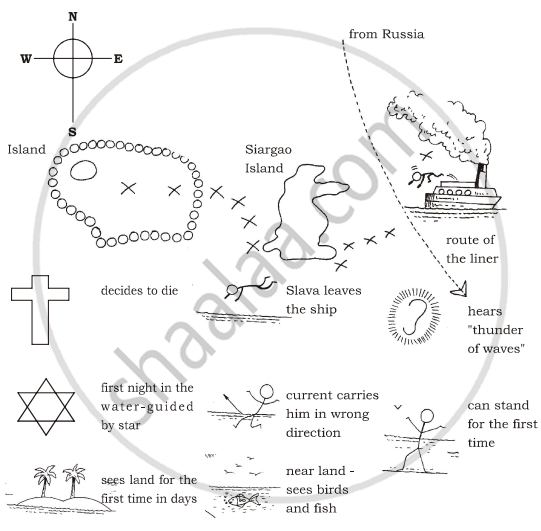
Given below is a map of the area in which Slava Kurilov faced his ordeal. You will also see the major events in the story, in mixed order, each accompanied by a symbol. After you have read ‘Ordeal in the Ocean’, draw the appropriate symbol against each x mark. (One is already drawn for you.) Draw the symbols or number the symbols, and transfer them to the map.)
"My father lived at Blenheim then,
Yon little stream hard by;
They burnt his dwelling to the ground,
And he was forced to fly;
So with his wife and child he fled,
Nor had he where to rest his head.
"With fire and sword the country round
Was wasted far and wide,
And many a childing mother then,
And new-born baby died;
But things like that, you know, must be
At every famous victory;
Read the lines given above and answer the question that follow.
What does Kasper’s attitude signify?
An old man with steel rimmed spectacles and very dusty clothes sat by the side of the road. There was a pontoon bridge across the river and carts, trucks, and men, women and children were crossing it. The mule-drawn carts staggered up the steep bank from the bridge with soldiers helping push against the spokes of the wheels. The trucks ground up and away heading out of it all and the peasants plodded along in the ankle deep dust. But the old man sat there without moving. He was too tired to go any farther.
Read the extract given below and answer the question that follow.
Why did the old man continue to sit without moving with the other villagers?
“I love the West,” said the girl irrelevantly. Her eyes were shining softly. She looked away out the car window. She began to speak truly and simply without the gloss of style and manner: “Mamma and I spent the summer in Deliver. She went home a week ago
because father was slightly ill. I could live and be happy in the West. I think the air here agrees with me. Money isn’t everything. But people always misunderstand things and remain stupid—” “Say, Mr. Marshal,” growled the glum-faced man. “This isn’t quite fair. I’m needing a drink, and haven’t had a smoke all day. Haven’t you talked long enough? Take me in the smoker now, won’t you? I’m half dead for a pipe.”
The bound travellers rose to their feet, Easton with the Same slow smile on his face. “I can’t deny a petition for tobacco,” he said, lightly. “It’s the one friend of the unfortunate. Good-bye, Miss Fairchild. Duty calls, you know.” He held out his hand for a farewell. “It’s too bad you are not going East,” she said, reclothing herself with manner and style. “But you must go on to Leavenworth, I suppose?” “Yes,” said Easton, “I must go on to Leavenworth.”
The two men sidled down the aisle into the smoker. The two passengers in a seat near by had heard most of the conversation. Said one of them: “That marshal’s a good sort of chap. Some of these Western fellows are all right.” “Pretty young to hold an office like that, isn’t he?” asked the other. “Young!” exclaimed the first speaker, “why—Oh! didn’t you catch on? Say—did you ever know an officer to handcuff a prisoner to his right hand?”
Read the extract given below and answer the question that follow.
Why is Fairchild heading east?
Easton, with a little laugh, as if amused, was about to speak again when the other forestalled him. The glum-faced man had been watching the girl’s countenance with veiled glances from his keen, shrewd eyes.
“You’ll excuse me for speaking, miss, but, I see you’re acquainted with the marshall here. If you’ll ask him to speak a word for me when we get to the pen he’ll do it, and it’ll make things easier for me there. He’s taking me to Leavenworth prison. It’s seven years for counterfeiting.”
“Oh!” said the girl, with a deep breath and returning color. “So that is what you are doing out here? A marshal!”
“My dear Miss Fairchild,” said Easton, calmly, “I had to do something. Money has a way of taking wings unto itself, and you know it takes money to keep step with our crowd in Washington. I saw this opening in the West, and—well, a marshalship isn’t quite as high a position as that of ambassador, but—”
Read the extract given below and answer the question that follow.
What was the crime of the prisoner? And what is the punishment.
Joe did not see the Guardians of the Poor on that day, on the next, nor on the day following. In fact, he never saw them at all on Maggie’s account, for in less than a week Mrs. Joe Thompson would as soon leave thought of taking up her own abode in the almshouse as sending Maggie there.
What light and blessing did that sick and helpless child bring to the home of Joe Thompson, the poor wheelwright! It had been dark, and cold, and miserable there for a long time just because his wife had nothing to love and care for out of herself, and so became soar, irritable, ill-tempered, and self-afflicting in the desolation of her woman’s nature. Now the sweetness of that sick child, looking ever to her in love, patience, and gratitude, was as honey to her soul, and she carried her in her heart as well as in her arms, a precious burden. As for Joe Thompson, there was not a man in all the neighbourhood who drank daily of a more precious wine of life than he. An angel had come into his house, disguised as a sick, helpless, and miserable child, and filled all its dreary chambers with the sunshine of love.
Read the extract given below and answer the question that follow.
What had changed Mrs Thompson?
Read the extract given below and answer the questions that follow:
Portia: To these injunctions every one doth s'vear
That comes to hazard for my worthless self.
Arragon: And so have I address'd me. Fortune now
To my heart's hope! - Gold, silver and base lead.
(i) Who had tried his luck in trying to choose the correct casket before the prince of Arragon? Which casket had that suitor chosen ? What did he find inside the casket?
(ii) What are the three things Arragon was obliged by the oath to obey?
(iii) What was the inscription on the golden casket? How do the actions of the martlet illustrate this inscription?
(iv) Which casket does Arragon finally choose? Whose portrait does he find inside? Which casket actually contains Portia's portrait?
(v) Who enters soon after? What does he say about the young Venetian who has just arrived? What gifts has the Venetian brought with him?
Answer the following question.
Golu’s relatives did not answer his questions because
Abbu Khan said, “No more goats in my house ever again.” Then he changed his mind. Why?
Explain three ways in which the dog helped his master.
What all facts Maya collected about Mr Nath?
Give the character sketch of Soapy.
Why and when did Dad say the following?
Funny joke
Watch a tree or a plant, or walk across a field or park at the same time everyday for a week. Keep a diary of what you see and hear. At the end of the week, write a short paragraph or a poem about your experiences. Put your writing up on the class bulletin board.
Who did Patrick’s homework? Why and how?
Multiple Choice Question:
The kite rides over _____________
Fill in the blanks with the words given in the box.
| how, what, when, where, which |
"You should know ______ to talk and ______ to keep your mouth shut," the teacher advised Anil.
