Advertisements
Advertisements
प्रश्न
Mr Gessler in his last wasn’t in good health. Give three examples to prove this.
Advertisements
उत्तर
Author had mistaken Mr Gessler for his elder brother because he looked too old. There was very thin lining of hair left on the top portion of his head. During the last meeting with the author within a period of one year, Mr Gessler had grown older by around 10 years. He looked tired and exhausted.The hardships of the trade have taken a toll on his health. He even failed to recognise the author at first.
संबंधित प्रश्न
Thinking about the Poem
Is this a true story? Which part of this poem do you feel is the most important?
The passing of time will no longer affect her, says the poet. Which lines of the poem say this?
What is Behrman’s masterpiece? What makes Sue say so?
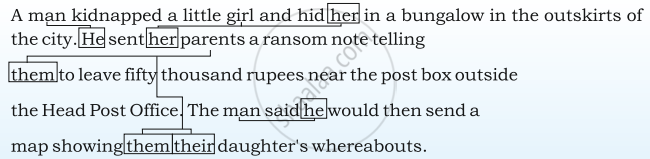
Look at the passage below and study how the personal pronouns refer to different people.
So please, oh please, we beg, we pray,
Go throw your TV set away,
And in its place you can install
A lovely bookshelf on the wall.
Then fill the shelves with lots of books,
Ignoring all the dirty looks,
The Screams and yells,the bites and kicks,
And children hitting you with sticks-
Fear not, because we promise you
That, in about a week ot two
Of having nothing else to do,
They'll now begin to feel the need
Of having something to read.
And once they start - oh boy, oh boy!
You watch the slowly growing joy
That fills their hearts. They'll grow so keen
They'll wonder what they'd ever seen
In that ridiculous machine,
That nauseating, foul, unclean,
Repulsive television screen!
And later, each and every kid
Will love you more for what you did.
Read the lines given above and answer the question given below.
Will the children thank the parents? Why?
“There were three animals altogether,” he explained. “There were two goats and a cat and then there were four pairs of pigeons.”
“And you had to leave them?” I asked.
“Yes. Because of the artillery. The captain told me to go because of the artillery.” “And you have no family?” I asked, watching the far end of the bridge where a few last carts were hurrying down the slope of the bank.
“No,” he said, “only the animals I stated. The cat, of course, will be all right. A cat can look out for itself, but I cannot think what will become of the others.”
“What politics have you?” I asked.
“I am without politics,” he said. “I am seventy-six years old. I have come twelve kilometers now and I think now I can go no further.”
“This is not a good place to stop,” I said. “If you can make it, there are trucks up the road where it forks for Tortosa.”
“I will wait a while,” he said, “ and then I will go. Where do the trucks go?” “Towards Barcelona,” I told him.
“I know no one in that direction,” he said, “but thank you very much.
Read the extract given below and answer the question that follow.
Where did the narrator want the old man to go?
Margot stood alone. She was a very frail girl who looked as if she had been lost in the rain for years and the rain had washed out the blue from her eyes and the red from her mouth and the yellow from her hair. She was an old photograph dusted from an album, whitened away, and if she spoke at all her voice would be a ghost. Now she stood, separate, staring at the rain and the loud wet world beyond the huge glass. “What’re you looking at ?” said William. Margot said nothing. “Speak when you’re spoken to.” He gave her a shove. But she did not move; rather she let herself be moved only by him and nothing else. They edged away from her, they would not look at her. She felt them go away. And this was because she would play no games with them in the echoing tunnels of the underground city. If they tagged her and ran, she stood blinking after them and did not follow. When the class sang songs about happiness and life and games her lips barely moved. Only when they sang about the sun and the summer did her lips move as she watched the drenched windows.
Read the extract given below and answer the question that follow.
What was the reaction of the children towards Margot?
Read the following sentences.
a) If she knows we have a cat, Paati will leave the house.
(b) She won’t be so upset if she knows about the poor beggar with sores on his feet.
c) If the chappals do fit, will you really not mind? Notice that each sentence consists of two parts. The first part begins with ‘if’. It is known as if-clause.
Rewrite each of the following pairs of sentences as a single sentence. Use ‘if’ at the beginning of the sentence
Work hard. You’ll pass the examination in the first division
Answer the following questions.
Why is it not good to be a rebel oneself?
Compare how the music teacher played the violin with that of Lalli’s.
Why Maya called Nishad Seven?
How did Chandni feel on reaching the hills?
What is one thing that dreams can never tell?
ind the word that refers to the snake’s movements in the grass.
Word in the box given below indicates a large number of… For example, ‘a herd of cows’ refers to many cows. Complete the following phrase with a suitable word from the box.
a _______________ of fish
Write True or False against the following statement.
Nasir lives in a city.
Multiple Choice Question:
How are words related to ideas?
What does the word ‘chasing in the extract mean?
Who went the other way?
Read the lines given below and answer the following question:
| Sophocles long ago Heard it on the Agean… |
What did he hear on the Agean?
