Advertisements
Advertisements
प्रश्न
Do all the electrons that absorb a photon come out as photoelectrons?
Advertisements
उत्तर
The photoelectric effect is the emission of electrons (called photo-electrons when light strikes a surface. To escape from the surface, the electron must absorb enough energy from the incident radiation to overcome the attraction of positive ions in the material of the surface.
The photoelectric effect is based on the principle of conservation of energy.
1. Two conducting electrodes, the anode (Q) and cathode (P) are enclosed in an evacuated glass tube as shown on next page.
2. The battery or other source of potential difference creates an electric field in the direction from anode to cathode.
3. Light of a certain wavelength or frequency falling on the surface of the cathode causes a current in the external circuit called photoelectric current.
4. As the potential difference increases, photoelectric current also increases till saturation is reached.
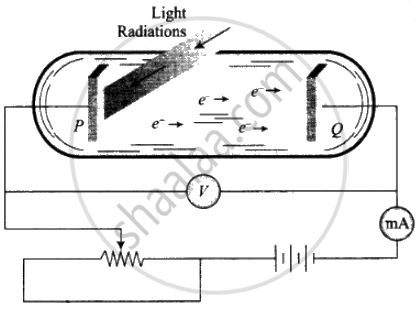
5. When polarity of the battery is reversed (i.e., plate Q is at negative potential w.r.t. plate P) electrons start moving back towards the cathode.
6. At a particular negative potential of plate Q, no electron will reach the plate Q and the current will become zero. This negative potential is called stopping potential denoted by V0. Maximum kinetic energy of photoelectrons in terms of stopping potential will therefore be Kmax = (|V0|) eV
So we conclude that in the photoelectric effect, we can observe that most electrons get scattered into the metal by absorbing a photon.
Therefore, all the electrons that absorb a photon don't come out as photoelectron. Only a few come out of metal whose energy becomes greater than the work function of the metal.
APPEARS IN
संबंधित प्रश्न
Every metal has a definite work function. Why do all photoelectrons not come out with the same energy if incident radiation is monochromatic? Why is there an energy distribution of photoelectrons?
Draw graphs showing variation of photoelectric current with applied voltage for two incident radiations of equal frequency and different intensities. Mark the graph for the radiation of higher intensity.
Should the energy of a photon be called its kinetic energy or its internal energy?
Planck's constant has the same dimensions as
The equation E = pc is valid
A point source of light is used in a photoelectric effect. If the source is removed farther from the emitting metal, the stopping potential
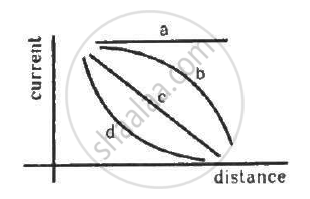
A point source causes photoelectric effect from a small metal plate. Which of the following curves may represent the saturation photocurrent as a function of the distance between the source and the metal?
Define the term: stopping potential in the photoelectric effect.
Consider a thin target (10–2 cm square, 10–3 m thickness) of sodium, which produces a photocurrent of 100 µA when a light of intensity 100W/m2 (λ = 660 nm) falls on it. Find the probability that a photoelectron is produced when a photons strikes a sodium atom. [Take density of Na = 0.97 kg/m3].
How would the stopping potential for a given photosensitive surface change if the frequency of the incident radiation were increased? Justify your answer.
A metallic plate exposed to white light emits electrons. For which of the following colours of light, the stopping potential will be maximum?
Which three factors are varied to examine how photocurrent behaves?
Which part provides an entry point for incident radiation?
Which apparatus provides monochromatic radiation for illuminating emitter plate C?
Which apparatus measures photocurrent?
What changes the polarity between the plates?
After applying a potential difference, how is the resulting photocurrent measured?
For frequencies above the threshold, how does photocurrent change with increasing incident light intensity?
What happens if the frequency of incident radiation is below the threshold frequency?
