Advertisements
Advertisements
प्रश्न
Distinguish between the following:
Hypotonic and Hypertonic solutions
Advertisements
उत्तर
| Hypotonic solutions | Hypertonic solutions | |
| (i) | In this condition, the solution outside the cell has a lower solute concentration than the cell sap. | In this condition, the solution outside the cell has a higher solute concentration than the cells sap. |
| (ii) | The water molecules from outside will move into the cell (endosmosis). | The water molecules from the interior of the cell will move out (exosmosis) under excessive root pressure. |
| (iii) | It is a weak solution and strong solvent. | It is a strong solution with a weak solvent. |
APPEARS IN
संबंधित प्रश्न
Movement of molecules of a substance from the region of their higher concentration to the region of their lower concentration without the involvement a separating membrane, is called
The space between the cell wall and plasma membrane in a plasmolysed cell is filled with ______.
Name the following:
Condition of cell in which the cell contents are shrunken.
Choose the correct answer:
Grapes when placed in a strong sugar solution shrink because of __________
Two potato cubes each 1 cm3 in size, were placed separately in two containers (A and B), the container A having water and the other (B) containing concentrated sugar solution. After 24 hours when the cubes were examined, those placed in water were found to be firm and had increased slightly in size and those placed in concentrated sugar solution were found to be soft and somewhat decreased in size. Use the above information to answer the questions that follow:
Account for the softness and decrease in size of the potato cubes which were placed in sugar solution.
What do you mean by transpiration pull ?
What is the water potential?
Give Reasons for the following.
Salt and sugar are used in preserving food.
Give Reasons for the following.
The raisins swell up in the water.
In the figure below ‘A’ shows a cell in the normal state and ‘B’ shows the same cell after leaving it in a certain solution for a few minutes.

(i) Describe the change which has occurred in the cell as seen in B.
(ii) Give the technical term for the condition of the cell as reached in B and as it was in A.
(iii) Define the process which led to this condition.
(iv) What was the solution-isotonic, hypotonic or hypertonic, in which the cell was kept?
(v) How can the cell in B, be brought back to its original condition?
(vi) Name the parts numbered 1 to 3.
The diagram given below is of an experiment just at the start. Study the diagram carefully and answer the following questions :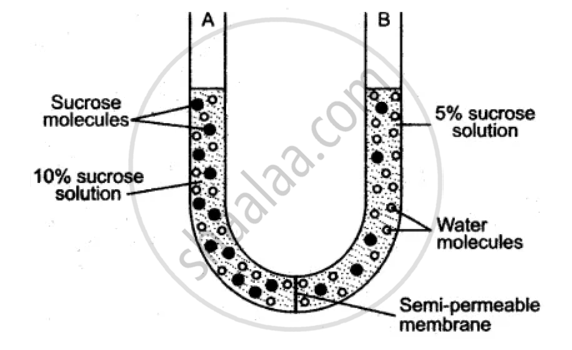
(i) What does the experiment demonstrate?
(ii) Define, the process demonstrated in the experiment.
(iii) What changes are observed after a few hours?
(iv) Give two examples of a semi-permeable membrane.
(v) Which limb of the U-tube contains a more concentrated sucrose solution, A or B?
(vi) Why is the membrane separating the two solutions labeled as semi-permeable membrane?
Give Technical Term for the following.
A solution whose concentration is greater than that of the cell sap.
Fill in the Blank
Raisin swells up when kept in a __________ solution.
Multiple Choice Question:
Osmosis involves:
Explain the Term: Endosmosis
DPD of a cell can be expressed as ______
During a practical exam, a plant cell in a particular solution was placed under a compound microscope. Students were told to observe the cell and name the tonicity of the solution and mention the process that occurred in the cell.