Advertisements
Advertisements
प्रश्न
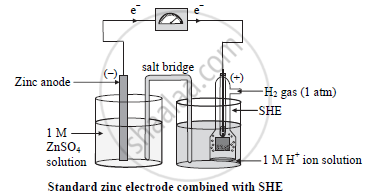
Construct a labelled diagram for the following cell:
`Zn|Zn^(2+)(1M)||H^+(1M)|H_(2(g,1atm))|Pt`
Advertisements
उत्तर
In the given representation of the cell, a standard Zn2+(1M)|Zn electrode is combined with standard hydrogen electrode to form the cell:
`Zn|Zn^(2+)(1M)||H^+(1M)|H_(2(g,1atm))|Pt`
APPEARS IN
संबंधित प्रश्न
What happens if external potential applied becomes greater than E°cell of electrochemical cell?
Can you store copper sulphate solutions in a zinc pot?
How many electrons flow through a metllic wire if a current of 0·5 A is passed for 2 hours? (Given : 1 F = 96,500 C mol−1)
Among Zn and Cu, which would occur more readily in nature as metal and which as an ion?
How many faradays of electricity are required to produce 6 g of Mg from MgCl2?
E°cell for the given redox reaction is 2.71 V
Mg(s) + Cu2+ (0.01 M) → Mg2+ (0.001 M) + Cu(s)
Calculate Ecell for the reaction. Write the direction of flow of current when an external opposite potential applied is
(i) less than 2.71 V and
(ii) greater than 2.71 V
How many moles of electrons are required for reduction of 2 moles of Zn2+ to Zn?
If 'I' stands for the distance between the electrodes and 'a' stands for the area of cross-section of the electrode, `"l"/"a"` refers to ____________.
What is the SI unit tor electrochemical equivalent?
If one mole electrons is passed through the solutions of CrCl3, AgNO3 and NiSO4, in what ratio Cr, Ag and Ni will be deposited at the electrodes?
A current strength of 3.86 A was passed through molten Calcium oxide for 41minutes and 40 seconds. The mass of Calcium in grams deposited at the cathode is (atomic mass of Ca is 40g/mol and 1F = 96500 C).
Assertion: pure iron when heated in dry air is converted with a layer of rust.
Reason: Rust has the compositionFe3O4.
A certain current liberated 0.504 gm of hydrogen in 2 hours. How many grams of copper can be liberated by the same current flowing for the same time through copper sulphate solution.
Define anode
Can Fe3+ oxidises bromide to bromine under standard conditions?
Given: \[\ce{E^0_{{Fe^{3+}|Fe^{2+}}}}\] = 0.771 V
\[\ce{E^0_{{Br_{2}|Br^-}}}\] = −1.09 V
Is it possible to store copper sulphate in an iron vessel for a long time?
Given: \[\ce{E^0_{{Cu^{2+}|{Cu}}}}\] = 0.34 V and \[\ce{E^0_{{Fe^{2+}|{Fe}}}}\] = −0.44 V
Two metals M1 and M2 have reduction potential values of −xV and +yV respectively. Which will liberate H2 and H2SO4.
For the cell \[\ce{Mg_{(s)}|Mg^{2+}_{( aq)}||Ag^+_{( aq)}|Ag_{(s)}}\], calculate the equilibrium constant at 25°C and maximum work that can be obtained during operation of cell.
Given: \[\ce{E^0_{{Mg^{2+}|Mg}}}\] = −2.37 V and \[\ce{E^0_{{Ag^{+}|Ag}}}\] = 0.80 V
Electrode potential for Mg electrode varies according to the equation
`E_(Mg^(2+) | Mg) = E_(Mg^(2+) | Mg)^Θ - 0.059/2 log 1/([Mg^(2+)])`. The graph of `E_(Mg^(2+) | Mg)` vs `log [Mg^(2+)]` is ______.
Which of the following statement is not correct about an inert electrode in a cell?
Use the data given in below find out the most stable ion in its reduced form.
`"E"_("Cr"_2"O"_7^(2-)//"Cr"^(3+))^⊖`= 1.33 V `"E"_("Cl"_2//"Cl"^-)^⊖` = 1.36 V
`"E"_("MnO"_4^-//"Mn"^(2+))^⊖` = 1.51 V `"E"_("Cr"^(3+)//"Cr")^⊖` = - 0.74 V
`E_(cell)^Θ` for some half cell reactions are given below. On the basis of these mark the correct answer.
(a) \[\ce{H^{+} (aq) + e^{-} -> 1/2 H_2 (g); E^Θ_{cell} = 0.00V}\]
(b) \[\ce{2H2O (1) -> O2 (g) + 4H^{+} (aq) + 4e^{-}; E^Θ_{cell} = 1.23V}\]
(c) \[\ce{2SO^{2-}_{4} (aq) -> S2O^{2-}_{8} (aq) + 2e^{-}; E^Θ_{cell} = 1.96V}\]
(i) In dilute sulphuric acid solution, hydrogen will be reduced at cathode.
(ii) In concentrated sulphuric acid solution, water will be oxidised at anode.
(iii) In dilute sulphuric acid solution, water will be oxidised at anode.
(iv) In dilute sulphuric acid solution, \[\ce{SO4^{2-}}\] ion will be oxidised to tetrathionate ion at anode.
`E_(cell)^Θ` = 1.1V for Daniel cell. Which of the following expressions are correct description of state of equilibrium in this cell?
(i) 1.1 = `K_c`
(ii) `(2.303RT)/(2F) logK_c` = 1.1
(iii) `log K_c = 2.2/0.059`
(iv) `log K_c` = 1.1
Can absolute electrode potential of an electrode be measured?
Depict the galvanic cell in which the cell reaction is \[\ce{Cu + 2Ag^+ -> 2Ag + Cu^{2+}}\]
What is electrode potential?
Match the terms given in Column I with the units given in Column II.
| Column I | Column II |
| (i) Λm | (a) S cm-¹ |
| (ii) ECell | (b) m-¹ |
| (iii) K | (c) S cm2 mol-¹ |
| (iv) G* | (d) V |
Match the terms given in Column I with the items given in Column II.
| Column I | Column II |
| (i) Λm | (a) intensive property |
| (ii) ECell | (b) depends on number of ions/volume |
| (iii) K | (c) extensive property |
| (iv) ∆rGCell | (d) increases with dilution |
Match the items of Column I and Column II.
| Column I | Column II |
| (i) K | (a) I × t |
| (ii) Λm | (b) `Λ_m/Λ_m^0` |
| (iii) α | (c) `K/c` |
| (iv) Q | (d) `G^∗/R` |
Which of the following statements about galvanic cell is incorrect
A current of 2.0 ampere passed for 5 hour through a molten salt deposits 22 g of the metal (Atomic mass = 177). The oxidation state of the metal in the metal salt is
Standard reduction electrode potentials of three metals A, B and C are respectively + 0.5 V, – 3.0 V. and – 1.2 V. The reducing powers of there metal is.
Cell reaction is spontaneous when
Read the passage given below and answer the questions that follow:
|
Oxidation-reduction reactions are commonly known as redox reactions. They involve transfer of electrons from one species to another. In a spontaneous reaction, energy is released which can be used to do useful work. The reaction is split into two half-reactions. Two different containers are used and a wire is used to drive the electrons from one side to the other and a Voltaic/Galvanic cell is created. It is an electrochemical cell that uses spontaneous redox reactions to generate electricity. A salt bridge also connects to the half-cells. The reading of the voltmeter gives the cell voltage or cell potential or electromotive force. If \[\ce{E^0_{cell}}\] is positive the reaction is spontaneous and if it is negative the reaction is non-spontaneous and is referred to as electrolytic cell. Electrolysis refers to the decomposition of a substance by an electric current. One mole of electric charge when passed through a cell will discharge half a mole of a divalent metal ion such as Cu2+. This was first formulated by Faraday in the form of laws of electrolysis.
|

- Is silver plate the anode or cathode? (1)
- What will happen if the salt bridge is removed? (1)
- When does electrochemical cell behaves like an electrolytic cell? (1)
- (i) What will happen to the concentration of Zn2+ and Ag+ when Ecell = 0. (1)
(ii) Why does conductivity of a solution decreases with dilution? (1)
OR
The molar conductivity of a 1.5 M solution of an electrolyte is found to be 138.9 S cm2mol-1. Calculate the conductivity of this solution. (2)
On which electrode the oxidation reaction takes place?
Which of the following is incorrect?
The two half cell reaction of an electrochemical cell is given as
\[\ce{Ag+ + e- -> Ag}\], `"E"_("Ag"^+//"Ag")^circ` = - 0.3995 V
\[\ce{Fe^{2+} -> Fe^{3+} + e-}\], `"E"_("Fe"^{3+}//"Fe")^{2+}` = - 0.7120 V
The value of EMF will be ______.
Galvanic cell is a device in which ______.
Can we construct an electrochemical cell with two half-cells composed of ZnSO4 solution and zinc electrodes? Explain your answer.
The cell constant of a conductivity cell is 0.146 cm-1. What is the conductivity of 0.01 M solution of an electrolyte at 298 K, if the resistance of the cell is 1000 ohm?
What are electrochemical reactions?
Explain the types of electrochemical cells.
