Advertisements
Advertisements
प्रश्न
Compare and contrast the advantages and disadvantages of the production of genetically modified crops.
Advertisements
उत्तर १
| Sr. No. | Advantages | Disadvantages |
| 1. | Genetically modified (GM) crops have shown a significant increase in crop yield and productivity. | There could potentially be a reduction in the genetic diversity of crops. |
| 2. | GM crops show resistance to pests and diseases, reducing the need for chemical pesticides. | They could potentially harm non-target organisms such as beneficial insects. |
| 3. | GM crops can tolerate abiotic stresses such as drought and salinity. | Altered gene expression in GM crops may lead to unforeseen negative effects. |
| 4. | GM crops like Golden Rice, enriched with Vitamin A, offer enhanced nutritional value. | There are potential health risks such as allergenicity or toxicity in genetically modified food. |
| 5. | The use of GM crops reduces agrochemical usage, thus lowering environmental pollution. | Farmers’ dependence on biotech companies for GM seeds raises socio-economic and ethical concerns. |
उत्तर २
| Sr. No. | Feature | Advantages | Disadvantages |
| 1. | Agricultural productivity | Enhances crop yields, helping to address food shortages and increasing farmers' income. | It can create a cycle of dependency for farmers, who must purchase patented seeds annually at high costs. |
| 2. | Environmental impact | Reduces the use of chemical pesticides on insect-resistant crops. Can promote more sustainable farming practices like no-till agriculture. | Increases the risk of creating herbicide-resistant "superweeds" and negatively impacts biodiversity. |
| 3. | Human health | Improves nutritional content through biofortification (e.g., Golden Rice). Reduces human exposure to pesticides. | Raises concerns about potential allergens, the creation of new toxins, and antibiotic resistance. |
| 4. | Economic and social factors | Can lower food prices and provide economic benefits to farmers. | Concentrates power within a few multinational corporations, which can threaten local agricultural diversity. |
APPEARS IN
संबंधित प्रश्न
Expand the Given and mention one application of each:
PCR
What is gene therapy? Name the first clinical case in which it was used.
Write any two biochemical/molecular diagonostic procedures for early detection of viral infection. Explain the principle of any one of them.
PCR proceeds in three distinct steps governed by temperature, they are in order of ____________.
Which one of the following statements is true regarding DNA polymerase used in PCR?
ELISA is mainly used for ____________.
What is genetically engineered Insulin?
ELISA technique is based on the principles of antigen-antibody interaction. Can this technique be used in the molecular diagnosis of a genetic disorder, such as phenylketonuria?
What are DNA vaccines?
The hormone insulin is secreted by:
C-peptide of human insulin is ______.
A probe which is a molecule used to locale-specific sequences in a mixture of DNA or RNA Mole cubs could be ______.
A pathophysiology is the ______.
ADA is an enzyme which is deficient in a genetic disorder SCID. What is the full form of ADA?
ELISA is based on:
Which of the following is the correct sequence of steps in a PCR (Polymerase Chain Reaction)?
When gene targetting involving gene amplification is attempted in an individual’s tissue to treat disease, it is known as ______
For effective treatment of the disease, early diagnosis and understanding of its pathophysiology is very important. Which of the following molecular diagnostic techniques is very useful for early detection?
Give the full form of ELISA. Which disease can be detected using it? Discuss the principle underlying the test.
Why is it that the line of treatment for a genetic disease is different from infectious diseases?
Who was the first patient who was given gene therapy? Why was the given treatment recurrent in nature?
Define Antigen and Antibody. Name any two diagnostic kits based upon them.
How is a mature, functional insulin hormone different from its prohormone form?
How is a mature, functional insulin hormone different from its prohormone form?
A patient is suffering from ADA deficiency. Can he be cured? How?
Explain how recombinant human insulin was prepared in 1983 by Eli Lily an American company.
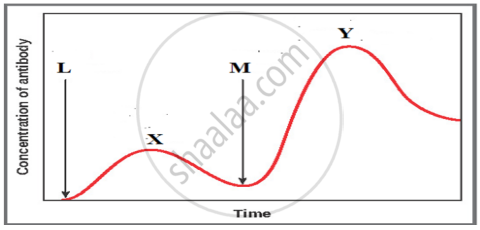
The graph given below indicates the administration of the first (L) and second dose (M) of a vaccine. The corresponding response of the body is indicated by X, and Y. Interpret the graph and explain the reason for such a response shown by the body.
The diagram given below represents the schematic structure of proinsulin, which undergoes certain modifications before it becomes a fully functional insulin.
Study the diagram carefully and answer the questions that follow:

- State the change the proinsulin undergoes to become fully functional.
- Name the modern scientific technique used for the production of human insulin.
- How are the two polypeptide chains of the fully functional insulin held together?
