Advertisements
Advertisements
प्रश्न
Arrange the following compounds in increasing order of reactivity towards SN2 reaction.
2-Bromopentane, 1-Bromopentane, 2-Bromo-2-methylbutane
Advertisements
उत्तर
SN2 reaction involves the formation of transition state. Therefore, reactivity towards SN2 depends upon the steric hindrance:
Due to the presence of 2 methyl group in 2-Bromo-2-methylbutane it is least reactive towards SN2 reactions, 2-bromopentane is moderately reactive while 1-bromopentane is most reactive.
2-Bromo-2-methylbutane < 2-Bromopentane < 1-Bromopentane
APPEARS IN
संबंधित प्रश्न
In the following pair of halogen compounds, which compound undergoes a faster SN1 reaction?

Which compound in the following pair will react faster in SN2 reaction with OH−?
CH3Br or CH3I
Arrange the compounds of the following set in order of reactivity towards SN2 displacement:
1-Bromo-3-methylbutane, 2-Bromo-2-methylbutane, 2-Bromo-3-methylbutane
In the SN1 reaction, racemization takes place. It is due to:
Among the following, the dissociation constant is highest for:
The increasing order of nucleophilicity would be:
How do polar solvents help in the first step in SN1 mechanism?
Why are aryl halides less reactive towards nucleophilic substitution reactions than alkyl halides?
Among the following compounds I - IV, which one forms a yellow precipitate on reacting sequentially with (i) NaOH (ii) dil. HNO3 (iii) AgNO3?
 |
 |
 |
 |
| I | II | III | IV |
The correct order of increasing reactivity of
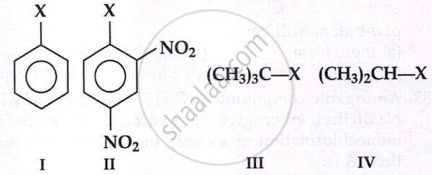
C-X bond towards nucleophile in the following compounds is:
