Advertisements
Advertisements
प्रश्न
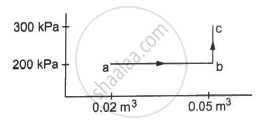
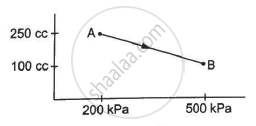
A substance is taken through the process abc as shown in figure. If the internal energy of the substance increases by 5000 J and a heat of 2625 cal is given to the system, calculate the value of J.
Advertisements
उत्तर
Given:-
Heat given to the system, ∆Q = 2625 cal
Increase in the internal energy of the system, ∆U = 5000 J
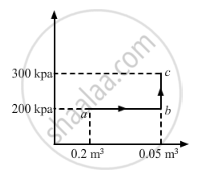
From the graph, we get
W = Area of the rectangle formed under line ab + Area under line bc
For line BC:-
Change in volume = 0
WBC = P Δ V = 0
∆W = Area of the rectangle
∆W = 200 × 103 × 0.03
= 6000 J
We know,
∆Q = ∆W + ∆U
⇒ 2625 cal = 6000 J + 5000 J
\[\Rightarrow J = \frac{11000}{2625} = 4 . 19 \text{ J/cal}\]
APPEARS IN
संबंधित प्रश्न
In changing the state of a gas adiabatically from an equilibrium state A to another equilibrium state B, an amount of work equal to 22.3 J is done on the system. If the gas is taken from state A to B via a process in which the net heat absorbed by the system is 9.35 cal, how much is the net work done by the system in the latter case? (Take 1 cal = 4.19 J)
Should the internal energy of a system necessarily increase if heat is added to it?
Should the internal energy of a system necessarily increase if its temperature is increased?
When we rub our hands they become warm. Have we supplied heat to the hands?
When a tyre bursts, the air coming out is cooler than the surrounding air. Explain.
Figure shows two processes A and B on a system. Let ∆Q1 and ∆Q2 be the heat given to the system in processes A and B respectively. Then ____________ .
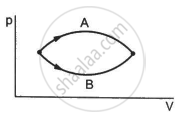
Figure shows three paths through which a gas can be taken from the state A to the state B. Calculate the work done by the gas in each of the three paths.
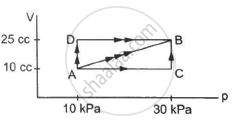
A gas is taken along the path AB as shown in figure. If 70 cal of heat is extracted from the gas in the process, calculate the change in the internal energy of the system.
A mixture of fuel and oxygen is burned in a constant-volume chamber surrounded by a water bath. It was noticed that the temperature of water is increased during the process. Treating the mixture of fuel and oxygen as the system,
- Has heat been transferred?
- Has work been done?
- What is the sign of ∆U?
Define heat.
When does a system lose energy to its surroundings and its internal energy decreases?
Explain given cases related to energy transfer between the system and surrounding –
- energy transferred (Q) > 0
- energy transferred (Q) < 0
- energy transferred (Q) = 0
Explain the different ways through which the internal energy of the system can be changed.
A thermodynamic system goes from states (i) P, V to 2P, V (ii) P, V to P, 2V. The work done in the two cases is ______.
When 1 g of water at 0° C and 1 x 10⁵ N/m2 pressure is converted into ice of volume 1.082 cm3, the external work done will be ____________.
Two samples A and B, of a gas at the same initial temperature and pressure are compressed from volume V to V/2; A isothermally and B adiabatically. The final pressure of A will be ______.
A steam engine delivers 4.8 x 10⁸ Jof work per minute and services 1.2 x 10⁹ J of heat per minute from its boiler. What is the percentage efficiency of the engine?
What is heat?
Explain the change in internal energy of a thermodynamic system (the gas) by heating it.
