Advertisements
Advertisements
प्रश्न
Two cylinders A and B of equal capacity are connected to each other via a stopcock. A contains a gas at standard temperature and pressure. B is completely evacuated. The entire system is thermally insulated. The stopcock is suddenly opened. Answer the following:
What is the change in the temperature of the gas?
Advertisements
उत्तर १
Zero. Since no work is being done by the gas during the expansion of the gas, the temperature of the gas will not change at all.
उत्तर २
The system being thermally insulated, there is no change in temperature (because of free expansion).
APPEARS IN
संबंधित प्रश्न
Explain why Air pressure in a car tyre increases during driving.
A steam engine delivers 5.4×10⁸ J of work per minute and services 3.6 × 10⁹ J of heat per minute from its boiler. What is the efficiency of the engine? How much heat is wasted per minute?
Should the internal energy of a system necessarily increase if its temperature is increased?
When we rub our hands they become warm. Have we supplied heat to the hands?
Can work be done by a system without changing its volume?
When a tyre bursts, the air coming out is cooler than the surrounding air. Explain.
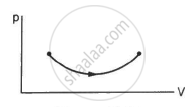
Consider the process on a system shown in figure. During the process, the work done by the system ______________ .
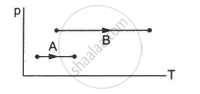
Consider two processes on a system as shown in figure.
The volumes in the initial states are the same in the two processes and the volumes in the final states are also the same. Let ∆W1 and ∆W2 be the work done by the system in the processes A and B respectively.
A gas is contained in a metallic cylinder fitted with a piston. The piston is suddenly moved in to compress the gas and is maintained at this position. As time passes the pressure of the gas in the cylinder ______________ .
What is the internal energy of the system, when the amount of heat Q is added to the system and the system does not do any work during the process?
When does a system lose energy to its surroundings and its internal energy decreases?
Explain the different ways through which the internal energy of the system can be changed.
An ideal gas is compressed at a constant temperature. Its internal energy will ____________.
Two cylinders A and B of equal capacity are connected to each other via a stopcock. A contains a gas at standard temperature and pressure. B is completely evacuated. The entire system is thermally insulated. The stopcock is suddenly opened. Answer the following:
What is the change in internal energy of the gas?
A person of mass 60 kg wants to lose 5kg by going up and down a 10 m high stairs. Assume he burns twice as much fat while going up than coming down. If 1 kg of fat is burnt on expending 7000 kilo calories, how many times must he go up and down to reduce his weight by 5 kg?
In thermodynamics, heat and work are ______.
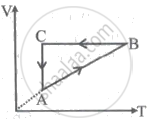
A cyclic process ABCA is shown in the V-T diagram. A process on the P-V diagram is ______.
The internal energy of one mole of argon is ______.
The internal energy of one mole of argon at 300 K is ______. (R = 8.314 J/mol.K)
