Advertisements
Advertisements
प्रश्न
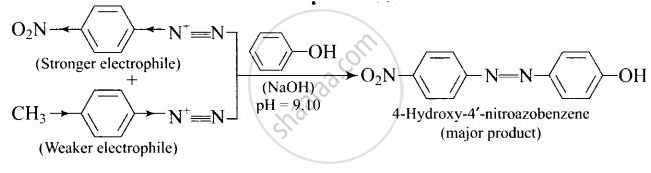
A solution contains 1 g mol. each of p-toluene diazonium chloride and p-nitrophenyl diazonium chloride. To this 1 g mol. of alkaline solution of phenol is added. Predict the major product. Explain your answer.
Advertisements
उत्तर
This reaction is an example of electrophilic aromatic substitution. In alkaline medium, phenol forms phenoxide ion which is more electron-rich than phenol and hence more reactive for electrophilic attack. The electrophile in this reaction is aryl diazonium cation. p-Nitrophenyldiazonium cation is a stronger electrophile than p-toluene diazonium cation. Therefore, it couples preferentially with phenol.
APPEARS IN
संबंधित प्रश्न
How is chlorobenzene prepared from aniline?
What is the action of acetic anhydride on ethylamine?
What is the action of the following reagents on aniline?
Bromine water
Write the structures of main products when aniline reacts with the following reagents :
Br2 water
Write the structures of main products when aniline reacts with the following reagents :
(CH3CO)2O/pyridine
Account for the following:
Although the amino group is o, p-directing in aromatic electrophilic substitution reactions, aniline on nitration gives a substantial amount of m-nitroaniline.
What is the action of acetic anhydride on diethylamine?
What is the action of the following reagents on aniline?
Acetic anhydride
Illustrate the following reactions giving suitable example in each case
Acetylation of amines
How will you convert the following?
Aniline into N−phenylethanamide
In the nitration of benzene using a mixture of conc. \[\ce{H2SO4}\] and conc. \[\ce{HNO3}\], the species which initiates the reaction is ______.
What is the role of \[\ce{HNO3}\] in the nitrating mixture used for nitration of benzene?
Give reasons for the following observation:
Aniline does not react with methyl chloride in the presence of anhydrous AlCl3 catalyst.
Assertion (A): Bromination of benzoic acid, gives m-bromobenzoic acid.
Reason (R): Carboxyl group increases the electron density at the meta position.
Given below are two statements:
Statement I: Aniline does not undergo a Friedel-Crafts alkylation reaction.
Statement II: Aniline cannot be prepared through Gabriel synthesis.
In the light of the above statements, choose the correct answer from the options given below:
