Topics
Roman Numerals
Number Work
Addition and Subtraction
Multiplication and Division
Fractions
- Types of Fractions
- Concept of Equivalent Fractions
- Like and Unlike Fraction
- Concept of Mixed Fractions
- Concept of Proper and Improper Fractions
- Conversion between Improper and Mixed fraction
- Conversion between Unlike and Like Fractions
- Comparing Fractions
- Addition of Fraction
- Subtraction of Fraction
- Multiplication of Fraction
- Using Operator 'Of' with Multiplication and Division
Angles
Circles
Multiples and Factors
Decimal Fractions
Measuring Time
Problems on Measurement
Perimeter and Area
Three Dimensional Objects and Nets
Pictographs
Patterns
Preparation for Algebra
Maharashtra State Board: Class 5
Method to find prime numbers
Consider the arrangement of numbers from 1 to 36 into six columns. Extending this pattern, we arrange numbers up to 102 in the same manner.
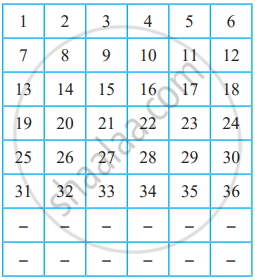
Observations:
- The numbers in the columns corresponding to 2, 3, 4, and 6 are mostly composite, except for the prime numbers 2 and 3.
- This implies that all other prime numbers will be found in the columns corresponding to 1 and 5.
Thus, this systematic arrangement provides an efficient way to identify prime numbers by focusing only on specific columns. Based on this method, continue identifying prime numbers up to 102.
